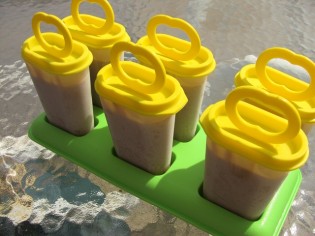

It’s embarrassing to admit, but growing up, I didn’t even know you could make your own cream cheese, and I’d only ever seen Philadelphia Cream Cheese. I never knew making my own raw milk yogurt and raw milk cream cheese could be so simple.
(Getting a video into a post, however, is not so simple. I had a video from last summer showing you how I make these, but after several tries I still haven’t been able to get that sucker into a post. Whatever.)
Instructions for making raw milk yogurt:
***BE SURE TO CHECK THE COMMENTS FOR SOME GREAT INFO YOU’LL WANT TO KNOW!
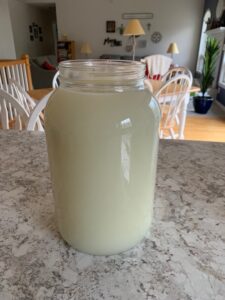
- Place 1 quart (4 cups) of whole milk, preferably raw in a glass jar (I use my half-gallon Ball jars.)
- Add 1 packet of Yogourmet yogurt starter OR 1/2 cup of yogurt from a previous batch (also get a variety of starters here – some that do and some that do not need to be heated – Note: I’ll be paid a small amount per click if you buy through this link, and I thank you!)
- Stir gently.
- Keep warm for up to 12 hours until it gets thick (see more below on the consistency) – leave it on the countertop in warm weather, or put it on the back of your stove while you’re making Crispy Nuts or something else in your oven. I’ve also kept mine in some hot water inside a crock pot, too.
That’s it! Now you have yogurt, but it won’t be very thick. I’ve heard it gets thicker using a yogurt maker, but then the enzymes in the raw milk are killed, and even then it’s still not that thick like store-bought. Commercial yogurt must have gelatin or some type of fake ingredients in it to give it the thicker consistency. If you know of a natural way to make raw milk yogurt more thick, please share!
UPDATE: to make it thicker, just use a different kind of yogurt starter!
Your kids may go for this yogurt, but mine don’t (I buy Stonyfield or Brown Cow whole milk yogurt for their lunches or snacks), so I use mine to soak grains, OR to make…
Cream cheese and whey:
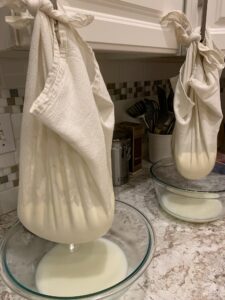
- Tie a cheese cloth with the corners so it can hang on a cabinet knob. (You can buy these cheap at Meijer or wherever.)
- Place a bowl under the cheese cloth to catch the whey.
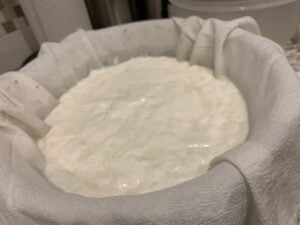
- Pour the yogurt into the middle of the cheese cloth and it will start dripping whey.
- When it is done dripping (12-24 hours, depends on how dry you want it), I usually try to squeeze a few more drops out.
- By the way, this is actually a picture of when I made a different kind of cheese, but I wanted you to get the idea of how to tie it up.
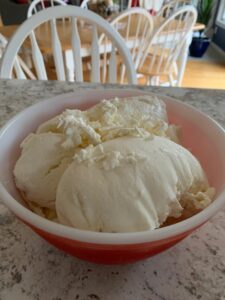
What you have left inside the cheesecloth is cream cheese! Scoop this into a bowl and it will keep for 1 month in the frig. You can add herbs to give it different wonderful flavors.
What you have in the bowl is whey – some drink it plain because it is so good for us, but I use it in recipes found in the below cookbook, in homemade bread, or in Real Food protein shakes (that link won’t work until tomorrow when I post it for Real Food Wednesday.)
By the way, you can make yogurt and cream cheese from pasteurized milk (only whole milk!), but obviously it won’t have as many nutrients – still much better for you than store-bought, though!
I learned all this and more from Sally Fallon’s cookbook:
Now, I’m sure there are MANY of you out there who know much more about all this and have done it for years, so feel free to correct me or give us more details if you can provide them!
- My tasty flop! (More about homemade cheese.)
- See some great recipes to make with your yogurt cheese!
- And more ways to use whey.
DON'T MISS NEW POSTS:
Learn more from the COMMENTS BELOW - join the conversation!


{ 2 trackbacks }
{ 81 comments… read them below or add one }
Laryssa @ Heaven In The Home 04.07.09 at 12:53 am
It’s so funny you would ask if there was any other way to get thick yogurt! I’ve been making crock pot yogurt for a few weeks now. I like it. It’s tasty…but, it’s runny. So, I’ve just been using it like keiffer.
You’re going to be as excited as I was, when I ran across this link today.
I found out that different live cultures will produce different textures of yogurt. Cultures for Health is a company that sells these different cultures. I have my eye on the Viili culture that originated in Finland.
All you do is stir in your “starter yogurt” and let it sit on the counter overnight. EASY! They say it results in a much thicker product. I’m going to order some as soon as I can. I’ll be glad to let you know how it turns out!
They also sell kombucha tea cultures, sourdough starter and much more.
Here’s the link to the different yogurt cultures, enjoy!
http://www.culturesforhealth.com
[Reply]
alisse 04.07.09 at 3:54 am
Hello Kelly,
I have had tremendous success with homemade yogurt congealment! My secret is to add much less yogurt than 1/cup per quart of milk. I have been informed that it crowds the culture. 1 tablespoon of whole yogurt will make very a very thick batch! Believe me, I know less works better from personal experience. However, I do gently heat the milk over the stove first, since the cultures thrive in above body temperature heat. I’ll have to experiment to find out if eliminating that heating over the stove step will give me thin yogurt. I’ll be looking for other comments on the subject!
Alisse
[Reply]
alisse 04.07.09 at 3:56 am
Oop, I meant to say 1/2 cup per quart…
[Reply]
Kelly 04.07.09 at 5:42 am
You guys are great!!! Both of these makes sense.
Laryssa, YES, please let us know how you like that different starter culture!
Alisse, can’t wait to hear if this works without heating!
[Reply]
L 04.07.09 at 7:48 am
Ok, I’m confused. I had thought that if you strained yogurt, you would get Greek yogurt? I suppose they are similar?
[Reply]
Lisa Imerman 04.07.09 at 7:59 am
Just and FYI, Villi may be similar to yogurt but it is a completely different culture (like Kefir is different too). Also, be warned and do a bit of research as what I have read say Villi will tend to take over other culture in your house and make them stringy and slimy.
Also, if you stain yogurt I thought it was yogurt cheese and that cream cheese is from just plain curds and whey that is strained???
[Reply]
Pam 04.07.09 at 8:50 am
I just order some filmjolk starter which is supposed to make a thick, raw milk yogurt on the countertop. I’ll let you know if it works out.
[Reply]
jeannee 04.07.09 at 9:30 am
All of the reading and recipes I have seen say that cream cheese, is the product of strained whole cow milk yogurt. Once you strain this yogurt you have a very firm cheese. It is great to add herbs, like Kelly said or to add homemade jams.
Wouldn’t greek yogurt be made from sheep or goat milk??
Kelly, I just made yogurt for the first time last week and was so disappointed in the consistency. Thanks for letting me know that it was normal and not a flop.
[Reply]
Mary 04.07.09 at 9:31 am
I make my own yogurt with a Yogourmet electric maker with whole, raw milk. But to make it thicker and more like commercial yogurt, I take 1/2 my batch, drip it, then mix it back into the runny part. This is a little more work but it does end up like commercial yogurt.
[Reply]
Shauna 04.07.09 at 9:35 am
I’m definitely going to try the 1 T instead of the 1/2 c. In fact – I’m going to do some up today! I’ll let you know how it turns out.
Re: the terms of cheese types, I think that there are many “names” for similar cheeses. When you make your own cheese, you find that the consistancy is nearly the same. Yogurt Cheese, Cream Cheese, “Queso Fresco”, “Fromage Blanc”, (“Fresh Cheese” in spanish and french”, which are also the same thing as “Ricotta Cheese”). These cheese are all “soft cheeses” vs. “hard cheese” (aged). The soft cheeses all have nearly the same flavor and texture – what varies is whether they were made from fresh milk, or cultured milk (yogurt) – and the texture differences are due to variences in hanging time. So – it’s a “you say tomato, I say .
Shauna
Shauna’s last blog post..Subscribing to my blog…..
[Reply]
Shauna 04.07.09 at 9:36 am
Okay – my italic didn’t work out…. the last sentence should have read:
“It’s a ‘you say tomato, I say to-mah-to’ kind of thing.”
Shauna’s last blog post..Subscribing to my blog…..
[Reply]
Kristin 04.07.09 at 9:37 am
I have read that using milk warm from the cow (it is at the correct yogurt temp) and inoculating with your yogurt culture is the way to get thick raw milk yogurt. I know, this doesn’t help if you don’t have a cow right there next to your kitchen.
I saw an article a few months back the showed traditional peoples in Eastern Europe making yogurt and they did scald the milk first. No, I don’t know where the article is now. Sorry!! If I find it, I will post. But scalding the milk to 180 degrees does make a thicker yogurt.
L is correct. If you strain this yogurt for a little while, you get Greek-style yogurt. Strain until it is completely whey-free and you have yogurt cheese. A true cream cheese is made with cream only. But they’re all good.
And only use 2 tablespoons of starter per quart! Whatever works for you!
[Reply]
Local Nourishment 04.07.09 at 10:26 am
I have become quite fond of Sonyfield’s whole milk yogurt lately. When the rest of the family is having a bowl of ice cream, I’ll have a bowl of that. So much better tasting than the slimy low and non-fat kinds!
I used to make my own yogurt, but stopped when we discovered our youngest’s milk allergies. Then, when I was learning about enzymes, I didn’t want to “waste” our raw milk on yogurt because I thought it all had to be heated. Very interested to know how countertop culturing comes out!
Local Nourishment’s last blog post..Cherry Pecan Salad
[Reply]
CharityGrace 04.07.09 at 11:30 am
This is interesting. Before I got married and moved away from home, I often made skim milk yogurt (cholesterol paranoia–if I were doing it today I would use whole). I always used a cultured yogurt like Dannon for my first starter, and from then just took starter from the yogurt I made. It was always nice and thick. I used raw cow’s milk, but did heat it to 180.
Recently I tried making yogurt from goat’s milk I buy from a local farmer. It is runny and kind of stringy. I’m doing it the same way I always did the cow’s milk yogurt, but for some reason it is not turning out the same, even after 24 hours. I don’t know if I am doing something “wrong” or if goat’s milk just behaves differently and I will have to settle for a different consistency. My kids eat it, but I think it’s kind of nasty.
CharityGrace’s last blog post..Slow and Steady
[Reply]
Naomi 04.07.09 at 12:32 pm
I’ve made cream cheese before, from heated whole milk (not raw) and the recipe called for tartaric acid (which I understand to be cream of tartar). This did taste like store-bought cream cheese. To me, strained yogurt tastes nothing like cream cheese, at least cream cheese as I know it. The texture is even different. Yogurt cheese IS delicious though. It’s like the Greek yogurt I do want to try the unheated raw milk yogurt; it seems like a lot less work than the old way. Maybe you could just strain it a little to get the nice thick texture we’re used to.
Naomi
[Reply]
Motherhen68 04.07.09 at 12:39 pm
My dh and I prefer the Greek style yogurt. So I make yogurt in the crockpot, then I strain it overnight. What’s left is thick. I mix in a 1/2 cup of heavy whipping cream till it’s smooth. This is a nice consistency.
Lately though, I’ve been just using the yogurt cheese in smoothies, etc. It’s got a great creamy taste.
Motherhen68’s last blog post..
[Reply]
Kathy 04.07.09 at 4:54 pm
To make thicker yogurt you just need to let it culture longer. I usually heat the milk up first, but not past the point of killing any enzymes, and put it in a cooler with a heating pad underneath it. I use a 1/4 cup yogurt per quart from seven stars farm yogurt, but I agree with the less culture the better (2TBlsp)–read Wild Fermentation, he says the same thing. I find the seven stars to have a better culture than stoneyfield.
I’ve done the same with raw goat’s milk, and a 1/4 cup goat milk yogurt from the store and have got the thickest creamiest goat yogurt.
[Reply]
Kelly 04.07.09 at 5:25 pm
I’m always amazed when a post I expect to have very few comments gets cooking after all. Good thing you’ve all answered each other’s questions, because I didn’t have a clue on most of what was asked, and this is all very interesting to me, too. Thanks for sharing your wisdom, everyone, and keep it coming!
[Reply]
Helen 04.07.09 at 8:54 pm
Do you have a recipe for that crock pot yogurt? I like to strain my yogurt, like the Greeks do. Fage was my favorite yogurt before, but it is not organic or raw.
Helen
[Reply]
Kelly 04.07.09 at 9:48 pm
Hi Helen,
No recipe, I do the same as explained above, but keep it inside a crock pot with warm water around it…
[Reply]
Joy 04.07.09 at 9:52 pm
I just wanted to add that I have been making yogurt in my crock pot for a long time. It is sooooooooo easy. When it is finished, I strain it into a colander that holds a large coffee filter. It always comes out thicker and creamy. I usually strain mine about 12 hours.
[Reply]
Katie @ Kitchen Stewardship 04.07.09 at 10:28 pm
I can’t give away the secrets yet, but my Monday post will be on making homemade yogurt — the no dishes, no fuss style. Our family of 3 eats almost a gallon a week! One comment I’ll give for now — I wouldn’t recommend shaking as a way to mix the culture in. They’re alive, you know, and you don’t want to beat the little buggers to death.
Check Real Food Wednesday for nutritional information/health benefits of yogurt, my link.
Katie @ Kitchen Stewardship’s last blog post..Recipe Connection: Homemade Refried Beans
[Reply]
Kelly 04.07.09 at 10:59 pm
Hmmmm, good point, Katie……..geesh, I was doing a bunch of stuff wrong! Using too much starter and shaking it are probably the biggies. Can’t wait to try it again soon.
[Reply]
Sustainable Eats 04.08.09 at 1:18 am
I have fil milk yogurt culture and it is runny – not thick at all. HOWEVER my piima culture is thick. I make all my yogurt from raw milk and don’t use an insulator of any kind, just on the counter in a re-used quart yogurt container.
You can make yogurt thicker by adding pectin when you add your innoculant, that is what the commercial guys do (or cargeenan).
If you culture your yogurt too long it will separate and become even runnier. You need to catch it before this happens to keep it as thick as possible.
Ricotta cheese is not the same thing as soft cheese – it is made with the spent whey leftover from making a hard cheese using thermophilic acid. Most soft cheeses are made with a mesophilic acid. I made ricotta a few weeks ago from the whey left from my mozzarella. It was amazingly delicate, creamy and yummy. We put it on a pizza mixed with gorgonzola, carmelized onions & pears.
http://sustainableeats.wordpress.com/2009/03/18/cultured-dairy-products/ is my yogurt post. FYI I made cream cheese using Sally Fallon’s whey recipe but it was nasty. I threw it out but I love the whey so I’m making more right now since I’ve gone through almost all of it in about 6 weeks.
Awhile back I made http://www.cheesemaking.com/store/pg/49.html this lemon cheese – very easy, makes overnight and very much like cream cheese but from whole milk. My five year old did most of the work. Here is how we strung up our cheesecloth: http://sustainableeats.wordpress.com/2009/03/09/making-whey/, in my whey post.
Happy yogurting! Or wheying, or cheesing…
Sustainable Eats’s last blog post..The Front Yard Conversion is Almost Done!
[Reply]
Motherhen68 04.08.09 at 12:33 pm
Helen,
I take 8 cups of milk and put that in the crock pot set on low for 2.5 hours. At the 2.5 hour mark, I turn off (unplug) the crock pot and let it sit undisturbed for 3 hours. At the 3 hour mark, I mix in a half a cup of yogurt from my last batch (or use a 1/2 cup from store bought). I then wrap a bath towel around my closed up crockpot and let that sit for 8 hours. At the 8 hour mark (or 7.5 or 9.5, it’s versatile) I dump it into my pasta strainer covered with a thin thin bar towel. This sits out draining overnight. In the morning, I scrape the yogurt cheese into a bowl and add 1/2-3/4 cup of whole cream…depending on how runny/thick you want it. There you go, Greek style yogurt that is remarkably like Fage.
HTH,
Motherhen68’s last blog post..Photoshopped Background
[Reply]
Helen 04.08.09 at 5:35 pm
Thanks so much. I have my crockpot on low and yogurt is in the making. I don’t have the heavy cream in the house, but will pick it up when we go into town tomorrow so I can do that for the next batch.
Helen
[Reply]
Stephanie 04.09.09 at 8:30 am
I have made crockpot yogurt according to the directions above for a long time. If I do the stovetop heating method instead, with the 1 Tbsp of starter, what is the whole process? Kelly, can you get alisse to tell us?
Thanks.
[Reply]
Katie @ Kitchen Stewardship 04.09.09 at 4:44 pm
Stephanie, I’ll try to remember to link here Monday when I post my homemade yogurt – heated on the stovetop, incubated in a cooler, but NO dishes to do, which is the best part.
I’m a detail gal, so the instructions will be easy to follow, I promise.
Katie @ Kitchen Stewardship’s last blog post..Mary and Martha Moment: Soul First, Body Second
[Reply]
Helen 04.09.09 at 4:52 pm
Okay, I made my raw milk yogurt. It came out pretty runny, so I was afraid to strain it. lol I did use the crockpot, followed those instructions exactly. What I did do differently, was instead of wrapping up the container in towels, I put it in my Excalubar dehydrater that has a yogurt setting. It stayed there overnight.
It came out more like buttermilk. It tasted great, I love buttermilk!
I did not add the heavy cream, I did not have it. Do you think that by adding the heavy cream it will come out thicker???
Helen
[Reply]
Kelly 04.09.09 at 7:46 pm
I love how you guys are coming together to figure all this out! (Since I’m no help!) I’m making yogurt tonight and have to go over all this again first…
Helen, it sounds like adding in the whipping cream is something Mother Hen did AFTER straining the whey out, she stirred in the cream with the cheese to make a better consistency.
This is something I should’ve mentioned in the post, and it’s happened to me before: If you culture your yogurt too long it will separate and become even runnier. You need to catch it before this happens to keep it as thick as possible. Thanks, Annette!
Katie, looking forward to it.
[Reply]
jeanne 04.10.09 at 8:52 am
Just wanted to let you guys know that I had made crockpot yogurt last week. I was disappointed in the consistency. After reading this post, I put my yogurt into glass jars and put the jars into the crockpot with a couple inches of water. I did a water bath on low for about 3 hours. At this point the yogurt was about body temperature (neither hot nor cold when I stuck my finger into a jar). I turned off my crockpot. Covered it with a thick bath towel to keep in the heat. And let it sit on the counter for 4 hours. After 4 hours it was much thicker, almost as thick as the Stoneyfield that I buy.
Thanks for the all the info!
[Reply]
Erica 04.10.09 at 2:54 pm
I made fil mjolk for a while, and it’s pretty tasty — somewhat different from yogurt, so it takes a while to adjust to the different flavor, but it’s mild and pleasing. I got interested in making fil mjolk because I was too lazy to warm milk to a precise temperature for yogurt, and my cold raw milk yogurt attempts had bad results (very, very runny). I read that fil mjolk ferments at room temperature, so it seemed like a good culture for a lazy person like me!
It took me a while to perfect my technique, however. First of all, my house seemed a little too cold — you do have to find a relatively cozy spot, though not as warm as what yogurt needs. I ended up putting it in my oven, but I can’t remember whether I left the oven light on and whether I left the oven door cracked open. It took about 24 hours to ferment. The second challenge was that I would make a quart at a time, and the first serving was always lovely and thick, but then the rest would start falling apart in the bowl, and I was left with curdy soup. I solved this problem by making individual one-cup servings in little pyrex bowls. Each one was thick and delicious!
I enjoyed the fil mjolk but after a while I got lazy and let the culture die. If you want to make fil mjolk with raw milk you have to preserve a pure seed culture by culturing the fil mjolk in boiled milk once a week; then you use this to culture your raw milk. After a while it was too much of a hassle for me. But it was fun and tasty, so some of you might enjoy making fil mjolk!
[Reply]
Alisse 04.12.09 at 2:15 pm
An update…
Omitting the heating step (and using one tablespoon of starter yogurt) turned out yogurt that is quite thick (in my opinion, anyway). I did place the jar in the oven with the light on, but that was all.
[Reply]
Katie @ Kitchen Stewardship 04.13.09 at 10:36 am
How to Make Yogurt is up! See http://kitchenstewardship.wordpress.com/2009/04/13/monday-mission-homemade-yogurt-the-easy-way/.
Katie @ Kitchen Stewardship’s last blog post..Monday Mission: Homemade Yogurt, the Easy Way
[Reply]
stephanie 04.25.09 at 3:06 pm
I have a question about making cream cheese and whey from raw milk . . . I read 1-4 days is typical for the two to separate but it seemed to take a little longer for me how long can raw milk sit in a glass container on the counter before it is not advised to eat?
Thank you.
[Reply]
Sustainable Eats 04.25.09 at 4:30 pm
Hi Stephanie,
Kelly may come back with some expert answer if I know her but mine has taken up to 4 days before and was totally fine to eat. Just think about how long cheese ages – sometimes for several years and the initial aging and curing can take up to a week at room temperature before the cheese goes into somewhat cooler storage but still well above fridge temps. You could NOT do this with pasteurized milk because all the good bugs, along with any nutrients would be killed in the pasteurization process.
Sustainable Eats’s last blog post..Planting Potatoes
[Reply]
Kelly 04.28.09 at 2:26 am
I don’t have my copy of Nourishing Traditions here with me, maybe someone could look up how long it can sit out, but I think the only thing that would happen is that it would get more sour with time.
[Reply]
Ben 05.12.09 at 2:12 am
I just started making yogurt and follow the scd 24 hour yogurt protocol to minimise the lactose. Using raw milk, heated to 43 degrees celcius and adding a tiny bit of culture powder, then fermented in a yogurt maker at around 43 degrees for 24 hours. It came out as thick as greek yogurt. Absolutely delicious and so good for you. I don’t know if the heating to 43 degrees kills the enzymes in the raw milk, but I get plenty of enzymes from raw milk kefir anyway. For those wanting a thick like commercial yogurt, it’s definitely worth a try. There is heaps of scd info on google, including the best types of starters. Happy yogurting!
[Reply]
Vera 05.23.09 at 5:37 pm
Could one make the whey and cream cheese using greek yogurt?
[Reply]
Kelly 05.29.09 at 2:23 am
Vera, I think so, but that’s a great question for Julie: http://www.culturesforhealth.com/zen/index.php
[Reply]
Rachelle 05.30.09 at 9:55 pm
Question re: goat yogurt…I bought a goat, but my friend who owns a farm w/ other milk goats is keeping her and milking her for me, does anyone know the going rate for raw goat milk/yogurt…although the goat belongs to me, she is doing ALL the work, so I’m paying her for the yogurt…yes, I realize that you can’t purchase raw milk products but the goat is legally mine…I’m paying her for her work.
Also, since goat milk does not seperate like cow’s milk, when it comes to making butter (her goats produce high cream/fat milk), do we need a machine to seperate the cream or is there another method to do this?
Thanks for any tips/answers to my questions! This site has been such a wonderful blessing during this new GOAT phase of life
)
[Reply]
Sustainable Eats 05.31.09 at 12:26 am
HI Rachelle,
In Seattle I pay $7 per 1/2 gallon for raw goats milk. Everything costs way more here though. Organic butter is $6.29 per pound! Enjoy your doe!
Sustainable Eats’s last blog post..Rhubarb Conserve
[Reply]
Katie @ Kitchen Stewardship 05.31.09 at 9:53 pm
I did some tests with raw milk yogurt with a store bought yogurt starter today. Interesting findings! I may have to disagree with Sally Fallon (hopefully that won’t make anyone around here up in arms…). Please see photos and read about my experiments at http://www.kitchenstewardship.com/recipes/raw-milk-yogurt-escapades/
Katie @ Kitchen Stewardship’s last blog post..Mary and Martha Moment: Called to be Good Stewards of the Earth
[Reply]
Joy 06.15.09 at 2:25 pm
Does anyone know if goat’s kefir grains can be used to make kefir with raw cow’s milk?
[Reply]
Naomi 06.15.09 at 3:22 pm
I have made kefir successfully with raw cow’s milk and raw goat’s milk, interchangably. I’m still using those grains (or successors of them anyway) for the same thing. They don’t seem to care which kind of milk I throw them in!
[Reply]
Jennifer 07.07.09 at 2:03 pm
Kelly,
I’m asking you the same thing I asked Cheeseslave to see if you can give some perspective…I’m overwhelmed! Here’s what I asked:
Okay. I’m getting quite overwhelmed with this milk thing. I just ordered my first meat from U.S. Wellness Meats, and of course, it was a little more expensive than “regular” meat. Now, I’m about to case out some raw milk. I’m going to try Amos Miller’s farm, who a friend here in Mississippi orders from. And obviously, it’s more expensive than yucky regular milk. Which is great with me…it’s worth it. But on my income of nothing as a SAHM, and my hubby’s income supporting everything else, I’m so afraid I won’t be able to get everything I need!! So I’m going to need to make whey, yogurt, sour cream, cream, kefir, and buttermilk from the milk that I order. How much milk will I need for all that every month, plus whatever we might put in our oatmeal or drink occasionally? I’m not sure how to calculate how much I’ll need to buy to have enough to make the soaked grains, mayonnaise, etc. HELP MEEEEEE!!!
Jennifer’s last blog post..Goooood advice!
[Reply]
Sustainable Eats 07.07.09 at 3:04 pm
Hi Jennifer,
It totally depends on how much of everything your family consumes. To give you an idea (and then you could change it after the first week maybe) I buy 7 1/2 gallons of milk each week, more if I’m making cheese. We make buttermilk, yogurt, kefir, lattes and the kids drink milk but we typically don’t. Likewise, the kids don’t eat yogurt or kefir but we do it rounds out. If I make cheese, which is about once or twice a month, I buy an extra 2 gallons for that week and once a month I buy 1/2 gallon of goat’s milk for chevre for salads or quiches, etc. Hope that helps!
Sustainable Eats’s last blog post..New Territory – Homemade Lotions, Shampoos, Cleaners
[Reply]
Kelly the Kitchen Kop 07.07.09 at 10:35 pm
Jennifer,
Youza, Sus. Eats buys LOTS more than we do! But I don’t regularly make all that stuff, either. We mostly just drink it, then once or twice a month or so I’ll use some to make buttermilk, yogurt/cheese, or whatever. But we only get 2 gallons a week – a big difference, I know. Our picky teen won’t drink any, and I don’t drink as much as I should, so it’s mostly 4 of us who drink that two gallons. My kids drink a lot of water, too. I was buying non-homogenized milk for my day care kids, so I’d use that if we ran out, but now that I don’t have day care kids anymore, I may end up running out of our raw milk more and need to buy another share or half-share.
My advice to you, though, is this: start small and work up as needed until you find the right amount for your family. For us here in Michigan, you have to pay up front to buy a milk share, so it would be much less hassle to *add* to that as we see we might need more rather than scale back.
Hope that helps a little!
Kelly
Kelly the Kitchen Kop’s last blog post..Black Bean Mango Salsa from Kathy (Check out my pictures!)
[Reply]
Kim in Ohio 07.13.09 at 2:25 am
Here is the URL for a great article by Mother Linda from the WAPF website about making raw milk yogurt, including a discussion of the benefits and downsides of heating to 180 degrees, as well as which methods produce a thinner/thicker final product (sorry I don’t know how to make it a hyperlink, so you’ll have to copy and paste):
http://www.westonaprice.org/motherlinda/yogurt.html
[Reply]
Kim in Ohio 07.13.09 at 2:27 am
The URL above apparently hyperlinked itself! Yay!
[Reply]
Kelly 07.14.09 at 10:22 pm
Oooh, that IS a good site full of great info, thanks Kim!
[Reply]
Nicole 07.21.09 at 8:11 pm
Ironically, my mom used to have us make cream cheese because they we could use nonfat yogurt and make fat free cream cheese, which of course they sell now. She used to make her own yogurt whenever we went to mexico, since it had all the bacteria fighting stuff/live cultures. I balkd at paying for the raw milk at the store, but did get whole milk yogurt, fresh ricotta and switched the whole family to whole milk.
Nicole’s last blog post..Moving to the Broccoli Forest
[Reply]
Meagan 07.25.09 at 10:23 am
I recently did the process in Nourishing Traditions to make whey and cream cheese. I followed the instructions very carefully.. but I think that my whey and cream cheese smell really funny, or unusual… What are they supposed to taste like? Mine smells a little off, but I followed all the instructions so I don’t know how I could have done it wrong, or how the products would be “unusable”… Has anyone experienced the same thing? Or can help?
[Reply]
Kelly 07.25.09 at 11:42 am
Meagan, are you sure the milk you started with wasn’t “off”? Also, if it hangs too long it gets fairly sour. Anyone else have ideas?
Kelly
[Reply]
Meagan 07.25.09 at 12:20 pm
Hmm, I thought of that as well, but didn’t really think it would be a factor? I used raw whole milk. In the first step when I let it sit out in a jar for 1-4 days to separate, the milk had been in the fridge opened for a few days. It wasn’t like I just came back from the farm and opened it. I know for a fact the milk was NOT sour. Maybe I will try it again when I first pop off the top right after I purchase it from a farm. I did get whey and “cream cheese” out of the process though. Even though they smell funny, do you think I should eat it? Technically it would just be the bacteria doing their think right? Maybe it was starting to ferment?
[Reply]
Kelly 07.25.09 at 4:08 pm
Meagan,
As long as it doesn’t smell *too* off, I’d just use it in a recipe that has a lot of other flavors going on!
Kelly
[Reply]
Steph 08.05.09 at 6:33 pm
Several comments ago there was a discussion about making whey from raw milk. I have done this successfully, however, I have one very pointed question. As the milk is sitting on the counter (while I am waiting for the milk to separate) the cream on top begins to yellow and it is my impression that it goes bad (i.e. smells bad, tastes bad, ranscid like what you expect from any fat exposed to air.) The last time, once the milk separated, I just skimmed the bad cream off the top and proceeded to the cheesecloth/drain stage and everything went fine. I had my cream cheese, though stiff, and my whey. I also use Nourishing Traditions and Sally does not address the aspect of the process that I have described. Does anybody share my experience? Is it possible that the cream is not actually bad. Is this yellow-seemingly ranscid cream supposed to be part of the resulting cream cheese? Should I skim the cream off of the fresh milk before I sit it out to separate? I guess this is more than one question!
[Reply]
KitchenKop 08.05.09 at 9:25 pm
Steph, someone a lot smarter than I am will need to jump in here, but I think that cream is just “culturing”…? Are you sure it smells “bad”, or is it just souring?
Kelly
[Reply]
Meagan 08.06.09 at 11:04 am
Steph, this is EXACTLY what also happened to me in my above discussion. I didn’t skim off the yellowish cream from the “cream cheese” so it is mixed in with the normal looking white “cream cheese stuff.” I still have the “cream cheese” and “whey” in separate jars in my fridge and I am afraid to use them because they smell so off!
[Reply]
Steph 08.06.09 at 3:27 pm
I am so glad someone has had the same experience! Because I skimmed the bad cream off, my cream cheese and whey were fine. If you mixed your bad cream with the cream cheese I would probably throw it out. I would think the whey would be fine, but I might use it only for soaking grains, legumes and such rather than putting it in a shake or smoothy. This time I am going to try skimming the cream off of my raw milk before I set it out to separate. That way the cream is usable. I assume that this will not deter the rest of the process. Then after the milk separates I will go on to the cheesecloth/drain stage and hopefully all will be fine. Thanks for you validation,Meagan. If you have or anyone else has any other insights on this detail of the creamcheese/whey-making process please write! Thanks
[Reply]
Debbie 08.23.09 at 9:28 pm
I have Sally Fallon’s book. I’ve been making raw yogurt for some time w/great success! But have a HUGE PROBLEM see below?!! It is THICK however! It must be that I don’t use too much starter? It does separate quickly after you spoon it out the first time. I was making just 1 batch w/a crock pot but its cheaper for me to buy the larger raw milk so I make 2 batches now. I used an old electric skillet and fill it w/water.
we just started noticing this? Yesterday I didn’t think much of it but today it is OBVIOUS something is growing here? ITs just on the cream that’s on the top?? What is this??? ORANGE SPOTS?? I made 2 batches…this is the 2nd…the 1st seemed ok?? The milk was plenty fresh…more than 5 days new…I make sure of it! I used a brand new store bought yogurt batch instead of reusing also?!
what this is growing on my raw yogurt?? I’ve been making it for many months now and only had black mold grow near the beginning on top of the cream. WHAT IS THIS ORANGE STUFF??
Anybody know? Is it going to turn into orange cheese????
Do you guys sterilize your containers before you make it??
I gave up on making whey and cream cheese. IT STINKS and the cr cheese tastes AWWWWFUL! Don’t know how anyone can eat that stuff? I can’t eat goat cheese either so maybe its just us??
Hope someone has an answer for me! thanks!
[Reply]
KitchenKop 08.23.09 at 9:34 pm
Debbie, that’s a new one for me! If you don’t get a response here, try asking at this Nourishing Traditions forum and see what you find out there…?
http://health.groups.yahoo.com/group/discussingnt/
[Reply]
Naomi Snider 08.24.09 at 3:37 pm
Debbie, I’m with you on the cream cheese. I don’t know why anyone
calls it cream cheese, because it isn’t true cream cheese. I have
recipes for cream cheese, and none of them are anything like the one
where you just drain soured milk. Yes, it’s okay for what it is, if
you enjoy that sort of curd, but all it is, is curds and whey. Miss
Muffet I am not! lol!
Naomi
[Reply]
Katie @ Kitchen Stewardship 08.24.09 at 9:58 pm
Naomi and Debbie,
If you make the “cream cheese” and whey using yogurt, it’s much more like cream cheese consistency. Raw yogurt for me ends up a little chunkier, but store whole milk homemade yogurt, hung in a cloth, yields cream cheese exactly like Philly spread but a little milder in flavor. I think it’s great, and my son loves it on sandwiches with jam or fruit. Hope that helps shed some light!
[Reply]
Brittni 10.06.09 at 3:35 pm
How to get thicker yogurt:
Use Sheep milk! it makes the most thickest… yummiest.. yogurt EVER!..
and tastes 100 times better the cow..
You can also make kefir yogurt.. its alot thicker.. but its alot tarter.. its also easier to make then regular yogurt.
step one. get kefir grains.
step two place kefir grains in milk
step three let sit out for a day or 2. I normally put about 6-7 spoon fulls of kefir into about 6-7 cups of milk. and let it sit out for a day or 2. if you have less kefir grains it will take longer.. if you have more. you need to cull some of the kefir grains. either by giving it to a friend or throwing it away.. or eating them.
step four if after a day or 2 the whey isn’t separated.. wait until the whey is separated. you can also shake the kefir after a day. I’ve noticed that sometimes helps the whey to separate faster.. but don’t shake too often cause then the whey will never separate. One shaking is all it needs (it doesn’t have to be shook though)
step five when the whey is separated. take a colander (small-ish holes)
place over a bowl and carefully pour the kefir in. if you do this correctly the whey will be the only thing that goes into the bowl. next get another bowl place the colander with the kefir yogurt in it over that bowl and carefully play with the contents until all of the kefir yogurt is in that bowl and the kefir grains are left in the colander.
step six. take kefir grains and put in fresh milk.. and start all over again
.. place your freshly made kefir yogurt in a storage container and keep in fridge. keeps quite awhile. but gets tarter as it ages..
GREAT VIDEO!!
http://www.youtube.com/watch?v=GdVQlTK3hcg
Debbie,
I have no idea whats wrong with your milk.. I’ve never had that happen before!.. how clean is the milk your getting? do they strain it?
also. if you don’t like goat cheese. you have never tried goat cheese made correctly. with fresh goats milk.
I used to HATE anything goat. but recently I met someone who does it correctly.
Goats milk. TASTES like Cows milk IF it is milked correctly.. if the utter is CLEAN and your hands are CLEAN. the milk will taste wonderfully SWEET!.. and if you make the cheese with FRESH milk it will taste JUST like cow cheese. WITHOUT the phlem in the back of your throat.
I personally don’t know why anyone would make goat cheese that tastes like a buck.. (bucks are very VERY smelly) but I think the fact that they make it and have other people taste it. is part of the reason why people don’t like goat products. which is extremely sad.
Oh. and BTW.. NEVER buy goat milk from the store. its really yucky.. and doesn’t taste anything like true goat milk.
[Reply]
KitchenKop 10.06.09 at 11:29 pm
Brittni, you’re full of great scoop, thank you!
[Reply]
Kelly 11.11.09 at 9:34 pm
I got the courage to try it myself today after reading this discussion…can’t wait to see how it turns out! And thank you, Kelly, for the amazing ministry you do with this site. I forget what link from what other blog brought me here, but this is where I found out about Nourishing Traditions, Weston Price, etc., and I know the changes I’m making are going to be so positive for my family’s health. Thank you!
[Reply]
shaelyn 11.15.09 at 3:26 am
If I’m making cream cheese with pasteurized whole milk yogurt, how long do you think it should take? My past attempts, a la Ms. Fallon, have yielded cheese that looks like the Philly kind but is oh, so sour. Thanks for such an extensive conversation above!
[Reply]
Beth 12.31.09 at 10:45 am
Ben,
You said: I just started making yogurt and follow the scd 24 hour yogurt protocol to minimise the lactose.
Do you have a reference for how much lactose is in different dairy products? How do you know that has less lactose? My dd has galactosemia and I haven’t been able to find good info regarding which dairy products have less galactose (but would be happy knowing which have less lactose to start). Fortunately she can eat dairy products, just doesn’t have enough of the enzyme to handle straight milk. I had started adding a small dash of raw whey to her almond milk but then stopped in case it was more, not less, concentrated in the whey. Anyway, if you have a link or info regarding lactose amounts I’d appreciate it!
Thanks,
Beth
[Reply]
Meagan 01.31.10 at 11:35 am
It sounds like the whole process should work! I am not sure about what happens if the temperature dips lower. I make my yogurt using your same process but incubating it in a yogurt maker which probably keeps it from 95-110 degrees or so. I’ve had good results as long as I don’t put too much/too little starter. It is definitely safe for your little girl! Raw milk is soo good for people of all ages. I would not worry, but make sure the milk is from a farmer you trust and is grassfed and organic. That’s my take… good luck!
[Reply]
Billie 01.31.10 at 11:53 am
Ok so my yogurt didn’t work…I got about a one inch layer of yogurt on top of the liquidy non yogurt stuff. I used only one tablespoon of starter cause there were posts about using too much and the cultures getting crowded. (the recipe called for 3 tablespoons if I remember correctly) I’ll try again and do exactly as the recipe says this time.
[Reply]
Meagan 01.31.10 at 5:08 pm
Oh, I am sorry! Culturing too long can make it do that too. So it is a good idea to watch it. Also DON’T throw it away! Pour it into a cheesecloth and let it drip – it separates out the liquid (whey) from the solid (yogurt) and you are left with yogurt cheese and whey! Use the whey to soak oats overnight and the yogurt cheese to spread on a bagel or piece of bread for breakfast or a snack. It’s delicious!
[Reply]
happy mom 02.04.10 at 9:55 am
Hey, I found a way to thicken the yougurt. After you have heated 1 qt of milk (or fresh warm milk from the cow) and let it cooled. I added 1 Tablespoon of unflavored gelatine to some warm milk (about 100 degrees or the feeling of a feverish child). I let it sit for a while to let the gelatine dissolve (there will be a few small balls don’t worry about these). Then I added my 1/2 cup of yougurt and and some more warm milk. Mix all of the milk with the yougurt and gelatine mixture. Keep at 100 deegrees for 6-10 hours depending on tartness desired.
[Reply]
Christina 02.16.10 at 10:51 am
You can make your yogurt thicker by straining it in the cheesecloth for less time (say 3 hours as opposed to 24). Some of the whey will drain out, making the yogurt thicker and giving you some whey to use in other recipes, but it won’t be as thick as cream cheese. HTHs.
[Reply]
Christina 02.16.10 at 11:00 am
Shaelyn, the cream cheese will be sour. I believe the tartness of it helps it to be more effective in your intestines. You can add honey or stevia or molasses or fruit or sugar or a combo of these ingredients to make it taste sweet.
[Reply]
Rebecca 02.25.10 at 9:17 am
Okay, I’ve tried making raw milk yogurt a couple times now, using a batch of pasteurized yogurt I had previously made as the culture, and using the yogourmet yogurt maker… and each time the yogurt turns out REALLY watery and curdled and I’ve had to throw it away.
Has this happened to anyone before? Any suggestions?
[Reply]
Beth 02.25.10 at 11:54 am
Raw milk yogurt is more watery when only heated to 110F (I haven’t done it to 180, then 110 like I have pasteurized). That’s okay
, just strain it a bit in a clean disch cloth or unbleached muslin and save the whey. If it’s curdled then maybe the milk wasn’t fresh? Or maybe left too long?
Hope some of that helps! I had trouble with raw milk the first few times and even ended up making cheese by accident, lol. Then I started making it the first day that I opened the new jug instead of near the end and apparently being fresher made a difference.
[Reply]
Rebecca 02.25.10 at 2:27 pm
Thanks Beth. And do you use a commercial freeze dried starter or yogurt as a starter? I’m thinking if I use a freeze dried starter, it may solve my problem.
[Reply]
Lanise 03.07.10 at 5:27 pm
What can whey be used for besides soaking grains?
[Reply]
Katie @ Kitchen Stewardship 03.08.10 at 4:21 am
Lanise,
Katie
Lots of things! I have a list here, if Kelly doesn’t mind me sharing: http://www.kitchenstewardship.com/2009/12/02/what-is-whey-where-can-i-get-it-how-to-make-yogurt-cheese/
PS – Kelly, you should consider the WP comment thread plug in so people can reply directly to others and it will send them an email even if they’re not subscribed to comments.
[Reply]
Beth 03.08.10 at 8:40 am
Rebecca,
I use yogurt as a starter.
Lanise,
I drink it straight. Raw whey has a precursor to a precursor to glutathione. Much better than the supplement and great for the immune system (especially a sorry one like mine!).
Beth
[Reply]