

I didn't know there were alternatives to reverse osmosis: Why we ditched reverse osmosis drinking water and what we got instead
***Quick water filtering links:
- If you have a hole drilled (or could drill one), you can easily use this unit to connect to your own faucet (called “Direct Connect”), and it saves counter space. This one filters out less than the next one though (see the chart below).
- Another option to save counter space is this one that comes with a separate faucet (called “Direct Connect Plus”), which is what we use, because then you don't need to waste filtered water for watering plants, etc. This one filters out the most (see chart below).
- Otherwise you could use this one on your countertop (like a Berkey but better), but you'd have to refill it however often, depending on how much water you use, and it takes a lot of counter space. This one also filters out the most (see chart below.) This is a great option for camping or if you know you won't be in a place for long and want to take it with you.

- If you need filter replacements go here for replacement filters or parts.
- Want your shower water filtered? Go here for a shower filter. There are currently 2 options there. Both filter chlorine. “New Century” is larger—it lasts 18 months and is one time use. “Restore” lasts 1 year, and that one has replacement cartridges.
***For all of the above, use the code KOP for a discount!
Now for the back-story…
Several years ago Kent and I bought a whole-house water filter to remove chloramines (chlorine + ammonia) from our water, so these wouldn’t come through our skin when showering, and also because chloramines leach metals like copper and lead from your pipes into your water! While the amounts would likely not be as high as what the people in Flint were exposed to, I didn't want any of that stuff in our water, thank-you-very-much. (Read more about Why the Flint water scare should be our wake up call.)
At the same time we bought a reverse osmosis drinking water filter (the kind that doesn't waste a bunch of water as it filters), having read that this was the purest drinking water you could get. This sounds like a good thing when you consider that our water supply is full of scary stuff these days like pharmaceuticals, lawn fertilizer and crop pesticides, not to mention fluoride, chlorine and a whole bunch of other junk I don't want going into our bodies. It's not that far-fetched at ALL to think that a little bit of each of these toxins, building up over time, could definitely have detrimental effects on our health.
However, it wasn't long after we got that system that I realized the big downside: reverse osmosis strips out everything from your water, it even takes out the life-giving minerals!
The Weston A. Price Foundation says:
As the remarkable properties of vitamins have revealed themselves to investigators, so too have those of the various minerals in our food and water. The seven macrominerals– calcium, chloride, magnesium, phosphorus, potassium, sodium and sulphur–now share the research spotlight with a longer list of essential trace minerals. These are needed only in minute amounts, but their absence results in many disease conditions. The number of trace minerals known to be essential to life now exceeds thirty, and some researchers believe that for optimum health we need to take in every substance found in the earth’s crust. Along with familiar trace minerals, such as iron and iodine, the body also needs others less well known, like cobalt, germanium and boron.”
So, after having spent so much money on this system, and not knowing of any good alternatives to reverse osmosis, we decided to just do our best to get minerals into our diet in other ways:
By adding plenty of sea salt to our food, drinking raw milk, and getting in lots of bone broth. Since pretty much everyone is deficient in Magnesium, I take this Magnesium and also supplement with every-other-day Iodine — I tried remembering to use this 

Over time it began to really bother me that our water had no minerals…
- At night when brushing my teeth sometimes I'd have a taste of our water in the bathroom that didn't go through the RO system, and it just seemed more fresh or “alive” to me. Sounds odd, but that's the only way I can describe it. I just wanted the taste of real, fresh water from our faucet again, but without all the scary toxins that are in regular tap water!
- The kids don't drink fresh raw milk as much as I'd like them to, and while they'll occasionally drink some kombucha or kefir soda, mostly we all drink water around here. So I'd watch them drink a big glass and think, “Too bad that's not full of all the good stuff.”

- This week our youngest had the flu, he ate very very little and would only drink water. It drove me nuts knowing he wasn't really getting much of anything. My friend Jill suggested we have him take a mineral bath to boost his electrolytes, and that really helped him turn the corner and start to feel better (I put in some epsom salts and also some of these mineral flakes and tried to get him to stay in there as long as I could so he could absorb all the good stuff through his skin), but since we're ALL mineral deficient, how often do we take mineral baths? Uh, never or very rarely…
- There are higher-end RO systems that are set up to add the minerals back in without you having to remember the drops, but it still just doesn't seem natural to have to add anything back in. And really, how can adding in specific minerals ever really make up for the many trace minerals and naturally occurring minerals in fresh water anyway?!
So Jill did some research into finding alternatives to reverse osmosis…
My friend, Jill and her husband were moving and needed to find an affordable countertop filter option (reverse osmosis systems are expensive and there's no countertop option; the Berkey is expensive plus a pain to always refill, plus it's lunky and takes up SO much room), so she found this countertop system that they love, which she wrote more about here: The best water filter on a budget. (Note, they don't have that version anymore.)
That got me looking into similar alternatives to reverse osmosis with under-sink options.
I was so excited to find a really affordable filter that goes under the sink and it also doesn't have an annoyingly-slow flow rate like some filters do! This one filters out all the same bad guys, but leaves IN the minerals! (I verified this with the company over several emails.)
Here's the water filter we purchased.

We also got the refrigerator kit you'll see at that link (to hook the filter up to our fridge water), some extra tubing, and an extra replacement filter to have on-hand — then when the time comes and we need to put in a new one, we'll buy another right then, so we always have one when we need it.
Note that we have not installed this yet, because, well, have you ever read the book, “If You Give a Mouse a Cookie” to your kids? About how one thing leads to another which leads to another? Well now, after having bought the filter, we've decided to fix a bunch of worn out and broken stuff in our kitchen, and that's a whole other post, so SOON it'll be installed, and then I'll tell you about our new kitchen! (We're in the picking-out-colors-and-everything-else stage, and this is NOT my gift.)
***Update: See our kitchen remodel video here, and yes, the water filter is installed and it tastes great, plus I love knowing all the minerals are still in there!

***Another update: recently we noticed our drinking water filters needing to be changed more often than normal (they normally last a year or so), so a guy from the city came out to see what the problem could be. He ran some tests and we learned that our water softener needs to be serviced, but we also learned something fun when he showed us the results of what's in our water before and after our drinking water filter…
Just as the company says, the filter does a GREAT job of removing the fluoride and chlorine from our water!
I knew from the reports on their site and the 3rd-party testing that it was a great filter, but it's still great seeing it with my own eyes with a random test done by our local water expert. Here are our actual results:
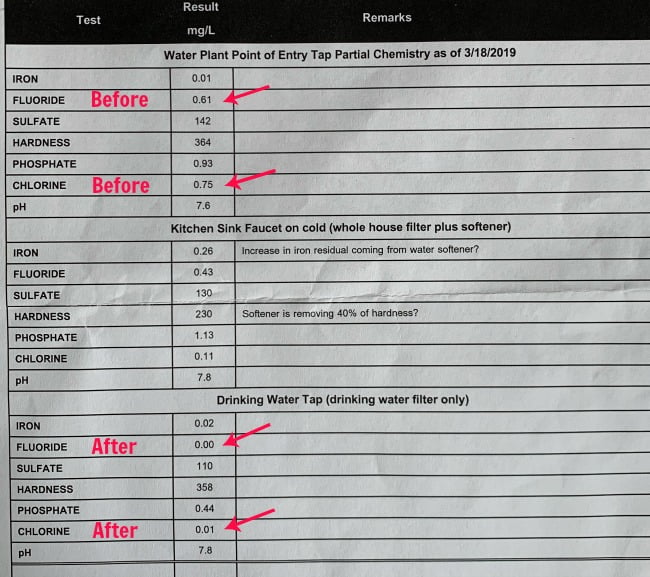
Here's an interesting note that this guy shared with me… Apparently normal fluoride levels in municipal water are “supposed to be” 0.7 (that's for the state of Michigan or maybe he said in our area, I can't remember), but where we live in Rockford they're naturally occurring at 0.6, so they were able to get by with not adding it to our city water since it was so close. We haven't had fluoridated drinking water in our home in at least 14 or more years and have still had ZERO cavities. Read more about the dangers of fluoride in your water here.
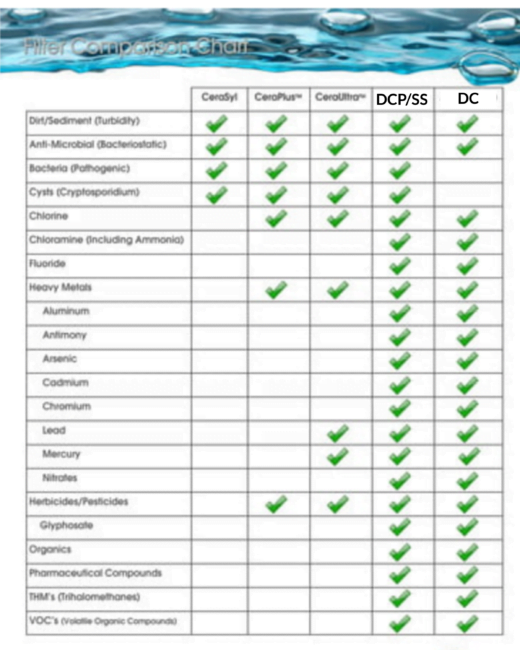
This chart shows how the filter we have is the best:
DCP=Direct connect plus, SS=Stainless steel gravity water filter (like a Berkey but better), DC=Direct connect
p.s. If you're on well water, you're not off the hook…
Yes, you don't have to worry about the stuff municipalities add to the water like fluoride or chloramines, but you have other ground water issues to be aware of like pharmaceutical toxins and things like herbicides/pesticides and/or glyphosate from local farms.
Sadly, no one can assume their water is pure these days.
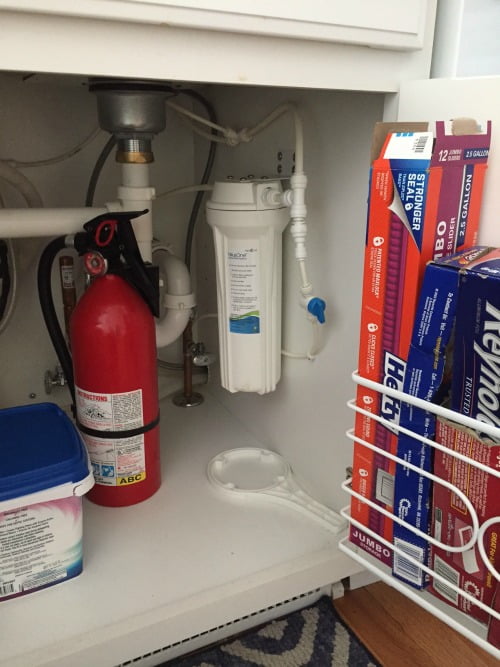
- Again, here's the water filter we got for an under-counter system, “Direct Connect Plus”. Here's the picture under our sink so you can see how big it is:
- Here's a newer post: A Drinking Water Scare Right Here in Our Town

I'm so thankful we found affordable and trustworthy alternatives to reverse osmosis and I can feel great again about the water my family is drinking!
More posts you might like:

- Jill's post: Best Water Filter on a Budget & Why You MUST Filter City Water (Flint Water Scare is Our Wake Up Call!) Also at that post Jill tells about the very worst of the dangerous contaminants in publicly treated water.



- Wish I'd had some of this around this week: How to Make Homemade Elderberry Syrup for a Natural Cold and Flu Remedy






Chris says
Thanks for the post.
After many years of use I finally discovered the inefficiency of RO (from a water waste perspective).
I plan to use my existing filter housings and use one prefilter plus the Ceramix filter. If I feed the output line directly in the existing tank I should be able to overcome the issue of low flow rate.
Any comments on this set up?
Greetings
Chris
KitchenKop says
I have a few comments that I’ll share once I’m back to my computer, too hard on my phone!
Kelly
Chris says
looking forward to it 🙂
KitchenKop says
Hi Chris,
Okay, first of all, there are some RO systems that don’t waste water like most of them do BUT as I explained in the post, I didn’t like how RO strips all of the natural minerals out.
I don’t know enough about plumbing to comment on your set up, but if it works with that filter (the one we are using), then good!
However, we don’t have any flow issues at all with our set up that I mentioned in the post, just FYI.
Kelly
Tom Herman says
Hi,
I also have a CeraMetix filter, although it’s a gravity system made by AquaCera itself. But how do you know that the filter does not remove healthy minerals–since it removes almost everything else? Why wouldn’t it remove those too?
Tom Herman
Quincy says
Hi Kelly, thanks for this review! It helped my search to switch from RO myself. We ended up going with the the Nokia Two from Aquacera. Have you found that the filtration system raises your water’s pH? Our tap is 7.5, but through the filtration system it’s 9.5.
Julie Zilkie says
Can you provide a link to the system you bought? I was unable to find that model with a google search. Thank you!!
KitchenKop says
Quincy, no, I haven’t checked ours, but you went with a different one than we did so it probably wouldn’t be the same anyway. Also, here’s an interesting related post you may want to read: https://kellythekitchenkop.com/who-should-eat-an-alkaline-diet/.
Kelly
Emily says
So it’s ok to bathe in the fluoridated water? I’ve been searching for a whole house system….
KitchenKop says
Emily,
We have a whole-house system too: https://kellythekitchenkop.com/whole-house-filter.
Kelly
Dan Overlander says
I originally WANTED a reverse osmosis filter, but am glad we finally wound up with this kind of setup, instead.
Kerry Lake says
We add the minerals back in to our RO water.
Kelly the Kitchen Kop says
Kerry Lake — we did that too for a while, I talk about that in this post.
Amber Egelston Cooper says
Any opinions on alkaline water?
Kelly the Kitchen Kop says
Amber Egelston Cooper — I just remembered that Joanie wrote a post for me about alkaline diets (with info on alkaline water) that might be interesting to you: https://kellythekitchenkop.com/who-should-eat-an-alkaline-diet/

Toni Smits says
Since Berkey does not offer a full spectrum filtration for shower head (we r in apartment & can not use a whole house water filter & wish not 2 bathe in & absorb toxins ie: chlorine, herbicides, pesticides etc.) Can anyone throw me a bone on what filter maybe out there that would fit the bill? Im at a loss at this point.
Kelly the Kitchen Kop says
Have you looked into Radiant Life’s whole house filter system? Their Series 4 system removes fluoride. There’s a link to it on this page: https://kellythekitchenkop.com/whole-house-filter

Jessica Walkington says
Thanks I love my personal water filter bottle. Married to a well driller you don’t even want to know what grows in your pipes
Debbie Eastham says
I have a berkey and love it but I’ve been wanting a under the sink system…thanks for the info
Joan Hawley says
We switched from the 14-stage to the NilusOne per your recommendation and have been very happy.
Kelly the Kitchen Kop says
Thanks so much for sharing Joan Hawley — we love ours too!
Andrea says
Hi Kelly, ?
I have done a bit of research and thinking since I posted the questions to you. The filter only filters to a specific micron, which in this case does not filter the small particles of minerals and just enough to filter the smaller amount of Fluoride.
The matter of finding an additional cartridge for Fluoride removal is still looming though. I would love it if there is a choice of this? Are you having any luck finding one?
Andrea ?
KitchenKop says
Hi Andrea, I contacted the company for more info, but hadn’t heard back then forgot. Thanks for the nudge, I’ll try again!
Kelly
KitchenKop says
Andrea, I realized I forgot to get you this info, this is what the company said: “Fluoride is absorbed in the media inside the filter, it has nothing to do with the ceramic.”
If you need more info, email me and I’ll put you in touch with the company directly: [email protected]
Kelly
MrsT says
Forgive me if this has already been answered, I need to find a whole house system to mainly filter uranium and pesticides from local agriculture that is in my well water. Any recommendations?
Natalie says
We just had our whole house filtration a system serviced. The technician said that the reverse osmosis portion now has a new component that adds back in the trace minerals since people were complaining that their water was stripped of everything both good and bad. He said it’s a newer feature. I’m excited to now have this as part of our system.
Kelly the Kitchen Kop says
Hi Natalie, yes I mentioned that option in the post, & it’s good for those with RO already, but I still wanted the all natural minerals instead of adding any back in.
Kelly
Lorena Sandoval says
Sorry but Berkey fails most of the time. The filters are a pain to prime and to clean and ours failed the red coloring test. I also read from trusted sources that they sent the water filtered thru Berkey for a lab test and the results were not what was expected. We returned ours and for now are using an RO and I add mineral drops to the water. Berkey is good in an emergency but not for everyday use. Just read the negative reviews on Amazon.
Didi says
Hi Kelly, it’s Didi from The Olive Bar in CA! We met at the WAPF/Wise Traditions Conference in November. Do you know anything about the Clearly Filtered company? I found them as an advertisement on your blog. Anything you’ve heard would be appreciated.
Thanks!
Didi
kitchenkop says
Hi Didi, good to hear from you! 🙂
Nope, sorry, no idea about that company. That was just a random Google ad on my site.
Kelly
Sealover Gabriel says
Ok, true, but if you take just 1 or 2 Klamath or any super-food that has minerals, problem solved! Also i would never accept a filter that remineralizes water, because the minerals they use are inorganic and hence non-absorbable by our bodies, plus, they clog-up our arteries…, whereas superfood minerals are organic and absorbable by our bodies and do not clog up our arteries…, love you all!
Tania Rachel says
http://www.findaspring.com
Mindy Tharp Worley says
This all makes my head hurt. How has something as basic as drinking water become so expensive and complicated?!
Mary Peters Herrera says
I’ve had several friends send their water samples
For independent testing to see if their Berkey was removing the flouride as it stated and I believe all 3 friends came back with way less flouride removed than Berkey claims. They contacted Berkey who gave them the run around and claimed the water needed to be a certain Ph level in order for it to remove all the flouride. They contacted Berkeys “independent tester” whom Berkey referred them to only to never hear from them after multiple phone calls and emails. I am throughly disappointed in Berkey as a company and how they handled this situation. I was planning on purchasing one as we have flouride in our water but now I will not due to their shady customer service practices and misleading information. Still researching better options.
Desiree Heckaman Odenbrett says
To all that add minerals back to their RO, what minerals do you use? I was about to buy Trace Minerals but noticed it had lead, cadmium and other concerning ingredients listed.
Karen Emerson says
So , you still have to add in the minerals
Jonelle Rust Hughes says
You can also buy mineral filters to add to your existing RO system that add all the minerals and good stuff back in. We have been very happy with ours.
April O-q says
We recently stopped using our RO system and got CeraMetix filters and the difference I notice with thirst is noticeable: I could drink an 18oz RO glass and still feel “thirsty” whereas an 8oz glass of CeraMetix is satisfying to my thirst. I still drink lots, but my thirst is quenched properly it feels.
Theresa Marie Cushing says
Kelly the Kitchen Kop I want to install a WHF when we redo our kitchen. What do you recommend?
Theresa Marie Cushing says
Is there no option to whole house filter out everything? You need the WHF plus a separate drinking water filter!?
Kelly the Kitchen Kop says
Theresa Marie Cushing I recommend this one: https://kellythekitchenkop.com/whole-house-filter.
And no, you also need a drinking water filter to get the Fluoride out and other contaminants.

Bill Kelleher says
Cerametix is good.. much better than Berkey for fluoride removal, but still only about 80%. You can get a mineral cartridge for a RO system. You can also fill a gallon at a time and premix the mineral drops so you’re not doing it for each glass.
Amy Winkel says
We drink Plant Derived Minerals with our water too – for an added punch:)
Krystal O'Connor Spears says
I don’t remember to be honest. I know I was specifically concerned with chlorine & fluoride.
Kelly the Kitchen Kop says
I mention that in the post, why I still don’t care for that option.
Kelly the Kitchen Kop says
Krystal O’Connor Spears But specifically WHICH bad things are removed…
Bethany Monks Fitzgerald says
Interesting point! We have been wanting to put in a filter, especially since I’ve woken up about fluoride. Hubby has talked about RO for years as if it’s the best so I know that is what he planned to get us. Looks like we need to do more research!
Kevin Licko says
Where is the science to back up the claims of what the filter removes? It would be more helpful to direct the audience to an independent certification body, like the Water Quality Association, who independently tests and certifies drinking water treatment products. They not only test to make sure the product removes what it claims, also that it does not contribute any harmful chemicals from the materials it is made of.
Kelly the Kitchen Kop says
The company has all this info.
Mindy Tharp Worley says
From the link Kelly posted:
The CeraMetix® elements have been tested in accordance with NSF protocols for cyst, turbidity, particulates, lead, chloramines and chlorine reduction (Class 1).
Is that not what you’re looking for?
I’m with you, I want independent verification, especially after the whole FCLO debacle. Ugh. I’m still upset about that…
Kelly the Kitchen Kop says
Please see the following regarding NSF Certification:
NilusOne™ Imperial CeraMetix® OBE filter:
Made in the USA
Silver impregnated to prevent bacteria grow through
Cleanable for prolonged life
0.5 Micron absolute
100% Removal of cysts
99.9999% Pathogenic bacteria
>99.9% Efficiency at 0.2 micron
***NSF 61 Certified materials
***Meets or Exceeds NSF Standards 42 & 53 for the following:
>99% Chloramine reduction
>99% Chlorine reduction
>99% Lead reduction
>99% Herbicides and Pesticides reduction
>99% Glyphosate reduction
>98% VOC’s reduction
>98% Heavy metals reduction
>92% Nitrates reduction
>85% Fluoride reduction
Melissa Wilson says
Hi Kelly. Just wondering how happy you were with the under the counter system you bought. In the post you hadn’t installed it yet. We are looking for something to replace our RO system. Thanks for all the info!
KitchenKop says
Melissa, we’ve been very happy with it. The water tastes great and I love knowing the minerals are still in there! Thanks for reminding me to add that update to my post. 🙂
Kelly
Kathleen says
Kelly, which lab tested all of these things for this company. I am curious. We have a Pusanova system. Love it, too. But it is on the higher end of pricing. Could you please let me know about the lab who did the testing? Is there one particular indpenendent lab that everyone trusts?
KitchenKop says
I’ll have to ask the company and get back to you. 🙂
Kelly
Mindy Tharp Worley says
Thanks, Kelly! You rock! 🙂
Bekah Laurain says
How often do find yourself changing the filter, Kelly?
Kristy Jeffries Butgereit says
This was my question as well
Kelly the Kitchen Kop says
We just got it, so I’ll let you know.
KitchenKop says
I’m expecting the filters to last around a year or so, that’s what the company says. Also, read my friend’s post about how she extends the life of her water filters (same as our under-counter only hers is the on-the-counter model): https://kellythekitchenkop.com/best-affordable-water-filter/
KitchenKop says
Update, yep, our first filter lasted for one year!
Kelly
Krystal O'Connor Spears says
Kelly the Kitchen Kop when the sales guy sold it to me, that was his pitch. It remove the bad stuff and added the minerals back in.
Kelly the Kitchen Kop says
Don’t know about that one, and if it does leave in the minerals, the other question is does it get all the bad stuff out? @Krystal
Julie Zilkie says
Kelly,
In your conversation with the company, did they say HOW they are able to leave the minerals in? I just find it odd that somehow they are able to do this, but the other RO systems that look just like this one don’t. Were you satisfied with the answer they gave you?
First time commenter here!
KitchenKop says
Hi Julie!
This is actually NOT an RO system at all, it’s just a really good filter. 🙂
Kelly
Andrea says
Hi Kelly. I hope you will still receive this message, knowing that the last post was March. Looking at these posts I think what’s being overlooked is that although I do agree that the filter in question is a really good filter, it would still however, remove all particulars from the water, then add the minerals back in, given that logically it could not choose what is friend or foe. How does it then return these necessary minerals (which we get enough through our food anyway)? Did you know that not all natural sources of natural water contain the full load of minerals? I’m in the process of head hunting a good system at the moment and this filter sounds great as opposed to an osmosis. I would however, like a bit more fluoride removal. I was therefore wondering if the option for an extra fluoride plus cartridge could be added? Oh the headache! ?
KitchenKop says
Hi Andrea, I’ll see what I can find out about that. 🙂
Kelly
Andrea says
Wonderful! Thank you Kelly. ?
KitchenKop says
Andrea, I can’t find where I ever replied to you about this. This filter doesn’t need to “return” any minerals back in, because it still has the natural minerals in there and they aren’t stripped out at all. Regarding your Fluoride question, if you’d like to email me I can put you in touch with the company so you can look into that more with them: [email protected].
Kelly
Emily McMillan says
Does the Berkey remove all the good minerals as well? That’s what we have…
Kelly the Kitchen Kop says
No, it wouldn’t remove all the minerals. Berkeys are great.
Kelly the Kitchen Kop says
@Emily – I mention in the post, it’s just that they’re so big & a pain to refill.
April Hunt says
Those of you with the berkeys….we have one too…and love it. But not really good at figuring when the best time to change to filters is? What do you guys do?
Kelly the Kitchen Kop says
I’m glad you guys love your Berkeys! That’s all I recommended for years, but I love this under-counter option. I just don’t want that thing on my counter when space is limited already. My kitchen is a pretty good size, but there’s just never enough counter space. 🙂
Alexis says
Kelly, do you still think Berkeys are ok (aside from the bulkiness)? We JUST purchased one but haven’t put it together yet. We’re renting so can’t put in an under sink device right now.
Thank you! Alexis (Seattle)
KitchenKop says
Hi Alexis, yes I do think they’re fine, they’re just more bulky, as you mentioned, plus annoying to always have to refill, and more expensive. That’s all! 🙂
If it were me, I’d rather go with the countertop model mentioned in the post.
Kelly
Marilyn Zimmerman says
What do you use to filter bath/shower water?
KitchenKop says
We got a whole house filter from a local place many years ago, but it was just like the one linked to above (https://kellythekitchenkop.com/whole-house-filter).
Kelly
Marilyn Zimmerman says
Thanks I missed that part. Also thanks for helping me figure out these water filtering issues! We just moved and now have tap water (fluoride added also):-(. We did get water from a wild spring once that was listed under Find-a-Spring and loved that water but it’s not exactly close by. Do you have any experience with wild spring water?
KitchenKop says
Hi again Marilyn, no I don’t, but would love that option! I might pay to have it tested though, since you wouldn’t know for sure what’s in there.
Kelly
Marilyn Zimmerman says
Yes getting it tested was on my to do list 🙂