
Since some of you may not be ready or able to make the switch to raw milk yet (which is the most nutritious milk — learn why here: Raw Milk Benefits and Information: Q & A with Mark McAfee), I thought I'd try to help you find the next-best choice when choosing which milk to buy for your family. Keep in mind that milk is a healthy food! But as with all things, there is a big difference between the various options available.
Scroll down to where it says, “which milk to buy”, if you just want to skip to the list of best to worst options.
I told you I was a freak
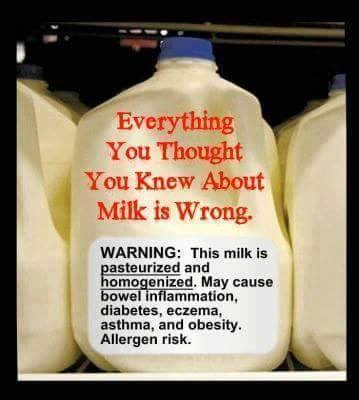
I can be a real crazy-woman on this topic, in case you haven't figured that out already. I was checking out at Meijer one day and saw a woman in front of me buying 4 half gallons ($3.29 each) of Meijer organic ultra-pasteurized milk. It was burning inside of me and I wanted to tell her that she was paying more for something that is not even nutritious, and to top it off, she had FAT FREE milk! It took everything in me to keep my mouth shut (no big surprise to those of you who know me), but I pulled it off.
The “organic” part was great, but there were two main issues with what she was buying:
- The date on the milk was ALMOST TWO MONTHS FROM NOW, which is an obvious hint that this is very UNNATURAL milk! When the date is that far out, that means the milk is “ultra-pasteurized” (which is also stated on the label), whereas most milk you get at the store is only “pasteurized” and the date is about a week or two out. Ultra-pasteurized basically means that they kill the milk at an even higher heat than with normal pasteurization, so it no longer even resembles milk! (They later add synthetic ingredients back in, like vitamin A & D.) The milk is so dead, it doesn't even need refrigeration, but stores sell it in the refrigerated section or else no one would buy it, they'd be so turned off. This processing technique for milk is ONLY to lengthen the shelf life and therefore increase profits for the milk companies. Especially watch for this on those little one-cup cartons of whipping cream, which I use to make whipped cream when I don't have enough raw cream from the top of our milk – never use “Cool Whip”! Real whipped cream is so easy to make, it only takes a few minutes and is much healthier!
- The other screaming issue was that she was buying the fat-free milk! I shudder at the thought that she probably has children she was buying it for. I know, I know, your doctor told you to drink low fat milk, and he even told you that once your child is a certain age, they should drink low fat milk, too. I will not tell you to go against your doctor's advice, however I will BEG YOU to please do your own research on this and see if there might be another side to the story that they aren't aware of! And even if it's not on the label, often they add in weird stuff to replace the fat they took out — there's more about that below. We all, especially our children, need healthy fats in our diet, and dairy fats the way God designed them are healthy fats! It's common sense: God didn't make whole milk cows and skim milk cows! For centuries people would drink their milk whole, unless they were taking the cream off the top to make butter, to stir into their coffee, or to put on their oatmeal or strawberries. Try to let go of the “low fat” mentality that has been beat into us. I know this is difficult since we're still being bombarded by that rhetoric, but just think in terms of common sense. What is more natural? How did God design it? (Read more about why dairy fats/saturated fats are NOT the “bad guys” they've been made out to be and in doing research for this post, I also found this article showing that intake of high-fat dairy products is linked with a lower risk for infertility!)
“But it tastes too thick!”
Some people tell me they just don't like the consistency of whole milk, I used to feel the same way, I loved my skim milk! This shows how not just our thinking, but even our taste buds had become warped. If I can get over this, believe me, you can too. At first it might taste a little heavier, but it wasn't difficult at all to get used to it (give it a couple days, tops), especially once I realized how much healthier it is. By the way, whole raw milk tastes much lighter than store-bought whole milk anyway. Another idea I haven't tried, but I'd love to hear from someone who has (leave a comment below please!): add a little water to your whole milk to make it taste lighter if you want to.
Here's more information on why to avoid low fat dairy, the following information in quotes below is from Nina Planck in her book, “Real Food: What to Eat and Why” (anything not in italics are my words):
- Q: But won't I gain weight drinking whole milk? A: No! “Unlike polyunsaturated fats, which the body tends to store, the saturated fats in milk are rapidly burned for energy.” Not only that, we absorb more calcium from whole milk, which helps us lose weight: “The butter fat found in milk helps the body digest the protein, and bones require saturated fats in particular to lay down calcium.” “The cream on the milk contains the vital fat-soluble vitamins A and D. Without vitamin D, less than 10% of dietary calcium is absorbed.” (Nina Planck also explains that calcium absorption may be the key to why recent studies show that people who consume more milk, yogurt, and cheese lose fat, especially belly fat, and gain lean muscle. She quotes a nutrition professor, Michael Zemel, who found that calcium from dairy foods is “strikingly more effective than calcium from fortified foods or supplements” for stimulating weight loss.)
- Q: Won't drinking whole milk give me heart disease? A: If that were true, then why in the first half of the twentieth century did the incidence of heart disease rise, as consumption of saturated fats fell? (Dairy fat, butter, coconut oil, etc.) In recent years, the more “they” convinced us that low fat was where it was at, the unhealthier we have become! And get this: reduced fat or fat-free milks lose their milky consistency when the fat is removed, so to give the consistency back that everyone expects in their milk, dry milk powder is often added. This contains oxidized (damaged) cholesterol, so the milk you thought you were drinking because it was better for your heart, turns the milk into a BAD FAT after all! (More about oxidized cholesterol from Sally Fallon. Also, my friend Katie wrote a post questioning this claim, so I did a follow up post on this issue of whether or not dry milk powder can be added to milk without it being on the label.) *More about the dangers of oxidized cholesterol (from dry milk powder) are here.
- “Skim and 2% milk must, by law, be fortified with synthetic vitamin A and synthetic vitamin D. There is some evidence that both synthetic vitamins are toxic in excess.“
- “Whole milk contains glycosphingolipids, fats that protect against gastrointestinal infection. Children who drink skim milk have diarrhea at rates 3-5 times higher than children who drink whole milk.”
Why is milk (and meat) from “grass-fed” animals so important?
If you can find grass-fed dairy products, you'll be getting even closer to healthy raw milk. From “Real Food: What to Eat and Why” (I love that book, can you tell?): “Cows on grass contain more omega-3 fats, more vitamin A, and more beta-carotene and other antioxidants. Butter and cream from grass-fed cows are a rare source of the unique and beneficial fat CLA… CLA prevents heart disease, fights cancer, and builds lean muscle. It aids weight loss in several ways: by decreasing the amount of fat stored after eating, increasing the rate at which fat cells are broken down, and reducing the number of fat cells.” (More here on grass-fed meat benefits.)
Avoid milk with synthetic growth hormones: rBGH (or rBST)
Most store-bought milk comes from cows given synthetic growth hormones to increase milk production and profits for the dairy industry. Don't worry, the FDA claims it is safe for us to drink, and we all trust them, right? (Wrong.) Not only is it uncomfortable, inhumane and unhealthy for the cows, it has also been linked to cancer, and early puberty in girls – this is highly debated, but it's a no-brainer as far as I'm concerned. If it makes cows more prone to illness (and shortens their lifespan by half), can it be good for us to drink? So whether or not the claims of increased cancer and early puberty are true, why risk it by ingesting something unnatural?
Non-homogenized milk
Homogenization is the process of shaking the milk so violently that the fat is dispersed evenly throughout the milk and no longer rises to the top. Just another way to denature a highly nutritious food! There are also health concerns related to homogenized milk.
If you're lucky, you may be able to find non-homogenized milk from grass-fed cows near you, we have a great local option like that–Hilhof Dairy. It's local (from nearby in Michigan), and contains no growth hormones. It is still pasteurized (obviously, or else we couldn't buy it at a store, but don't forget the cigarettes while you're there, UGH. It stinks that we can buy THOSe buy not fresh raw milk), but that's the only difference from our farm-fresh milk — it even comes in glass jars. When I can buy milk at a store that is only one step away from the best, that's a great option!
You're wondering why it matters, since we drink raw milk. The answer is because we sometimes run out of our raw milk each week and need some store-bought milk to hold us over a day or two until we get more from the farm. (And I also need store-bought milk to give to my day care kids.) OH, and some who think whole milk is too thick, really like this whole milk.
Which milk to buy
Milk Best to Worst–I'm not adding in raw milk here, which is always best if it's from a farmer you trust, or low-fat milk, which is always the worst, as explained above. Here are your in-between options:
- Organic, grassfed cows, glass bottles, lightly pasteurized, but non-homogenized. Near us I can find Hilhof Dairy in this category. If we couldn't get fresh milk from the farm, we'd get this and it's this type of milk that I look for when we're on vacation.
- Non-organic but non-homogenized, from grassfed cows.
- Non-organic, homogenized, from grassfed cows.
- Organic, not grass fed. Note that Horizon milk and almost ALL organic milk at the store that I've ever seen is ultra-pasteurized–you can see the use-by date is months away and even that's a lie, it's actually shelf-stable for years, so don't buy this!
- Non-organic, not grassfed. This is typical “conventional” milk from factory farms, and I recommend it the least. As a matter of fact, if we could only get these last two options, we wouldn't drink milk at all… (Read more about conventional dairies: Dairy Cesspools – Neatly Dividing One Solution into Two Problems.)
To find information about the milk you're thinking about buying, you'll probably need to go to their website and/or call the company, I've done this often.
Can't tolerate cow's milk or can't find milk you're comfortable drinking?
Read about your next-best options here!
As always, if you have any good information to add, please comment below. Or if I've confused you more than before, let me know and I'll try to clarify for you.
Related posts:
- Here’s a book on the topic that you’ll definitely want to read: The Untold Story of Milk
- Do fats make us fat? Read more about the myths surrounding saturated fats
- Here's a link to more info on oxidized cholesterol in dairy powders.
- Raw Milk Benefits and Information: Q & A with Mark McAfee
- Eating healthy on a budget
- My Dark Secrets
- A report on which dairies are healthiest. (If you click on “full report” at the bottom of this site and go to pg. 35, it explains the criteria used.)
- Easy chicken recipe: better than chicken nuggets!
- Healthy school lunch alternatives
- Meatless/Lenten/Vegetarian meal ideas
- An article by Nina Planck on homogenized milk




Katrinka Snider says
Please do not be a milk Nazi. The vast vast majority of Americans who wish 2adhere 2the standards UR outlining in this article do not have a) access; or, b) funds 2 a) locate; or, b) afford raw, super-duper perfect milk. Pasteurization is the name of the game. USDA does not sanction humans drinking raw milk. City dwellers have scant access 2milk in its raw form. We’re glad 2have vitamin-fortified, calcium-laden, bad bacteria-free (pasteurized) milk. Can’t expect Americans (the majority of whom, @least in the Midwest, shop @Wal-Mart) 2go on a long pursuit 2locate non-homogenized perfect milk. Lobbying, not self-righteousness, leads 2social progress.
Alison Willis says
Thanks for this info. I’ve been struggling on which milk to use for my one year old. I’ve been using raw cows milk and may just stick with that, but this article has been helpful!
Pamela Vickers McMahan
Gayle N Scott Lind says
I wonder if homestead creamery whole milk is okay?
Kelly the Kitchen Kop says
@Gayle I’m not familiar with that one.
Kim Lane says
Thanks this is wonderful
fuwmilkalberta says
Many pain issues is caused by store milk because most comes from cows which have Johne’s Disease which has a bacteria known as MAP which is not killed by pasteurization. For more information go to ‘news’ in the http://www.rawmilkconsumer.ca web site. Also, the Homogenization process which bust up the cream fat molecules which prevents the cream floating to the top, causes Histamines to be released which why people with Asthma should not drink milk that has no cream on top.
KitchenKop says
Hi Laura, I LOVE Kalona Supernatural products! As far as 2% milk, I feel the same way about that as any low-fat or fat-free product, see the post above for more on that. 🙂
Take care!
Kelly
Laura says
What are your thoughts on Kalona SuperNatural milk? I’ve been recently doing some research and it seems to be pretty good… Other than the fact that we, too, are from Michigan. And I’m assuming you are since you said Meijer & Hilhof. I should get Hilhof next, but I can only find it in a small store that wasn’t open today. Also, thoughts on 2% instead of whole milk? Thanks!
meera says
My daughter is allergic to raw cows milk, raw goats milk and then some one recommended camel milk to me and i tried it out for her and she is now drinking a cup of camel milk a day, its actually very very healthy compared to cow/goat milk as it has very low amount of casein, which is very difficult for our body to digest.
You can get all info here; https://www.camelmilkassociation.org/
meera says
Kids who are allergic to raw cow’s milk and raw goat’s milk can tolerate raw camel milk, which is a much better and healthier option than raw cow’s milk .
Elian says
Greetings fron France! Just wondering, is Organic Valley UHT whole milk an acceptable option? The thing is, it says fortified with D3 in the list of ingredients. Is it something I should be concerned about? Plus, no information is provided on whether a gentle UHT process is used or not. Thanks.
KitchenKop says
Hi Elian,
Personally, I wouldn’t buy anything UHT.
Kelly
Elian says
Hi Kelly, I thought maybe you’d make an exception for a Bavarian Alpne dairy brand called Berchtesgadener Land. Their organic, 100% grass fed, whole, shelf stable milk is a gently UHT processed product with a 50% reduction of the heating time compared to other UHT brands. https://bergbauernmilch.de/produkte/bio-alpenmilch/milch/haltbare-bio-alpenmilch/
KitchenKop says
Hi Elian,
Well, if my choices are organic, grassfed UHT milk vs. conventional UHT milk, then sure, I’ll pick the organic, grassfed choice, but if I have another choice that’s grassfed and NOT UHT, I’ll go for that every time. 🙂
Although, I’m not sure, but I MIGHT just go with NO milk if UHT was my only option. It’s THAT denatured…
Kelly
Elian says
Hi Kelly,
What about if you had to choose between conventional raw milk, organic low fat pasteurized milk, and organic, grassfed, full fat, gently UHT processed (still UHT though) milk?
Plus, to make things a bit more tricky, both the raw and pasteurized milk come in a plastic bottle and are local products, whereas the UHT milk comes in a carton and is imported from the Swiss Alps.
Answering “NO MiLK” is not a valid option. 😉
Thanks,
Elian
Elian says
I mean, more than 50% reduced thermal stress for Berchtesgadener Land organic, whole UHT milk compared to conventional UHT milk…
Elian says
What’s more, their main breed of dairy cows is Fleckvieh which, according to the Journal of Dairy science, has a large percentage of A2 milk… https://www.fleckvieh.de/Fleckviehwelt/World/FVW_2013/World_8-11.pdf
Christopher Downey says
Ive drank braums milk for 20 plus years Im still normal and i love Braums milk it tastes so much better then walmarts waterdown
Rachel says
Any thoughts on Oberweis whole milk?
KitchenKop says
Nope, they must not be in our area. Just hop on their website and look around, and even better, go visit!
Kelly
Tim Robinson via Facebook says
(Sarah) I have not tried it but I have seen many people refer to tiger nut milk. It is a tuber grown in Africa.
Janet Talmadge via Facebook says
Give her bone broth and skip the milk completely.
Kat Bauman via Facebook says
Milk is not something that we NEED to drink once we are weaned from the mother’s breast. We can get the nutrients that milk provides via plant foods with the exception of b-12. Not to mention milks that are fortified are using lab created vitamins vs naturally occurring food based vitamins and minerals. I can NOT stand to drink milk myself. It’s a taste/consistency for me although I will drink soy milk in a mocha and will make my own almond milk in my blender for smoothies and other recipes. But by it’s self, I can not stand it! lol
Tribes_NaturaLaw says
Soy is actually poison to most people, it diminishes thyroid and causes other problems, further, buying soy given the mass takeover of the food supply and dealings by monsanto which controls 90% of soy here and around the world is NOT a good ‘choice’ for ourselves or our environment. The ‘eat plants’ ‘vegan’ agenda is to weaken us and distract from the mass population explosion here, which had paid attention to population there would be plenty of room for all the cows we want to be on grass where they belong. It is all tied together, everything that is plaguing us is not ‘coincidence’ it is a plan and centuries of ignorance has feed that plan. We have used Raw milk for thousands of years, our gut bacteria developed as part of drinking Raw milk, the agenda to ‘pasturize’ milk was Not for our benefit it was to weaken us and attack the farmers forcing them to ‘buy’ their ‘pasturization machines’ or be ‘outlaws’ which ‘laws’ are in fact bogus and made by the same cabal calling itself ‘government’. The ‘constitution’ is a con, search ‘No Treason” by Lysander Spooner, fourmilab has copy. When people see the big picture you stop accepting bogus ‘fixes’ such as ‘eat plants’ and you see the real agendas then you can go after the core problem. Raw milk is best for optimum health for most of us. Soy and rapeseed/canola and other mega-corporation gmo products are NOT good for our bodies and have destroyed our enviroment. We could control our own lives if we chose to live by natural law and make our own tribes. We don’t have to allow others to dicatate what we do or don’t ‘need’ or swallow agendas that are Not for our benefit. For those who want to choose freedom, best way is to inform others, I use paper notes with links and info on them and hand them out, it’s a way to inform and meet others. Because of ‘govt’ and corporation dictators from every direction we are losing that ability to choose. Best do something while we can.
Stephen Hyland via Facebook says
Personally, It wouldn’t give any kid any kind of nut or seed milk. The enzyme inhibitors and very high PUFA content would be quite problematic. Cows milk is definitely the more natural and all around healthier approach.
Kirstin says
Hi,
My daughter is lactose in tolerant. She HATES coconut and almond milk (she’s three, there is just no convincing her). We had her in goat milk but that doesn’t work either. Is there a healthier lactose free alternative?
KitchenKop says
Kirstin,
I’d say that your only option is to skip the milk and find those nutrients from other foods. This link may help some but you’ll probably also need to do extra googling:
https://www.westonaprice.org/blogs/kdaniel/what-can-i-drink-instead-of-soy-milk/
Kelly
Paul says
What is your opinion about the studies that milk and other dairy products kill people, is white poison? Just google “milk kills”.
KitchenKop says
Hi Paul,
My opinion is this: the milk that is questionable is *conventional* milk from factory farms with cows in confinement and fed junk they were never meant to eat. On the other hand, fresh milk from a farmer you know and trust to raise their animals humanely and out eating pasture grasses, that milk is a superfood. Granted, there are *some* who cannot tolerate any dairy, but most thrive on fresh milk.
Kelly
Paul says
I drink milk from either Borden or Braums (in Texas). Is there a way to determine if these brands are in the conventional or superfood category?
KitchenKop says
Paul,
I’m from Michigan so I don’t know those companies, but I’d suggest going for a visit and see for yourself how the animals are raised. If that’s not possible check them out online and call them to ask specific questions.
I’ll tell you that where we are, if we didn’t have a good source for fresh milk right from a farmer we trust, the only other milk I would buy is a from a local organic grassfed dairy who sells pasteurized but non-homogenized milk in glass bottles. (It’s Hilhof for those of you who are nearby, you can get it at Kingmas, Harvest Health, and probably many other places I’m not aware of.)
If we couldn’t get milk from a place like that, we just wouldn’t buy milk & would follow these recommendations instead:
https://www.westonaprice.org/blogs/kdaniel/what-can-i-drink-instead-of-soy-milk/
Kelly
Ella says
Thank you for this! I’ve started eating less processes foods and have been buying organic ultrapasturized milk (what a waste of money!). I came across mooville at the Fulton farmers market. I asked on their Facebook whether they feed their cows gmo corn. They replied truthfully that they are not organic and yes, it is gmo corn. With that being said, do you still recommend them over the ultrapasturized organic milk or is there a better option in the Grand Rapids area?
KitchenKop says
Hi Ella,
Have you seen the Hilhof brand milk and cream? It’s awesome! From grass fed cows and it’s pasteurized but not ultrapast. – it’s even in glass bottles! You can get it at the health food stores.
Kelly
Heather says
I just wanted to spread the word that Hick’s dairy farm added a new drop off location for raw milk in Dearborn Heights! It’s in the Pure Pastures parking lot. The first drop off will be Thursday June 12.
whirleegig says
I don’t understand why you run out of raw milk. Why don’t you simply buy more? You do know that raw milk takes a looooong time to spoil, right? It just sours and sour milk is delicious and nutritious.
Great article! Thanks!
Jennifer says
While I agree with some of the stuff that has been posted here, I find it funny about other comments that have been mentioned. I grew up on a dairy farm in MI who supplied milk to Dean Foods. So, I know for a fact that not ALL milk that Dean Foods has is from factory farms. In fact, in the area I grew up (Leroy) all the dairy farms there sold their milk to Dean and not one of those farms fed anti-biotics to their cows like a lot of the factory farms. I grew up drinking “fresh” milk which came directly from the cows & before it went into the tank. I am not any kind of expert but just wanted to share what I know from my experience living on a dairy farm.
Kelly the Kitchen Kop says
Hi Jennifer, I’m glad you shared your experience growing up on your farm. There were a lot of good farms like yours where Kent and I grew up in mid-Michigan, too. So I totally agree and realize that not all milk from the grocery store is from factory farms, but here’s the sad part: the good milk just gets dumped into a big tank with the icky milk so it can all be pasteurized and bottled, right? It’s such a shame, really.
Thanks again for jumping in. 🙂
Kelly
Sri says
Hi,
Your article is great. I’m a vegan and I heard milk made in the US is done by torturing the cows. I buy Kirkland non fat milk and I want to know if the process of milk making involves torture. Could you please help me with this? And anyway, now I know I can buy normal milk in place of non fat milk. Thanks.
Sri
KitchenKop says
Hi Sri,
If you buy from a farmer you know and trust, you can go visit and see that the animals are being treated well!
Kelly
Mariah says
what are your thoughts on publix organic milk? I was trying to do research but I couldn’t really find anything.
KitchenKop says
Sorry I don’t know anything about it, find out where it comes from and how the cows are raised. 🙂
Kelly
Erin says
This might be at least a starting point to find out where your particular milk comes from.
https://whereismymilkfrom.com/
Sue E. says
Kel,
There is also a Heffron Farms in Cascade by the Harvest Health at 28th Street and Cascade Road. Thought you could put that also above.
Sue
Fiona says
What do you think of non organic raw milk (I’m guessing primarily grass fed because most cows in this country are)? It’s illegal to sell raw milk here so very hard to buy (I’ve heard of some selling it as “bath milk” but that’s not local to me. Anyway I found out a few weeks ago that my sisters boyfriend’s family own a dairy farm and she’d tasted some raw cream! Well I jumped on the opportunity and asked if she could get me raw milk! She can’t get it for me every week, but I now have it about 50% of the time and it’s growing on the kids too! (He lives a couple of hours away or we’d get it more often). But I’ve heard you should only drink raw milk if it’s organic and this isn’t! It just seems that it’s the only way we’re going to get milk raw.
KitchenKop says
Well, I think that I’d visit the farm and see how things are done – see how clean they are, what the cows are fed, etc., and if it’s all good, I’d be more apt to drink this than anything from the store. But that’s a decision you have to make after checking everything out thoroughly.
Kel
Fiona says
Thanks Kel! Yes, one day I’d like to visit the farm myself. I can also ask if the cows are pastured or if they’re fed other stuff as well (I find it sort of ridiculous that most cows are fed grass here, but before slaughter they grain feed them to improve the flavour of the meat!! Silly!! Not sure if they supplement the feed of dairy cows though, at least not while there’s plenty of grass).
The second best option milk wise is to buy organic non-homogenised milk from the supermarket. It’s pricey, but obviously better than the other stuff, but I’ve waited ages to find some actual raw milk so I was pretty excited by this! But I’ll try and suss out more information :).
Carol says
That could easily have been me in line in front of you with the ultra pasteurized fat free milk. I can’t speak for everyone, but I would have been grateful if you’d quit biting your tongue and given me an education. It might not have changed my purchase at that moment, but it would have sent me home on a mission to learn.
KitchenKop says
Hi Carol,
Oh boy, that’s just what I needed to hear, I’ve never been told I should speak up MORE, but maybe I will!! 🙂
Kelly
melawe says
Keep talking! It is true why should you be quite? If anyone tells you to be quite, take a peice of duck tape and tape there mouth, and tell them you try it first. 😛
Laurie says
Here is a link to an article I read and it sites the research to back it up. I have been so busy, this is the first chance I have had to post this.
https://experiencelife.com/article/digesting-the-new-usda-dietary-guidelines/
KitchenKop says
I love most of that article except it does seem to be down on dairy and doesn’t mention raw as an option at all.
Kelly
Laurie says
Jessica,
what I have discoved in all my reading is that the fat in milk and butter and the cholesterol in eggs is good for you. it is what your body can use. Processed foods, like skim, 2%, margarine for example, is what is bad for you. I agree that whether it was created for us to use or not, it is there to use. we use lots of things in ways they were not designed to be used. So eat the full fat versions of the healthy whole foods. Avoid Trans fats, excess sugars and refined grains. If we want to get picky, God did not create Margarine, or pasta for that matter. We did. God/Goddess did create whole foods and that is how we should eat them. Eating a pound of butter, of course is not good, but a few tablespoons of butter is way better then processed veg oils. I drink whole, non-homaginzed milk from pasture/grass fed cows, best I can find.
My point is there is so much new research out there stating that a lot of what we thought was healthy is not. like sodium. new reseach shows it has no or minimal effect on blood pressure. if you avoid processed foods, you won’t get much sodium anyway. And this research is backed up by science too. It is not just someone’s opinion. Be open to new ideas and sometimes we have to get past the past.
Margie says
Laurie, Do you have links to published studies in peer-reviewed journals to back up the claim about the “new research”? The “science” is that one needs to increase potassium while lowering sodium in order to achieve optimum balance for good cardiac conduction and to prevent/alleviate muscle cramps.
Alisha says
Since December we have made the switch to local raw organic pasture raised whole milk. It’s the best tasting milk I’ve ever had. So worth the extra cost IMO!! Can’t wait for my own jerseys!! 🙂
Jessica says
Hi Kelly,
While I appreciate the time you’ve taken to put together this article for readers, I think you should take a minute to really think about the logic you use to support your assertions in your post. Is it just your opinion, or is it really logical? You said to think about the fact that God created cows that make whole milk (not skim milk), thus whole milk is healthier. Well, if you really think about it, “God” didn’t create humans to drink cow’s milk at all. In fact, the majority of people aren’t even able to digest it properly.
Other commenters have used this point of your post to argue that we shouldn’t be drinking milk at all, but that’s not my argument. I think it’s absolutely fine that humans drink milk (even though we weren’t “created” to do so). Humans do plenty of things and eat plenty of things that we might not have been created for, and that’s okay. My point is that you can’t prove whether something is healthy for a human just by imagining whether God created something that way or not. First of all, you have absolutely no clue what God created anything for. Even if you thought you did, you’d find at least a billion other humans who disagreed with you. Second, even if God created something a certain way, that doesn’t mean that we should use it that way. Humans have survived by ADAPTING elements of their environment, not by using them blindly. God created rhubarb to have stems AND leaves, but does that mean we should eat both the stems and leaves? Of course not! The stems are nutritious, but the leaves are poisonous! Just because God created cow’s milk to have 3.25% butterfat does not mean that 3.25% butterfat is healthy for human consumption.
I’m not saying that what you are advocating is unhealthy. All I’m saying is that you should think deeper about the ways you justify your beliefs and whether or not they are truly logical, especially before spreading them to the public.
KitchenKop says
Jessica,
I do get what you’re saying, but a lot of this comes from traditional cultures and what they’ve handed down. They’ve taught us NOT to eat rhubarb leaves, for example, or other plants that are harmful.
One thing I take issue with, though, is that ‘most people aren’t able to properly digest dairy’ – instead I’d say ‘many people can’t properly digest *processed* dairy’. And if someone IS going to drink it, doing so in its most natural form still makes sense to me. We all have to listen to our bodies, though, and if someone doesn’t tolerate it well, (even raw), then they shouldn’t drink it.
Kelly
HDM says
After finishing reading your article I went to Kalona Super Natural website just to make sure it’s healthy. I love their milk and they have coupons!! Have you ever heard of it? If you have, what is your opinion about it?
KitchenKop says
I love it – I buy their yogurt and just wish I could find it more often! It’s from grass-fed cows and you can find the whole milk version!
Kelly
RMG says
When I saw your link for “healthy milks,” I expected you were going to have soy, nut, coconut or other vegetable-based “milks.” You mention that God did not make skim milk and whole milk… which is right. But God also made mammals with the ability to produce milk for their own offspring during infancy. I don’t know that any other animal’s milk is truly GOOD for us – especially in adulthood.
KitchenKop says
Read more about the benefits of raw milk at my link in this post above.
Minimally processed coconut or nut milks are good options for those who need to be dairy-free, but soy milk I’d stay away from for sure. There are too many negatives to soy. (Google ‘soy dangers’ for more info.)
Kelly
Mel says
Thanks Kelly! Was really thinking of making soy milk cheese, that is, if I can find rennet. Though, if such diseases and disorders are caused by soy, why is it mass produced; I know they do it with other things such as tabaco and alcohol, etc. though most people have a general knowledge of their dangers, but I’ve never heard anything bad about soy, till this moment.
Mel says
The promised land was described by God as a land flowing with milk and honey, if there was something God didn’t like about humans drinking animals milk, then I doubt God would describe it that way.
Mel says
Hi,
My milk expires in 4 month. :/
Colleen says
Please explain this comment “The milk is so dead, it doesn’t even need refrigeration”, because when we leave milk unrefrigerated it gets nasty pretty quick.
KitchenKop says
That’s just it, normal milk goes bad, but ultra-pasteurized milk is so fake and overheated, that it’s shelf-stable for months!
Kelly
AmandaonMaui says
I think the commenter, Colleen, is saying that even UHT milk once opened will go bad sitting on the counter.
emzujo mama says
Oh, sorry! Oberweis is everywhere in the Chicagoland area that I didn’t realize it wasn’t everywhere in the world – they have monopolized our area I feel like (unfortunately for the smaller mom n’ pop stores). Almost every other house in the area has an Oberweis cooler on their front porch for their “fresh” milk delivery! They have a website that gives a lot of information – though I’m thinking that a lot of what they are saying is just for marketing. Anyway, here’s their site:
https://www.oberweis.com/web/default.asp
I’m going to try to see if I can get to the store today to find other milk alternatives I can find until I start the raw milk.
Thanks so much for any insight you may have. Happy New Year!!!
emzujo mama says
Researching the switch to raw milk for my family – 4 year old twins, 2 year old, husband and self – pregnant with #4 due in 2/13. In the process of finding a raw milk farm, which it seems are plentiful in my area – though in the meantime would like to not serve the “other” stuff. Is Oberweis whole milk an ok alternative until I figure out the farm for raw milk?
Thanks for the info and looking forward to delving into the archives. You’ve outdone yourself on this sight 🙂
KitchenKop says
Sorry I’m not familiar with that milk!
Kelly
Kim Morisett says
Kelly,
I buy organic, grass fed, creamline whole milk from Hilhof Dairy when I don’t have raw milk. They are located in Hersey, MI and their milk retails at a variety of locations.
https://hilhofdairy.com/
KitchenKop says
Well said, Ella, on both issues!
@Melanie, did you happened to read today’s post? There is a lot of info in there and other links for you to check out that will help you, too. 🙂
https://kellythekitchenkop.com/2012/05/pushing-the-lie.html
Kelly
EllaJac says
@Melanie, you’re welcome!
@Citrine; Death wish??? Seriously? How many generations for how many millennia survived and even thrived from the produce of their herds..? Pasteurization, and especially homogenization are a recent tiny blip on the radar of history. YES milk can be contaminated, and is a good place for bacteria to grow… But HOW do you think yogurt, kefir, and cheese are made? They all depend on *bacteria* (i.e. germs) – as do traditional pickles, sauerkraut, kombucha, and probably a host of other foods. As for the death wish thing.. I’ve been a consumer of raw milk for about 4 years; 2 of my children have ‘come of age’ (turned a year old) during this span. Both have suffered no ill effects, doctor visits, or death. 🙂 [by the way, I do not advocate just *any* raw milk; more important that whether to drink it raw, is *whose* raw milk it is.]
[email protected] says
People died from drinking raw milk. That is why we use pasteurized and homogenized milk. It is unhealthy for anyone to drink raw milk. It is full of GERMS. The best milk to drink is the milk your doctor advises you to drink be it whole, 2%, skimmed, or otherwise. But definitely not raw milk straight from the source unless you have a death wish.
Melanie says
Thanks a lot, Ella, for this great answer!
Melanie
EllaJac says
Melanie, et al;
There are a lot of problems with the cholesterol theory.. I think some suggest that only 5% of blood cholesterol can be ‘blamed’ on saturated fats in the diet.
A brief history, if I may: 70ish years ago people started getting heart disease and cholesterol soon hit the radar as a component of the disease. Thus began a big “saturated (read: animal) fats are bad!” campaign, where crisco and margarine became “healthy” alternatives. After several more decades, when heart disease rates did NOT drop (but increased), they shifted their tune to, “ALL fats are bad. Limit consumption.” Thus we had low- and nonfat options for sour cream, yogurt, milk, and other traditionally-fatty staples. It’s STILL not working. (interestingly, 70ish years ago is when white refined flour, sugar, etc. became staples in every modern household)
Dr. William Davis, cardiologist and author of Wheat Belly, offers some compelling information – that cholesterol (the ldl and vldl especially) levels are more determined by *carbohydrate* (especially those quickly broken-down in digestion) intake. Any container that is the same size as it used to be, but has had the fat reduced or removed, has had something *else* added in – usually a very refined/isolated starch.
There are other studies that suggest cholesterol is like a ‘bandaid’ or ‘sealant’ that only happens as a *result* of arterial damage – it comes along to paste-over the damage – and is not *causing* the damage.
Saturated vs. unsaturated fats are another realm – the terms refer to how many double carbon bonds are in the triglyceride, and thus how ‘likely’ they are to accept another molecule. Vegetable fats are often ‘unsaturated’ – meaning they can hold a few more hydrogen molecules, while ‘saturated’ cannot. Crisco is the result of a vegetable fat being ‘hydrogenated’ – (think “trans-fat) this tends to make the fat more solid at room temp. But it ALSO makes them less likely to oxidize (saturated can handle higher temperatures). Few of us would deep-fry anything in olive oil, because it would burn/oxidize before it cooked your food. if “antioxidants” are helpful, a burnt oil is NOT a good plan.
I at least prefer to eat a fat that is easy to find in nature – not requiring “continuous bleaching!” and hexane and whatnot to get the oil out (when was the last time you squeezed oil from corn in your kitchen? Olives, coconuts, sunflower seeds, flax – yes.) Whether you believe we evolved or were created, it makes sense that other things that evolved/created are familiar to our gut flora, enzymes, etc as opposed to something lab-refined.
Lastly, there is the Ω-3, Ω-6, Ω-9 debate – again, another molecular-structure-defined term. Ω-3s get all the press, not because they are *better* but because they are so lacking in almost all vegetable/grain oils, and WE tend to eat so many of them (good ratio of -3:-6s is 1:1. Typical Americans eat about 1:20 ratio)! A grain-fed beef will be high in the Ω-6 fats, as is corn/canola/soy/grapeseed oil, and that only adds to the imbalance.
Good luck in your quest for answers! It’s impossible to know what is 100% accurate, but we can only do our best to foster open discussion, information, education. Only then does ‘choice’ become legitimate and possible. 🙂
Melanie says
Just one final word – I see that people and some studies suggest that saturated fats can be very good for you. What makes you personally “believe” in those and not the others? Because people always used to eat fatty foods and were in better health than today?
Does make sense.
Sigh, I do find it difficult to decide what’s right.
Melanie says
Regarding that book:
https://www.tigersandstrawberries.com/2007/05/22/nina-planck-stirs-the-pot-vegans-get-steamed-film-at-eleven/
Melanie says
Only saw now that the reply was from you, Kendra. Anyway, in this case mine is for Kendra and Kelly 🙂
Melanie says
Dear Kelly,
You are right – I am learning something very new here! Please advise me and point me to studies that prove YOUR point!
I mean this seriously. I am very interested in nutrition and certainly don’t think doctors know it all.
But it has seemed common knowledge to me that saturated fats are the BAD ones! Obviously I’m PRO taking in the good ones – like from nuts, etc.
When I do research I find for instance the following:
“High-fat dairy products such as cheese, butter and cream contain saturated fat. Saturated fat is the most important dietary factor involved in raising blood cholesterol levels. The consumption of high-fat dairy products has also been found to cause atherosclerosis, heart disease and stroke. Finland which has a death rate from heart disease that is among the highest in the world, also has one of the highest rates of dairy product consumption.”
Since when are saturated fats healthy?
Yes, you guys in the US are known to have probably the most unhealthy eating habits on earth.
Personally I look to the East for healthy eating (TCM), but also consider Western medicine for some basic health facts and guidelines of which one is – avoid saturated fats.
You are also entitled to your opinion, but if some gullable people with high cholesterol take your advice as that of a health expert it may in fact be a very dangerous advice.
Considering that you obviously have many people looking to you for advice you should at least point out that this is simply your opinion and what it’s based on as well as stress that the majority of studies do suggest that consuming full fat dairy products regularly can have hazardous effects on your health.
Best regards,
Melanie
Kendra says
Dangerous? Seriously? I recommend taking time to do your own research on the benefits of saturated fats & other healthy fats before you say something is “dangerous.”
The full-fat milk issue is about much more than just calcium consumption (which is also important.) Limiting healthy fat intake & eating according to the VERY outdated “FDA approved” food pyramid is something that I would consider much more detrimental to one’s health.
This, of course, is my own opinion, but considering the unhealthy state of the United States as a nation, I think poor eating habits (many of these habits have been taught to us by our own government, by the way) have a big play in that. This issue included. I don’t have to be a doctor to see that, nor am I one who believes doctors are correct about everything, all the time.
In the end, you are very much entitled to your own opinion & must do what you feel is best for yourself. However, you sound ignorant when making statements such as “All studies point to the opposite,” when that is simply untrue. There are numerous studies that prove the benefits of exactly what “all” those studies are trying to disprove. Take time to study the other side of the issue before making comments like that.
No one has to drink milk, raw or otherwise, to be healthy. But seriously limiting healthy-fat intake is truly the real danger, to the brain & the body as a whole.
Melanie says
While I agree with much of what you say – IF you drink milk, THEN …- you forget that people drinking another another animal’s milk is unnatural in the first place. Milk in nature is intended for babies not adults.
Teaching that full fat milk is healthier than low fat is in my opinion downright dangerous. Are you a doctor? All studies point to the opposite. What makes you the expert?
In the end better get your calcium from other foods.
Commenter via Facebook says
Well, as Karen said, if they’re getting hay it’s still ‘good’ (way better than store-bought!), but just not AS good as summer pasture. 🙂
Commenter via Facebook says
Kelly the Kitchen Kop: Thanks so much for asking that question for me! So what do you think about drinking winter milk (when the cows aren’t on pasture)?
Commenter via Facebook says
Bonny Busch Reckner – My friend Karen answered your question (dairy farmer: @cowslipcreamery ): “Hi Kelly, Most farmers milk their herds year around, but all of the farmers I know stop milking pregnant cows 2-3 months prior to their giving birth. It’s to give the cows a rest, let them build up strength and give their energy to the developing calf. Cows can be bred any time of the year and therefore give birth any time of the year. Year around milking is therefore able to occur although all of the cows are not milked all of the time. I’m not sure about estrogen levels late in pregnancy, but if the cows are resting at that point it’s a non-issue. This practice might be entirely different in CAFO dairies. I think the bigger issue for drinking milk during the winter is that the cows are not on pasture. That’s the best milk. Winter milk is from hay-fed cows — still good, but not as good. Now that we no longer have a cow share we have gone to seasonal milking. Better milk = better cheese. I would guess that traditional cultures did not milk in the winter. Putting up feed is difficult and milking cows eat extra feed. Warm shelters for newly birthed calves would have been difficult. I would also guess that the original cow, prior to selective breeding, was far more seasonal in its pregnancies, like deer perhaps. Interestingly, only two species that humans regularly turn to for food no longer have their counterparts in the wild — cows and corn.
I hope this helps.” (Thanks Karen!)
Barb says
Is there anything you know about Lactaid? I buy it whole, and this seems to be the best solution for lactose intolerance. But maybe raw milk would be better even for this? I’d appreciate feedback…
Amy says
Sorry to keep replying 🙂 but I am lactose intolerant and I drink raw milk without any problems. The enzyme lactase is still intact in raw milk and helps you digest lactose.
KitchenKop says
Hi Barb,
I don’t know much about it, except that it doesn’t seem very natural to me. If you could drink raw milk, that would be much better. 🙂
Amy, don’t apologize, I love it when others help field questions!
Kelly
Barb says
Thanks Amy & Kelly – just what I wanted to hear. Now to find a source, and we’re good to go!
Commenter via Facebook says
in countries that have very broad seasonal coverage like Aus it is more of an issue of transport … I source my raw milk locally and so I am happy to not get it when the season is done and go non dairy for a while, but then I have my cheeses maturing to cover my cheesaholism in the down time *grin* Camembert has a 5 month maturation and blue 8 months ….
Commenter via Facebook says
Bonny Busch Reckner I have someone I can ask, I’ll get back to you. 🙂
KitchenKop says
See comment #261 below for the answer to this. 🙂
Commenter via Facebook says
Its true. Have taken it out of my diet together with a shit load of other stuff. Feeling better than I have in a very long time.
Crika says
Well I’m not religious, so that doesn’t really answer anything for me. Out of curiosity though, does it say “land of COW milk and honey”? Why cow’s milk? Maybe we are supposed to be drinking HUMAN milk.
Also of course humans are the only species to drive cars, cook our food, etc. My point was drinking cow milk is not NATURAL. Everyone keeps talking about how drinking raw milk is the NATURAL way to go…but it’s not…at all. I’m not saying all the other things people do are natural, just saying that drinking milk isn’t either.
Commenter via Facebook says
I have a question maybe some one can answer about the seasonality of raw milk. I know Jenny at Nourished Kitchen talks about how raw milk is a seasonal food, and that they only drink it spring through fall, thus avoiding drinking the milk late into a cow’s pregnancy. I’ve also read that estrogen levels in cows are very high late in their pregnancies, so I guess only drinking spring-fall would mean you avoid that estrogen spike. Raw milk is available year-round here, and I talked to our farmer, who said he doesn’t know of any dairy that doesn’t milk their pregnant cows year-round. So, I’m just wondering…did traditional cultures consume milk year-round? Or did they only use spring/summer milk and turn it into cheese to last the winter. Anyone have any info on this, or thoughts on the wisdom of drinking it year round?
Commenter via Facebook says
I drink raw milk. LOVE it! Have goats and a cow. Many other animals drink cow & goat milk. Our pigs thrive on it. Chickens,dogs and cats like milk. My friend had a pig that was “stealing” milk by nursing her cow. “Store bought” milk make me feel bad…bloaty, sluggish and tired.
Commenter via Facebook says
oh and my partner has lost over 20kg since xmas again without dieting
Commenter via Facebook says
I have been using raw milk since February and I have less sinus issues, I have not been sick and I am slowly losing weight without dieting. We make our own yogurt and cheese and OMGoshness there is nothing better! and bread made with raw milk whey is the bomb (pizza base NEVER tasted SO good!). Buying raw milk for consumption is still illegal in AUS, but we can belong to co=ops and have our own portion of our own herds milk unprocessed just like any farmer ….. *chukkle*
Commenter via Facebook says
I grew up on an organic dairy farm, as well. My parents never used poison as a quick fix for any problem, whether in the dairy barn or in the garden or in our orchard. I had no idea that the rest of the world did not eat the same kind of delicious pure food that we ate, but quickly came to appreciate the difference between what was available in the stores and what I had known growing up on our farm. I still treasure organically grown produce, grass-fed meat and eggs, and the perfect taste of organic raw goat’s milk, cow’s milk and raw honey. I’m so grateful that these wonderful foods are legal and available where I live.
Commenter via Facebook says
I grew up on an organic farm (and now run it) where my Mom used to go milk our cow and I would drink the delicious, fresh and still warm milk every morning. As I got older, not knowing just how unique that experience was, I mostly forgot about it. My Mom reintroduced me to raw milk in my crazy college frat-house/animal house days. The thing that struck me instantly was that it would instantly fix my gut after any (of many) nights of hard drinking! If it can not only taste great but also make up for drinking the finest tequila (from NYC), how could it be anything but amazing for you? I still love my milk! 🙂
Commenter via Facebook says
The only thing that truly separates us from animals is EGO. The ability to communicate verbally and create is not the same as being superior to; therefore, humans are not superior to animals nor to each other, and animals are not “dumb”. To regard animals as dumb shows an arrogant lack of respect for life which is a tragedy because we humans are responsible for the stewardship of this planet and all life on it. If we’re so incredibly smart and superior, then why have we created such horrific problems with the environment, with our food system, with sport hunting to the point of species extinction, and war due to invisible boundaries drawn in the dirt? Are we really as smart as our arrogant egos would have us believe?
Oh, the milk issue, yep, I agree that organic raw is best and hopefully the cows are treated ethically and fed non-GMO, but until the day comes when everyone rises up against companies like Monsanto and start putting our health over profits, then we can’t really be sure that anything we consume is untainted.
Natalie Neal says
Not wishing to contradict, but when the word “dumb” is used in reference to animals, it doesn’t mean a lack of intelligence. The primary meaning of the word “dumb” refers to an animal’s inability to speak.
Enid McBride says
Sorry to disagree, and I am not sure where you stand with God, but as a Christian I believe that more then EGO is what seperates us from animals. We have a soul that will live forever and we have been made in the image and likeness of God which makes us superior and different then all animals. No matter how much we love animals and try to give them human qualities they are still animals. Just like humans can never be angels and angels are high then humans.
Commenter via Facebook says
Not a huge milk fan but I do LOVE cheese 🙂
Commenter via Facebook says
My very lactose-intolerant wife has no issues with real milk whatsoever. I
Commenter via Facebook says
Just be aware @Robin Shay, that skim milk generally contains dry milk powder, which is a source of (bad) oxidized cholesterol in order to bulk it up. This is why I won’t use half and half. If it’s simply whole milk that has had the fat skimmed off, then obviously it would not have the dry milk powder. However, most store-bought SKIM MILK has dry milk powder added to make it thicker. This is usually not on the label as it is, in fact, milk.
Commenter via Facebook says
Leslie Merriman Kortes Yes, I’ve read it, that’s one I read before we decided to begin drinking raw. 🙂
Commenter via Facebook says
If we weren’t to drink milk why did God use the “land of milk and honey” as his description of the promise land? Just a thought.
Commenter via Facebook says
another trick is to take skim milk and add cream to it if you can’t get non-homoginized. my problem is finding organic cream without carrageenan, which inflames my intestines.
Commenter via Facebook says
Have you read the Untold Story of Milk, Kelly? We drink raw here, although I’ll tell you… I do not drink as much milk as I used to. Basically in the AM for my latte. I think raw milk from happy grassfed cows probably falls into that superfood category. 😉
Commenter via Facebook says
And a disclaimer, it’s a healthful food, but not healthful for every BODY at every time. I can’t tolerate pasteurized dairy at all, but I am fine with raw. However, there are people whose bodies can’t tolerate dairy, regardless of it’s inherent healthfulness.
Commenter via Facebook says
It’s true we weren’t MADE to drink cow’s milk. We naturally drink human milk. However, that doesn’t mean that cow’s milk (in healthy form (raw) from healthy grassfed animals) is not a healthful food. It IS a healthful food and if other animals could harness milk from cows (or goats) they probably would. Watch your dog lap up some raw milk- they weren’t MADE to drink it, but it’s still HEALTHFUL!
Crika says
…dogs will also eat cat poop and anti-freeze. o.O
I was just saying it’s not natural, I’m not arguing that it doesn’t have healthy benefits. I don’t drink milk just because I don’t like the taste, though I have never had raw milk. Who knows I might like it better! 🙂
Commenter via Facebook says
I don’t think we were meant to drink pasteurized milk (especially ultra pastreurized) and definately NOT meant to have homogenized milk. But drink up on the raw milk and raw fermented dairy products. 🙂
Commenter via Facebook says
I am so grateful for this post, thank you!
Commenter via Facebook says
We are also the only species that plant crops
Carol says
I still don’t believe that we as humans were really meant to drink other animals milk….but with that said, we love the stuff and I still use it despite my sinus issues…just not as much as I use to. And when we do use it we try very very hard to use RAW…but that is hard to come by and the only organic milk I can find is ultra pasturized 🙁 We do buy whole though….none of that icky low fat for us. But though it’s ultra pasturized, at least we are avoiding the hormones, antibiotics, etc. in buying organic….
Amy says
FYI – my friend had lots of sinus issues that disappeared when they started drinking raw milk exclusively.
Michele says
My husband and I both had allergies that we thought were due to pollen, grass, etc that manifested as runny nose, itchy eyes, sneezing, etc. When we quit drinking milk, they disappeared within a few days. When my LO turned 1, I started investigating milk and chose REAL milk (as I like to call it now) for her. We both started drinking milk again and don’t have any allergy symptoms.
Carol says
We did drink it exclusively for two years when we had access to a good source…. my sinus issues were better but certainly did NOT go away.
Elisabeth Hartline says
I think that you can rest easy about whether, or not, you were meant to drink milk. There is nothing alive on the face of the earth that wasn’t “meant” for another purpose. I’m not agonizing over enjoying the ovum of the peach, or the egg of the hen. I’ve listened to people sanctimoniously tell me that cow’s milk was meant for baby cows, while standing in a pair of cow hides (which I believe is just fine, as well). And don’t get me started on pleather. The grain from which it originated would’ve been happily perpetuating itself, if it hadn’t been usurped for human use. So, really…not to worry at all.
Commenter via Facebook says
Humans are the only species on earth that drive cars too. I think the “humans are the only….” argument is such a DUMB one. We are also the only species on earth that do a lot of things that animials don’t do, like brush our teeh, wear clothing, cook our food. Guess what???? WE are not dumb animals.
Commenter via Facebook says
Humans are the only species on earth that drive cars too. I think the “humans are the only….” argument is such a DUMB one. We are also the only species on earth that do a lot of things that animials don’t do, like brush our teeh, wear clothing, cook our food. Guess what???? WE are not dumb animals.
Commenter via Facebook says
Love it guzzle a gallon daily fresh that day from our goats.
Commenter via Facebook says
Humans are the ONLY species on the planet that WILLILNGLY drinks the milk of another animal…that in and of itself, makes it strange.
EllaJac says
I hear that a lot too, but never from anyone who grew up on a diversified farm. 🙂 The ubiquitous barn cat lives for a saucer of milk, you can raise pigs on leftover milk, clabbered it will feed your flock of chickens. I’ve even heard of pigs on pasture trying to sneak a drink “from the source!” Humans are NOT the only mammals who drink milk after infancy; we’re just the only ones clever enough to obtain it regularly. 🙂
Commenter via Facebook says
thank you for this post! i have gotten that question like 3 times in the last couple months! we have been drinking raw milk for 3 years and i was never able to digest processed milk well. i made the wapf raw milk formula for both of my girls to supplement since my milk takes forever and a day to come in 🙂 we go through 2-3 gallons a week including making yogurt from it 😉
Commenter via Facebook says
Humans also weren’t meant to fly.
Commenter via Facebook says
I don’t believe humans were/are suppose to drink cows milk. But, I do occasionally drink it. My family drinks it. I support the dairy industry and all who drink milk. Most everyone drinks milk, yet the farms are long gone…sad!
Commenter via Facebook says
Hard to say: My mothers family grew up on fresh whole dairy. They all have serious health problems with arthritis leading the pack. Several have lactose intolerance, and female hormone imbalance.
Crika says
Everyone keeps repeating “going back to what’s natural”, but what is natural about humans drinking cow milk? What other mammal continues to drink milk into adulthood? And why cows milk? Because its the most convenient? If we were meant to drink it, then why are most of the people in the world lactose intolerant? I just don’t get it I guess…
KitchenKop says
Hi Crika,
Good question, because that is one that comes up often.
If you go to this post, https://www.realmilk.com/healthbenefits.html, a little over half-way down, there’s a section titled, “History of Milk & Evolution” – read that whole section and he makes a great case for drinking milk.
One piece of info from there that I found especially interesting: “Domesticated animals were first used for milk eight to ten thousand years ago.” He goes on to explain how that came to be – good information.
As to the increase in milk allergies, keep in mind that *many* who are allergic to pasteurized milk can drink raw milk with no problem, because there’s an enzyme killed in pasteurization that we need to digest it correctly.
Kelly
NeoLotus says
Just thought you might also like to add this Iowa distributor to your list of good milk sources for those who can find it.
https://www.kalonasupernatural.com/our-process/
Kelly says
Kelly, Great blog that I stumbled upon when researching milk and whole foods! I know you are in Grand Rapids, but here in Southeast MI we can get fresh (not raw) milk from Calder’s Dairy farm in Carleton, MI. Although not organic and not raw, you can buy both non-homogenized and homogenized and it is Vat pasterized and never use hormones. I like Calder’s because I can go to the farm and see the cows and watch them get milked (which the kids love to watch as well). You can buy there milk at a few stores in the area and also at the farm. It is a little under $3.00 per half gallon. They also offer home delivery in nearby areas!
Thought I would pass along in case any of your readers are from SE MI, like me!
KitchenKop says
Great scoop, thank you! Do you know if their cows are all mostly on pasture? (As much as possible in Michigan anyway…)
Being able to visit the farm and see things firsthand is HUGE. 🙂
Kelly
Kelly says
Yes they are all on pasture.
It is great to be able to visit the farm and see everything at work. We have even been fortunate to be visiting when a calf was being born. We were able to walk right in the barn and watch!
For anyone interested, the farm is open to the public 7 days a week, no fees or parking to pay. You can help feed the baby calves at 3:00 each day and the milking of the others starts at 4:00 each day. They have a small store onsite where you can buy all the dairy goodies, including homemade ice cream!
KitchenKop says
That is SO cool!
Susan says
After reading this, I went to the store and found nothing grass-fed and also not ultra-pasteurized. oh dear.
KitchenKop says
Well you won’t know if the cows are grass-fed from the label in most cases. You have to call the company (hopefully a local farm) to find out.
To find NOT ultra-pasteurized, if you can’t find any at your local grocer, you may have to contact local health food stores.
Kelly
Debi says
Hello,
Thank you for the information about the raw milk vs. the ultra pasteurized. Something’s been bothering me though about it. I have been buying Costco’s Kirkland organic milk and was wondering why it’s still so creamy and tastes like the milk I grew up on? My husband is 50 and he agrees that it taste like the milk he grew up on too. How long have they been doing this ultra pasteurized thing?
Thanks,
Debi
KitchenKop says
Are you sure it’s ultra-past.? Check the date, if it’s 2 months out, then it is. If so, maybe they are adding cream to it or something????
Susan says
Thank you so much for this. I have only recently started to figure out milk. I have been researching nonstop on this subject and you have broken it down into all the separate parts. I shop at Meijer too and the fact that you mentioned Meijer in the 2nd paragraph was awesome. I am going to look tomorrow at all the different milks and see what kinds they have that are best. I grew up drinking raw milk until the lady who had the farm died. My parents would buy it by the gallon and it was usually 1/3 – 1/4 cream on top. I am so thankful I had that while growing up. Now I cannot find anyone local who sells it, so I need to find the next best. Thanks again for taking the time to research, explain and share this AND include a list of milks to look for.
Kristy says
I just found your site and I am guessing your from Michigan (the Mooville comment). Unless Meijer sells the Mooville brand in other states too. I have bought the cream line milk for quite a while but I am looking for raw milk in the Charlotte MI area (just a hop skip and a jump from Mooville), Do you have any idea where I can find some? I have looked on the internet and can’t seem to find local raw milk. I would appreciate any suggestions. Thank you Kristy
KitchenKop says
Hi Kristy,
The best way to find raw milk locally is to go to RealMilk.com or ask your local WAPF chapter: https://www.westonaprice.org/local-chapters/find-a-local-chapter
(Lansing has one.)
Kelly
Audrey says
I was told in the past that Dean’s milk is hormone-free but I’m finding that this is not the case. I am trying to find a milk for my 2-year old daughter that is in a close vacinity to my house (closest Whole Foods / Health store is 30 miles).
I have a CSA subscription that offers weekly milk delivery. This is the description:
“Local, non-homogenized, low-heat pasteurized, antibiotic and hormone free milk in a glass bottle with cream on top from JD Country Milk”
In your opinion, would this be a healthy alternative or should I stick with the organic milk sold at Kroger?? I’m really trying to research this so I can give her the best product.
KitchenKop says
Sorry Audrey, I just found this buried in my box…
The JD Country milk sounds OK, but really whichever milk is *pastured* is the best option, so try to find that out. Have you looked into raw milk? That’s the very best (if from a clean farm with cows on pasture).
Kelly
Jacob says
Has it occurred to anyone here that companies can really put whatever you gullible masses will believe on their products and then sell sell sell?
A few you have applied critical thinking of their own have taken note (in a few posts).
I actually happen to like the taste of UHT milk and I like the long shelf life too. Some of us do not drink milk too often. It has never settled well with me that people drink gallons upon gallons of something designed to grow 80 lbs. calf into a 3 ton bull instead of water (a “need”) or veggie milks.
I’m shaking my head realizing how much time I wasted reading these comments too and decided I might as well justify it by commenting myself.
Melissa says
I hear what you are saying about drinking whole milk, but as soon as my son turned 2, we switched him to skim. He has HORRIBLE constipation issues, and he is unable to go if he has anything more concentrated than skim milk. Does anyone else have this issue? He is a skinny boy, so I would have no problem with giving him whole milk, but he is in terrible pain if we do. 🙁
KitchenKop says
Hmmmm, I wonder how he would do on raw milk? Raw milk is much easier to digest. Just a thought…
Amy says
My daughter used to have constipation issues until she started on raw milk. It will come back if she switches back to pasteurized (on vacation) or whatever. Maybe worth a try?
mary says
I am so glad I found you. I have also felt the same way about all the adulterations to milk that we have done over the past 30 years. I have a MS in nutrition and drink nothing but whole milk. I would like to try raw milk but haven’t found a reliable source in NJ. I do add about 1/2 cup of filtered water to a half gallon of whole milk to lighten the taste.
If people only realized that a cup of milk has the same amount of fat as an ounce of meat they would understand that low-fat milk is unnecessary. Unfortunately the dairy industry has become so intertwined with the food additives industry that it is impossible to change things. I feel that most people are getting far too much synthetic Vitamin A which can cause genetic mutations. This is why they do not allow pregnant women to take Vitamin A.
Kendra says
I REAAALLY should be in bed by now, but I can’t stop reading theses comments. I just stumbled upon your blog tonight while looking for a Hot Cocoa recipe and can’t stop reading! So glad to have found you and look forward to reading and sharing more of the fantastic info you have here.
I just started to buy raw milk about a month and a half ago after, to my utter delight, I found a farm in my town that sells it! I mainly bought it for my 13 month old to supplement the times he’s not drinking breastmilk, but I’ve started using it, too. Sadly, he hasn’t been drinking much milk lately and I’m not sure how to get him to drink more. He loves loves to drink water. I give him breastmilk whenever possible, which he rarely refuses, so that’s good, but for those other times, it would be great if he’d drink the raw milk. *sigh* In the meantime, I definitely don’t let it go to waste, but I should probably figure out how to make yogurt ( for now I buy Whole milk, Stonyfield brand, which he eats everyday) and butter (for now I buy Organic Valley) but for some reason I feel intimated to make either of these, lol. Silly, I suppose. I just need to go ahead and try it and then it won’t be so intimidating. 🙂
Any ideas on ways to get him to drink more milk? Any recipes you could recommend, perhaps?
Lastly, (and here I call myself writing a “quick comment”! So much for that!) I also must say, I noticed how you respond to each persons comments and I think that’s totally amazing. I can imagine takes a whole lot of time! I don’t see many bloggers who do this, esp. when the original post is from a few years ago! I plan on starting a health & green-living blog soon and just have to say how much of an inspiration that is. Your integrity and passion for the subject matter on which you write, coupled with such a good-natured energy is not something you come across everyday. It is no wonder you have so many readers! And I am glad to be a newbie amongst them.
Thank you!
Blessings,
Kendra 🙂
Kendra says
I apologize ahead of time for any typos and I hope everything I said mades sense because I’m so tired right now my head is buzzing. Lol. Thanks again! I’m really off to bed now!
KitchenKop says
Hi Kendra, thanks for your sweet words. Sometimes I think maybe I shouldn’t try so hard to respond to every question in the comments, because I often stay up too late doing it, kind of like you did last night! 🙂
Check out some of these ideas for using more raw milk (https://kellythekitchenkop.com/2008/11/index-of-healthy-drinksbeverages.html), but my best advice is not to make too big a deal of it. My kids go through streaks and sometimes drink more and other times not at all for a few days or even a few weeks. I barely even mention it, and soon, they’re asking for it again.
Kelly
Kendra says
Thank you, Kelly. I will be sure to check them out. I just bought a gallon on raw milk instead of my usual half gallon, so I look forward to some new ideas.
Thanks again,
Kendra
Sue Sullivan says
Hi Kelly,
Thanks so much for giving us some alternatives to the best choice—raw milk. In our area, I’d need to buy a gallon of raw milk a week in order to get it. That’s too much for me by myself, and I don’t want to go through the hassle of trying to find someone across town who wants to share it.
So these alternatives are great until I’m able to get the best.
Eran says
Hi Kelly,
I have a question. I have just started to buy raw milk from a local farm. It does not say organic on the label–but it does say grade A. However, I do not see the cream rising to the top like many people have said is supposed to happen with raw milk. Is this something to be concerned of?
Thanks,
Eran
KitchenKop says
Hmmm, that’s interesting. So after you leave it in the frig for a few hours, the cream isn’t setting on top? If not, I’d ask your farmer about it and see what they say.
Kelly
Kellie Hunt says
I have had to buy “store” milk after my milk cow died back in the spring from what I thought was bloat,but after callin 4 vets one,who never even came out and looked at her said it was milk fever.Anyway after months of drinking something that is like water with a paint brush washed out in it ,my husband is on the market for a new cow.He says he just can’t take it any more.
Commenter via Facebook says
Death at such an early age was due large in part to preventable diseases. Preventable by switching to synthetic, processed & fortified foods? No! Prevention came in the form of what we now consider basic hygiene! The reason the rich lived longer was because they were able to live a more sedentary life, compared to a laborer, and could afford to wash more regularly (although even then it was usually once a year-that is until those crafty Greeks & Romans spread the word of their fancy bath houses) Did you know that in ancient Europe it was considered healthier not to bathe? And that it was also considered an honor to bathe after the head of house, so the same water would be used repeatedly without being changed (a years worth of filth person after person ::ick::), and guess who went last-the youngest and most vulnerable to illness! People died from infection more than anything. How many times do we see in their writings of people dying from a ‘fever’.
Plus, there are plenty of things that they used that contributed to a timely demise. Lead in their cookware for one, throwing human excrement into the streets (no sewers), breathing smoke from fires (which affected the poor much more since their homes were normally one room and proper ventilation was such an issue), absence of oral hygiene (high rate of abscesses=infection= death), poor work conditions, and the vast majority didn’t have access to a BALANCED diet! They ate what they could (mold rot and all). They survived off these foods and that fact is very important. If these foods can nourish even the most down trodden & and bolster their immune systems to be able to survive those conditions, then that speaks volumes! Have you ever heard of famine foods? It can tell us so much about the human body & each culture offers something unique and precious in their history. Now we have the science to know why they would take certain foods over others and be able to survive for months and months on end. Generation after generation has been one giant field test that shows, for those really looking, exactly what we should and should not be eating. ‘Strangely’ enough it’s the foods and animal products that have sprung up all around us. How bloody lucky for us!
Commenter via Facebook says
done!
Erin says
I know that organic milk is hormone and anti-biotic free. But I assume that the milks listed as being hormone free still have antibiotics in them. Anyone know if this true? And if so, what are the dangers or the antibiotics?
KitchenKop says
Antibiotics in our food supply are dangerous because the more we’re exposed to them, the less chance that they’ll work when we really might need them to someday.
I think most milks do not have antibiotics in them anymore, but it’s something you’d have to call the company to be sure, or just get it right from a farmer you trust like we do.
Kelly
sdh63 says
Common sense and natural are not necessarily healthy. Some dairy fat is good, but that doesn’t make skim milk bad. (Remember, after making butter, our ancestors drank the butter milk which has no fat.)
The common sense, natural, and historical for thousands of years approach would be to consume whole milk, butter, bacon, lard and in large quantities. In fact, pigs where bred for centuries to produce more & more lard because it was so much of our diet. Oh, and we died very young (except for the wealthy) which is what nature intended. Hey, once you reproduce [age 16-25] and raise your offspring [15 years later] what does nature need you for? Make room for the next generation. You’re gone by 40 or so.
We would have died even earlier except most people did so much physical labor and had relatively little to eat, the opposite of today. Just because it’s the natural / traditional approach doesn’t mean it’s healthy. Don’t just do research, THINK.
Andrea says
The reason the average life expectancy was around 40 back in the day was because 1)many women/babies died in childbirth – no C-sections or antiseptics and the lady next door delivered your baby 2)There were no antibiotics and germs were not yet discovered. If you got scarlet fever – everybody in your one room house and the whole village got it and there was no penicillin to save the day 3)Life was incredibly hard! There was no grocery store down the road and no food stamps. If the crops you had been tilling from sun up to sun down died, hopefully you had a nice neighbor to share with you (but theirs probably died too!). Otherwise, you starved – that is if the wolves in the nearby woods didn’t kill you while you tried to find meat for your family! With all these variables, it’s still amazing how healthy many of the skeletons we find are – cave men had no cavities, no heart disease and barely anyone knew about asthma and allergies until the last century. Cultures that lived on diets based on healthy animal proteins and FATS were extremely healthy. Check out the modern day Arctic Inupiak from Russia. Doctors can’t figure out how a people that live on Walrus and whale fat year round – no veggies at all – have absolutely no heart disease! Fats are good. If we ate like our ancestors and combined our modern advancements with a healthy life style – there is no reason we all shouldn’t live to be 100!
S. says
I guess I’m one of the only people who doesn’t think that whole milk from the store is that heavy feeling or thick or anything. Sure, it’s thick enough such that I’d want to take a sip of water after it, but whole milk isn’t the nightmare that it’s made out to be – at least in terms of the thickness and tasting heavy, etc. Hmm – I don’t know, that’s just me.
I’ve noticed the addition of Vitamin A Palmitate in 2% milks and below when I was at the store the other day. Ugh. You know, if it were not for the internet I wouldn’t have realized the deception in all this. I mean, without the right knowledge, who is going to even catch this? Even I didn’t, til recently. I hate how people are being deceived and how their ignorance in this is being taken advantage of. It’s just something that I don’t take too well. People are being murdered:(
Julie says
Hello,
I am new to this whole raw milk thing. I have always done skim because if it is no fat then it has to be better right?? I’m learning not. However, my husband loves the taste of skim milk (He actually balked when I brought home 1% once). When you buy raw milk, can you skim some of the cream off the top (to use for other things) and have it taste not so thick? I guess I don’t even know how it tastes. we live in OH (near Cincinnati) and I am having a really tough time even finding raw milk. I have checked out realmilk.com but didn’t really find much for OH. Thanks!
Kelly the Kitchen Kop says
First, raw whole milk does actually taste quite a bit lighter than past. whole milk, in my opinion…
Another option is just adding a bit of water to thin the milk more.
Ladtly, yes! You could also skim some cream off to make something yummy!
Any of these would be great alternatives to nasty lowfat, denatured milks from the store. 🙂
S. says
I know that they add a bad synthetic Vitamin D to skim and 2% milk, but what about the Vitamin D that is in Vitamin D milk? I am aware that the latter is homogenized (sorry LOL), but I am still wondering if anyone knows. I know that Vitamin D2 is worse for us than the D3- well, I think. I’ve been reading a lot online about this and it’s driving me up a wall.
Low-fat dairy is looking scarier than ever now, lol. for so many reasons.
Kelly the Kitchen Kop says
Sorry, but I’m not sure about this, you’ll probably want to call the milk manufacturer.
Laura says
If you live in Ohio check out Snowville Creamery.
https://www.snowvillecreamery.com/home.html
Meggan says
I just emailed Promised Land Dairy about adding powdered milk, and they said they do not add any powdered milk to any of their milk products! Yay! It is pasturized, but they said they use HHST processing which requires a processing temperature of 194 degrees F for a period of at least 0.5 seconds.
Laurie says
I am pretty new to this too and I have lost weight. I use fresh 1/2 1/2 or fresh heavy cream in my coffe. My whole milk is organic, pastured cows (it is pasturized but not Ultra) Can’t find raw milk close to me. I found a local dairy that makes whole milk yogurt from pastured cows. Still getting used to it though, very sour compared to the commercial yogurts loaded with sugar. My kids won’t eat the sour yogurt. I have also cut out most processed foods. I bake my own cookies with butter. My addiction is sugar and when I am really good, I loose more weight, if I eat more sugar, not as much weight. Breads and pasta are my other weaknesses. they make quick meals when you work 40 + hours a week and sometimes a part time as well.
I have also found a local farm for my meats and my local grocery store sells organic, pastured meats and even a different local farm for organic meat. Very costly though at the big chain. It takes time to convert over and I hate throwing away food too. When I do eat too much “bad” food now, my stomach does reflect it. I still crave it, but I pay for it later.
Good luck and stick with it. Little changes make big differences.
Colleen says
Hello S:
As a VERY newbie myself (2 weeks), I wanted to share with you some of what I have experienced. What you have to remember about those processed foods – the yogurt and brownies – not only do they have the HFCS and tons of bad other stuff but they are also made with the bad oils that Kelly talks about so much. AND because you are trying to get rid of them, perhaps you are eating more of them than you would normally eat.
I have switched to whole milk (from 1%) and heavy whipping cream for my coffee (from an artificial liquid creamer). I still eat 0% fat Greek yogurt as I have been unable to find it full fat and I love the taste and texture. I am only using coconut oil, Kerrygold butter and ghee. I have almost entirely switched to grass-fed and free range meats. I have been on this new eating plan (I refuse to call it a diet, LOL) for just under 2 weeks and I have lost 4.5 lbs to date (I did not start this to lose weight) while changing nothing else. In fact, I am an avid exerciser (running, weights, aerobics, etc. and I haven’t been exercising the last week as I have had terrible allergies and cannot breathe.
Hang in there! The weight loss is going to come once you start feeding your body properly. Just do what you can. We have adopted Kelly’s rule of 80/20. If we can eat the right way 80% of the time and have to eat the old bad way the other 20% of the time, I am happy!
Good luck to you! This is the greatest group of people and I’m sure they can help you!
P.S. I went out to lunch today with some people from work and now have a TERRIBLE headache. I am so certain that I have eaten some MSG. Yikes!
S. says
Hi, I know I’ve been writing a lot here (because I recently found this blog and am really liking it) but I think I could be gaining on whole milk and having digestive problems:(
I had been using 2% and didn’t think it was that thick – still watery as a matter of fact, and I am actually not a fan of watery milk – but when I tried whole, I’m starting to feel fatter 🙁 I don’t know why. At first I thought I was losing. But not anymore. I have been guilty though of eating too much white rice, and having a couple things that have HFCS in it over the past couple of days – and that was the time frame that I noticed myself feeling heavier.
Those brownies are so addictive (the things that have the HFCS). Also, there’s some low-fat yogurt that I was “eating in order to get rid of it.” It’s the Yoplait Thick and Creamy and they put both HFCS and nonfat milk in it. Who knows – maybe it’s the HFCS that has made me want to gain and nothing else. The stomach issue though – I just don’t know.
KitchenKop says
This may be a stretch for you still (keep reading and soon I’ll have you won over though!), but have you thought of going to raw milk? I’ll bet you’ll feel great on that. (And getting rid of the brownies will help! Have you seen my recipe for homemade brownies? Also getting rid of anything low-fat will help you feel great, too!)
Kelly
S. says
just stumbled upon this article today and people are having a fit over it.
https://shine.yahoo.com/channel/food/is-skim-milk-making-you-fat-2479492/?pg=86#comments
whenever whole milk is chastised for its saturated fat content, I get pangs of worry all over again 🙁 but at the same time I cannot stand the sentiments of the skim and low-fat milk supporters either! 🙁
KitchenKop says
That article has more info on powdered milk and oxidized cholesterol, as well as other interesting scoop, thanks for finding it!
Kelly
Laurie says
I have not been able to find an organic 1/2 1/2 or cream that is not ultra-pasteurized but my grocery store sells fresh 1/2 and cream. Best I can do right now. I am in search of a local dairy to buy from. I found one that makes yogurt and other items like cheese, sauces, puddings and dairy tonics (not sure what that is) They sell at a farmers market every Sat morning and the farm is only about 30 mins from me. I think the more you start looking, the more you pay attention to what is out there, opportunities start to show. It is frustrating because you want to eat the healthiest you can right now. If you have a local health food store, ours is Feel-Rite, they often have dairy products there too. I never knew that until I started searching.
I tried cooking with the Coconut oil. I found the unrefined oil adds a strong coconut taste. Certain foods are ok with that, some, the dish was ruined. I use butter with a little olive oil mostly.
Good luck.
Colleen says
Hello again!
Well, I now see that all of the milk for Organic Valley is Ultra Pateurized and I thought pasteurized was better than homogenized, but I guess they are really one and the same so I guess it really makes little difference. Sigh… Must reach out to the local Weston A. Price chapter and get some resources.
I grew up in Michigan, just north of Toledo, Ohio, but now live in the suburbs of Atlanta, GA.
Thanks again Kelly!
KitchenKop says
Pasteurized and homogenized are not the same. More scoop on that up above in the post. But YES, your local chapter is the best place to find the best local resources! 🙂
Colleen says
Hi Kelly!
I am “new” to much of what I am learning on your blog! I am re-learning and re-teaching myself what is healthy after years of the low-fat, vegetable oils and artificial sweetener poisoniong of the body and mind. Interestingly I’ve known about trans fat and the terrible effects of hydrogenated oils for years and stopped buying HFCS two years ago. But the info about milk and coconut oil, etc. has been such an eye-opening experience! Now I just have to get the DH onboard. I have gone throught the pantry, frig and freezer and thrown out so much garbage food (I have to admit that I did package up a bag of non-perishables and take it to a food bank – I felt bad about throwing it away). So, I purchased my first jar of organic coconut oil – Nature’s Spectrum brand (and it was solid which I thought was strange). I have also purchased Organic Valley Heavy Cream, but it’s ultra homogenized so I feel like it’s crap, too. Any idea who sells organic heavy cream that is pateurized?
Thanks for your great ideas and suggestions!
KitchenKop says
Colleen,
Coc. oil is solid under 70 degrees I think it is, so that’s normal!
If you’re by me (West Michigan) you can find plain pasteurized cream at Meijer, but if not, you’ll have to do some looking and calling around!
Kelly
S. says
I somehow feel that you guys are right about this – since when does anything low-fat not have something tainted about it – but I’m eager to see some stuff to back this up nonetheless.
Lisa Sargese says
For starters look at the ingredients on the label. Some will actually state that they contain “milk solids”. As for the unlabeled ones, I’m sure someone here will provide documentation shortly.
S. says
can anyone give me concrete PROOF that some companies put milk powder in their reduced/low-fat milks? I somehow believe this, but is there any actual substantiation so that my suspicions about this are confirmed? I get my milk at Meijer right now and they have their own store brand as well as Country Fresh.
Sarah W says
IIRC, Katie at KitchenStewardship looked into this question and found that it is not something that milk manufacturers do anymore. They might have done it once upon a time, but even if they did today, it would be required to be on the ingredients list.
KitchenKop says
I know that was Katie’s conclusion, and I’m not saying she’s wrong, but I need to look into this more (it’s been on my list, hope to get to it soon!), and I’ll let you know what I find out. I don’t trust that it would *always* be on the ingredient label.
Kelly
KitchenKop says
Duh, I forgot I already looked into it more! Here’s the post on it: https://kellythekitchenkop.com/2010/07/follow-up-to-kitchen-stewardships-post-on-dried-milk-powder-in-low-fat-milk.html
Laurie says
Well, on my quest for eating right, I bought Real Foods and what a great book. I have found a grass fed Non?homogenized but pasteurized milk in my local health food store. If I shake it, it still has little clumps of cream, and I did not find this appealing to drink and the taste was very different from milk I am used too and unfortunatly, not in a good way. Maybe it just takes time to get used too?? I did find an organic grass fed low pasturized milk that I really like and it is not ultra P… Most organic milks, New Horizon and others I find here are all Ultra- P. Not sure if I should stick with that or keep trying the Non?homogenized and try to aquire a taste for it Did find pastured/organic whole milk yogurt. White Cow Dairy. Only sold in NYS. Actually the farm is not far from me, maybe an hour drive. Organic and pastured as much as they can in the Western New York area, aka Buffalo NY. Also found a local farm for my meats/eggs/poultry. Out of beef until summer, pastured and well, it’s Buffalo, long winters… We should be getting lettuce soon. have to wait for other local produce and it is gone mostly by Sept. Short season. I think all this is worth the effort but this is a lot of work and costly. I did get your guide, which helps a lot.
Kelley says
That sounds great! Thanks :0D
Kelley says
Hi! I live in Mexico City and dairy products are huge here! I love dairy and milk, but I have one little problem….I’m lactose intolerant! I was wondering if there were any healthier choices in regards to lactose-free dairy products for folks with my condition – or if I should just bite the bullet and accept that fact that I can’t consume dairy? Thanks! :0)
KitchenKop says
Hi Kelley,
I don’t know if I mentioned it in the post, but have you tried raw dairy? (Carefully though!) Many who are lactose intolerant do fine with raw dairy because the enzymes to digest it are still intact.
Otherwise, I know that coconut milk is a very healthy option! If not that, then just eat a variety of other nutrient-dense foods to get what you’re missing.
Hope that helps!
Kelly
Laurie says
I heard you can freeze raw milk but it changes the taste significantly, but since I have not even had raw milk yet, I can
Laurie says
I am new to this and there is so much info, it gets very confusing. Here is my question. Most of the yogurts I find in the grocery store are made with non-fat milk. So are these made with skim milk with powdered milk in them? Even organics that I looked at, some said milk powdered added. So, are there good yogurts out there that don’t have powdered milk in them?
I found an organic, grass fed, whole milk, low pasteurized but homogenized. It tastes great and even my family, who were very hesitant on the “whole” part, (we drank skim exclusively before I found how bad it is.) The closest dairy to me that sells raw milk is about 1.5 hour drive. I can
KitchenKop says
Did you know that you can buy a bunch of raw milk at once and then freeze it? Ann Marie (of Cheeseslave.com) does that because her dairy is far away.
If you found an organic, grass fed, whole milk, low pasteurized yogurt I’d say that’s pretty good. To know for sure if it has milk powder or not you’d have to call the company.
Kelly
samantha says
What about Horizon brand or Stonyfield Farms
KitchenKop says
I’ve only seen milk from those brands that is Ultra-pasteurized. Finding whole milk products from them isn’t always easy either. I’ve also heard that Horizon brand dairy comes from factory farms. 🙁
Bob says
I’ve been using goat milk products from a company called Meyenberg for quite a while. I disagree with your unfounded fear of “Ultra-Pasteurization”, since anyone that heats up milk for “hot chocolate” is doing more harm than the UP process. Here are some facts / comments from their company website.
By the way, the milk is good… but the best thing they have is GOAT BUTTER! Delicious, melts at low temperature… and superb in cooking.
Bob
From Meyenberg Website:
Goat milk contains only trace amounts of the major protein in cow milk to which many people are allergic (alpha s-1 casein). If you are sensitive to this protein, goat milk may be well tolerated. Soy sensitivity is also a problem for some people. Always check with your doctor prior to using goat milk if you have severe cow milk protein allergy.
Goat milk does not contain soy proteins. It also has a predominance of short and medium chain fatty acids (vs. the long-chain fatty acids, predominant in cow milk).
Goat milk is not a medicine, but a wholesome food like cow milk, with the added advantage of being more easily digested because of its softer curds and smaller, more easily assimilated fat globules. As a result, goat milk often agrees with sensitive or weak digestive systems.
Does goat milk have lactose in it? Yes. All natural mammalian milks, including human milk, contain lactose (milk sugar). However, many people diagnosed as lactose intolerant people are able to tolerate goat milk. It has been suggested that the reason for this lies in its superior digestibility. Quickly passing through the digestive tract, goat milk leaves less undigested residue behind in the colon to ferment and cause the unpleasant symptoms of lactose intolerance. Goat milk also has a natural buffering quality to it, making it an excellent choice for those with ulcers and/or sensitive or weak digestive systems.
Goat milk is uniquely different from cow milk in the concentration and forms of its nutrients. Compared with cow milk, goat milk contains 13% more calcium, 25% more vitamin B6, and 47% more vitamin A. It is also higher in chloride, copper, and manganese. Additionally, MEYENBERG evaporated and powdered products are supplemented with folic acid and vitamin D3.
Does MEYENBERG Goat Milk contain antibiotics, preservatives or bovine growth hormones (BGH)? Milk produced by MEYENBERG is free of antibiotics
KitchenKop says
Bob,
That’s why we only heat milk for hot cocoa *gently*. Besides, anytime milk is sold that doesn’t even need refrigeration, that’s a clear sign of what an unnatural product milk is after UT.
Kelly
Meggan says
Hello, I was recently at a farmer’s market where the dairy farmer said his milk was “low-temp pasturized” and non-homogenized. I understand that UHT is really bad, but what is the difference between “low-temp” pasturization and regular pasturization, or was this a marketing gimme??
KitchenKop says
Low-temp past. is pasteurized at a lower temp than “regular” milk, so more of the nutrients are retained. I’ve heard it tastes better, too, but I’m sure it’s still not as good and fresh-tasting as our raw milk!
Sandra Roman says
For medical reasons I buy the 2%. Prone to calcium based kidney stones; high blood pressure; high cholerstol; and prediabetic. Physician said to use skim or 1%, but have difficult time with colored water. Checked your links and raw milk in my area is for pet consumption only according to Fl law. So, that would leave me back where I started. Confused! Do you know of any other websites I could follow up with.
Thank you for all your help and very quick responses. It is very much apprerciated. Happy New Year!!!
KitchenKop says
I’d recommend that you don’t drink low-fat milk no matter what, but don’t take my word for it, read the many sites I link to in these posts on healthy fats and how healing they are:
https://kellythekitchenkop.com/2008/08/healthy-fats-oils.html
Also, read this about kidney stones, there is a lot of helpful information here: https://www.westonaprice.org/food-features/1894-the-role-of-oxalates-in-autism-and-chronic-disorders.html
Lastly, in FL real, raw milk is labeled for “pet consumption only” because that’s how they are forced to sell it to those who are aware of the many health benefits of raw milk. Each state is different. In some you can’t get it at all, here in MI we buy a share of a cow, and in some states like yours you buy it “for your pets”…
Kelly
Sandra Roman says
Just went pickin’ and was able to rescue the label from Save-a-Lot. Total fat 5g and Sat Fat 3g; Cholesterol 20 mg – 7%; Sodium 125 mg; Carbs 13g; Sugars 12g and protein 8g
KitchenKop says
Hmmm, that is interesting, I would assume they’d be the same, too, but honestly, rarely do I pay much attention to amounts of this or that on labels.
The most important thing is that you always always buy only *whole* milk. Even better, do you have access to raw milk? Check out https://www.realmilk.com/where.html to find a source near you. 🙂
Kelly
Sandra Roman says
Sorry I have already disposed of the empty Save-a-Lot container. I only have access to the label from Walmart. Their milk states: Total fat 5 g; Cholesterol 7%; Sodium 110 mg; Carbs 11g; Sugar 11g; and Protein 9 g. Everything was less except the protein which was more on Walmart label.
Sandra Roman says
Found your article by searching for info on the milk I usually buy. Perhaps you could answer my question. My usual is 2%. I always thought whole milk, 2%, or skim were the same from dairy to dairy with a standard being set for each variety. Today I emptied one brand and opened another for my morning cereal. Having both setting on the table at the same time I read the labels and found one was nutriciously healthier than the other. How do I know if it is better and is infact what the label stated? Or, is this just another ploy to get consumers to buy their brand? Walmart vs. Save-a-Lot. — Have never even heard of the brands mentioned here but, will definitely be on the look-out for them. TIA.
KitchenKop says
I’m curious what each ingredient label said??
Beth says
We raise dairy goats, so we get full fat milk, raw and delicious. My three-year old truly hates the taste of reduced-fat milk when he encounters it “off-farm.” I wanted to mention that WIC, the federal supplemental nutrition program for women, infants and children, does not allow milk over 2% milkfat after a child is 2. (Of course, this is the same program that provides checks for formula, but that’s another issue.) Apparently the reasoning is that higher fat milk is bad for children, the original fat content is unnecessary, and the government wants to stem the rising tide of childhood obesity.
It’s unfortunate that people without means are excluded from enjoying the benefits of farm-fresh raw milk, but it really adds insult to injury when the government will help them buy milk – but only if it’s stripped of its natural fat content.
Kelly the Kitchen Kop says
I’d heard this before too and it’s just so WRONG and SAD…
KitchenKop says
Oooh, that’s a handy link. Is it organic but not ultra-pasteurized, I hope? Could you share your code so I can read where Meijer milk comes from?
Thanks!
Kelly
Herbwifemama says
https://whereismymilkfrom.com/
Have you seen this? Helpful to track your milk source, if you’re not getting it personally from the farm. I get mine at Meijer (organic whole), and I discovered the milk isn’t local, but is produced just a state away, and found out the company’s policy on important milk issues. Raw grass fed would be better, but I feel better about the milk we drink now. 🙂
Katie @ Kitchen Stewardship says
I checked out the Mooville website b/c I had asked about what the cows eat before and wasn’t assured that they were grassfed. I always figure if someone knows what they’re doing enough to raise grassfed cattle, they should know enough to answer well when someone asks and teach the stores to, as well!
Anyway, this is how they pasteurize: “the milk moves onto the HTST pasteurizers where the milk is heated to 172 degrees for 20 seconds.” Is that High Temp, not UHT? I thought the UHT was quick like that and regular past. was longer, but maybe that’s low-temp.
Aha – I did find a mention of eating grass, that’s good! “spend their days outside when weather permits to lay and graze on our pastures.” Now I’m more interested in Moo-ville – I had sort of written them off as only one step above Meijer brand for twice the cost, but I didn’t know about the grassfed. They’re selling via Rakowski Farms at the Fulton Farmer’s Market, by the way!
Thanks for helping me look into this a bit more –
🙂 Katie
Meggan says
So I was wondering, if the homogenization is a big part of the problem, and oxidizing the fats in milk are an issue, if you do have to buy “conventional” milk, why isn’t the non-fat better than the whole? This seems like it would take out the homogenization issues, and leave only the problem of pasturization…
Kelly the Kitchen Kop says
Hi Meggan,
Personally I’d never buy non-fat or low-fat milk again, that’s missing the most nutritious part. I heard somewhere that skim milk is what farmers used to give their animals to fatten them up, isn’t that interesting? And actually it’s the cream (the fat) in the milk that holds up best against pasteurization, which is why Sally Fallon said that if you can’t get raw milk, instead of giving your kids pasteurized milk, she suggests watered down cream.
Here’s more on all this if you didn’t see it yet: https://kellythekitchenkop.com/2009/05/oxidized-cholesterol-sally-fallon-answers-a-reader-question.html
Kelly
Meggan says
Bummer…the only cream I can find is UHT…so then what is better?? Ahh!! I’m so confused!
Kelly the Kitchen Kop says
Don’t ya hate that it has to be so tricky sometimes? So you’ve tried and can’t find a source for raw milk by you?? (www.realmilk.com)
Otherwise, can you find some non-homogenized whole milk? Call around to smaller local markets, that’s who has it by us. You may have to call 10 to find one.
KitchenKop says
Denise, have you tried to find a source for raw milk? (www.realmilk.com)
If not, then try to find a somewhat local dairy who have their cows outside, and one that doesn’t homogenize is even better, just be sure to always get whole and never get ultra-pasteurized.
Kelly
Denise says
What is the best milk to drink if you are pregnant and also for a one year and older? I have been buying Horizon Whole with DHA added…But now that I have found this website I am soooooo mad at what I have been buying…..I was drinking nonhomogenized local milk but since I became pregnant and my daughter is now 17 months I have been buying the Horizon…Very Disappointing!! What do I do now?
Suzanne says
I just wanted to say that I am so glad that I found this article. I have been wondering what the best milk in my area was and then I saw on your post about organic valley…I knew I had seen that brand before….so i went on a milk hunt. Sure enough I found organic valley (the gallon version thats not UHT pasturized) but to my suprise, I also found non-homogenized, grass fed, vat pasturized, organic whole milk. I was so suprised. I had been looking for that….of course it was in the last place I looked. Only problem is its $3.69 for 1/2 gallon….so expensive, but I think it could be worth it.
Lori says
I am new to ALL of this. We have been buying organic milk for several years, but it has been 2%, and probably UHT. I am so very upset that I have been letting my daughter drink the little “shelf-stable” Horizon chocolate milks!! Oh no!!!!! I thought I was doing good because it is organic.
I did find this link, perhaps it will help answer some questions about “grass fed” milks:
https://news.medill.northwestern.edu/chicago/news.aspx?id=156964&print=1
KitchenKop says
Lori,
I know how you feel, it makes me sick to think of all the crap we fed our oldest before we knew better, but all we can do is go forward from here.
That link is great, I’m going to use it in my Monday post, thank you!
Kelly
Tracey says
Thanks for your work here Kelly! I have read lots on your site and am using recipes. One I really look forward to trying is making my own stock.
I recently was introduced to your site by my niece. We have recently been changing our diet to organic. This is a slow process as we are a large family. But we are doing it! We found a few farms to buy organic beef and chicken. And can’t wait till spring to plant a garden and also check out local produce!
We also have found a great farm that sells organic milk….it’s called Happy Cow!!! Of course it was a change for us as we were used to low fat milk and soymilk.
I added water at first to the milk so that it wasn’t as heavy. We have 7 children and most of them like it! (unfortunately the older ones age 23 and 22 buy their own ‘bad’ milk to drink!:( they still live at home) We also have switched cheeses to Happy Cow cheese! I love it!
KitchenKop says
Hi Sarah, I understand what you’re saying, but personally I couldn’t buy UHT anything. It is just SO denatured. I know cream is expensive, what about using diluted cream or even just whole milk?
Kelly
Sarah W says
I could not quite read through all the comments, so I hope this hasn’t already been asked… but I’ve been considering the UHT half n half I buy as just “nutrient neutral…” I know that it doesn’t have any health benefits really b/c it is dead, and that’s not why I drink it, but I was hoping that it isn’t detrimental to my health either… (although I suppose the homogenization isn’t too great.) I don’t think it has any vitamins added back in – at least it is not labeled as such.
I’ve been following NT and WAPF principles for about 8 months now and I’m definitely a believer in nutrient dense foods. I do buy raw milk, but not cream or half n half b/c it is so much more expensive and we drink it with our morning coffee. Plus I’ll use it in the occasional recipe where it’s going to get heated up anyways.
Sometimes I wonder if there is something I eat a lot of, can I not afford to get the natural/organic version? or can I not afford NOT to get it? 🙂 (Do you know what I mean? 🙂 )
I guess UHT half n half is one of my compromises…. is it a reasonable one? (just curious of your opinion!)
KitchenKop says
Would you suffer from not having any milk for an extended period? That’s hard to say, but a well-rounded diet would be smart, as always. And it would take a while to go through all the nutrients in milk and what foods would be good alternatives, but if you’re thinking specifically about calcium, bone broths are a great source!
christine says
My D.O. says we do not need dairy to thrive. I’m not sure you can say that about meat (personally, having been a veg. for 10 years).
Valerie says
I’ve gone over and over in my mind about whether or not to use dry milk powder. I keep a moderate amount of food storage at home to use in case of emergency (and it’s economical to buy in bulk). One of the foods recommended for storage is dry milk. If I buy any I’ll have to use it slowly to rotate it, but have read about oxidized cholesterol, so don’t necessarily want to store any at all. So if I were in a position only use only the food we have at home for an extended period (several months) would we suffer from not having any milk? What would be a storable item we could use to replace the nutrition from our raw milk?
KitchenKop says
Lisa I. – such great info, thanks so much!
Kelly
Lisa Imerman says
Forgot to mention, WAPF does put out a pocket shopping guide that is very valuable. It lists brands in order of best, better and good for many items including dairy. Most brands listed are national brands although some are regional, but often are things you can get shipped, etc.
Kerry Gold butter is listed as a good brand of butter. Costco sells it for a good price too.
You can get the shopping guide from a local chapter usually or directly from WAPF. I think they cost $2.
Lisa
Lisa Imerman says
I didn’t get a chance to read all the comments, but a few I can address. I understand the skepticism with all raw milk info leading to WAPF info. I am involved with the Metro Detroit Chapter of WAPF and I do agree with much of what they stand for as an organization, but they are a non-profit with a very small staff and a pretty small budget considering all they do, so there are times when WAPF doesn’t get the message out in the best way possible but I think overall their “heart” is in the right place. My advice to those on the fence is look at the science, history and where the money trail leads. WAPF isn’t leading the money trail, but the info you find from other sources probably is leading right to the milk industry (FDA, etc. all get a lot of financial backing and employees that have ties to big business).
The book that convinced my husband was “The Untold Story of Milk”
It give you a lot of the historical background of milk and pasteurization and also a lot of the science. It probably isn’t perfect and this is controversial topic, but it is a good resource and starting point to get the arguments and questions formed and somewhat answered for at least on side of the equation.
If you choose to do raw milk the most important things are to know your source. Really get to know what issues are important in good milk production and consumerism. Things like what the cows eat, how they are raised, what if any “drugs” are they given, is their feed organic, does it have soy, is the pasture rotated, is it fertilized, GMO grasses, etc. How does the farmer milk, clean the equipment, cool the milk, store the milk, etc. Also, when you get raw milk, you really need to keep the cold chain.
I know the Warnke’s at Our Farm and Dairy personally and they are amazing farmers, so do your research, ask them questions and feel confident that they are a good fit for your family. I will tell you that they love what they do and they care about the animals and their members!!
Also, Peg Beals wrote a great book for Raw Milk consumers about handling milk. You can get it right from Peg. She is part of the MI Fresh Milk Council, so you can probably find her contact info online.
Also, check out David Gumpert’s Blog http://www.thecompletepatient.com as he writes extensively about raw milk and you will get a good view of all the issues and there are readers who leave comments from both sides of the arguments for and against raw milk, so it is a good resource.
Calder’s which was mentioned above is a good brand, they aren’t organic but they do pasture and low-vat pasteurize their milk . Read labels on their other products as many have artificial ingredients, but their cream and whole milk are great.
Stay away from Horizon or many store brand organic milk. They are really factory farmed and Horizon and Aurora (many store brands like Costco and Walmart are Aurora milk) are being sued by the Organic Consumers Association and have been cited numerous times for violations. You can read more on this at the Organic Consumers Association’s website.
Dry Milk Powder, not only is it oxidized cholesterol but it also is processed in such a way to form free radicals which is the equivelant of MSG. I react to it with migraines and am very allergic to MSG, so beware of it in many items, including a lot of meat products (even from reputable farmers, always read labels).
In Clarkston, MI there is also Cook’s farm Dairy and it isn’t organic but is pastured and better than store milk!!
christine says
Lisa, thanks for all this info. Just yesterday I was trying to recall the name of Cooks in Clarkston – thanks!
This a.m., I spoke with the farmer at Calders. She was very nice and answered all my questions, and more, and invited us up to help feed the calves (at 3 pm each day), lol.
I’ve drank this for years, but am comparing this to Farmer’s Creamery (which I also buy).
Calders is pasture AND grain fed, upon free choice. The cows have MATTRESSES in their stalls to lay on (so they aren’t on cement) which I found amusing. Their barn is free for them to go in and out of, temperature controlled, and ‘each of the girls has a name.’ <3
I found they use very minimal pesticides (so corn grows and not all weeds.) They never use hormones. I asked if antibiotics are used, and was told only IF a cow becomes ill and the vet decides it is warranted. Upon antibiotic use, the cow's milk is separated out and NOT bottled for sale (it is used on some pigs across the road, she said).
The calves are given the same milk that is sold – vat pasturized to protect them as well. In the farmer's words, the vat pasturization kills off the bad but not all the good.
While this is all nice, I am leaning (now) towards the organic Karona (Farmer's Creamery). Both seem to be good options.
KitchenKop says
Kim, I’m so glad you found your way here! We have the TOTB book, but need to look for the DVD. 🙂
Lisa, I love going to the meetings and being involved when I can, but if I add anything else on my “to-do” list I’ll go crazy! I’d love to be a chapter leader someday, though. 🙂
Lisa Sargese says
Excellent article! You should consider being a WAPF Chapter leader! Or are you already?
Kim Allen says
Kelly,
What a great website/blog! I was just looking for an organic brownie recipe to feed my fam now that we are trying to eat much more naturally (so I’m making everything from scratch, including breads). I think I have now browsed your articles for an hour!! I am somewhat interested in the GAP diet, since I have a son with Asperger’s. I will say that since we have tried eating only what God has made, he has been calmer and communicated more effectively, which is a big deal to us. And so thankful that there is someone else out there communicating about the gift of chastity. Have you seen “Theology of the Body for Teens”? It is a DVD course for teenagers, and I think the best thing out there for having discussion with teenagers on the love and dignity with which they were created. We viewed it with our 15 year-old daughter, and we will most definitely use it with our son.
Please continue your blog, it was such an encouragement to me this evening!
Grace and peace,
Kim
KitchenKop says
Kip, that stuff looks and sounds disgusting. Here’s what part of their description on their site says, “Introducing Smart Balance
KIP says
Why isn’t Smart Balance Milk mentioned as another healthy alternative they seem to have lots of advertising to promote a healthier product than Ultra pasteurized….??? Im not in A/2 Mi anymore… to go to Meijers or for that matter, any milk producing farms either….
So is the Smart Balance healthy at all ??
Kelly says
Lanise,
Ann Marie (Cheeseslave.com) uses Kerry Gold butter, so it must be great!
Homog. but grass-fed vs. non homog.not grass-fed – THAT is a tough one. I can’t pick! Does anyone else have a good suggestion to share? Hopefully you’ll find out that the non-homog. one IS grass fed.
Sorry I’m not more help!
Kelly
Lanise says
Hello
Thanks for the great info. My local trader joes sells non-ultra-pasturerized non-homogenized organic whole milk. However, I don’t know if it is grass-fed. Would it be better to go with one that is homogenized but grass-fed, like Organic Valley? Also, I have been buying Kerry Gold butter (I think that’s the name of it) because I heard it was also grass-fed. Do you know anything about that brand? Thanks so much.
Jeramie says
I have also found in my experience that Chiropractors are sometimes a great local information source. They usually promote more homeopathic medicine and Raw dairy has many benefits. My chiropractor has been very helpful in pointing us to the raw and natural diet. I know that several states cannot legally sell Raw dairy, and the dairies have gotten creative and are selling the milk and other products under the “pet” products. Our dairy is in North west Florida and is growing all the time.
Jeramie says
To Lauren in Florida, you might check for “Pet” Milk. It is the only way they can legally sell raw dairy in Florida. They put a sticker on it that says for pet consumption only. We get ours from a co-op, we all meet in a church parking lot every other week but it is well worth it. My husband teases me about our “pet” milk but my family loves it!
Kelly says
Michelle…Moo, you’re so funny and sweet, too. I’m glad you found your way here and you’d better comment a lot because I love anyone who uses exclamation points as much as I do!!! 🙂
Michelle Tan, I’ve never researched raw goats milk, but can only tell you that everything I’ve ever heard about it has said it is more nutritious than cows milk. I’ve also heard the the taste is “different”, though.
Kelly
Michelle Tan says
I am wondering which raw milk is better? Goats milk or cows milk. I am thinking of switching from cows milk to goats milk. Please advice.
Michelle the new MOO! says
KELLY!!!! OMG! I can’t believe I found this site! SOOOOO refreshing to see someone posting some awesome eyeopening information! I am switching my family over to all organic and grass fed meat, milk etc. I was reading about the milk and just saying yes, yes Absolutely! We need to get milk back to MILK the way God intended! Big business and BIG GOVERNMENT are destroying our food and our bodies and those of our CHILDREN! What kind of future can we hope for if we are breeding a generation of obese and unhealthy diabetes ridden children into adults that die at the age of 40! UGHHHH! Ignorance is not BLISS it is DEATH! WAKE UP AMERICA!!!! GOD BLESS YOU KELLY THE KITCHEN KOP you are a blessing and you rock!
I went to Organic Valley’s website and signed up for their newsletter. I also joined MOO (Mothers of Organic) the website is http://www.organicvalley.coop I highly recommend it!
Stay informed and never bury your head in the sand! TAKE A STAND and we can change the face of our nation!
My Boy's Teacher says
Thanks Kelly! I’m really looking forward to reading what you have to say.
Kelly says
My Boys Teacher, FYI: I’m posting about your oxidized cholesterol question this week- sorry it took a while! 🙂
Kelly
Kelly says
Sassy, Organic Valley makes past. AND ultra-past. – depends on where you buy it. I know I told you this in an email, but for the other readers in GA – you can buy raw milk there but it’s sold as “pet food” – stupid hoops that we have to jump through for real food. Anything pasteurized is better than anything ultra-past.
NicSin – thanks for sharing the results of your taste-test with us!
NicSin says
Hello! I have just started embarking on the journey of finding the “right” milk for my family. We have long been on the organic path, especially for milk, but I was disheartened to learn that the Organic Valley milk in my neck of the woods is ultra-pasteurized. So, I started doing my research and found the Mooville milk mentioned in previous posts, as well as milk from Hilhof Dairy in Hersey, Michigan. Hilhof milk is organic, pasteurized, non-homogonized milk and comes in those delightful glass, half gallon bottles. I purchased a half gallon of skim (obviously, before reading this blog) and a half-gallon of whole milk with the cream on top.
Taste test time! As I had been on the hunt for “good” milk, I had a few different kinds in my refrigerator when I got home with the Hilhof Dairy product. So I put my two year old and my husband to a blind taste test of three kinds of milk – all were fat-free. The taste test results were a little surprising, but the one I thought would turn out on top was the clear winner. Here were the results:
1) Hilhof Dairy Organic, Fat-Free, Pasteurized, Non-Homogenized Milk
2) Country Dairy Conventional, Fat-Free, Pasteurized, Homogenized Milk
3) Organic Valley Organic, Fat-Free, Ultra-Pasteurized, Homogenized Milk
Needless to say, after the fat-free milk taste test was over the Hilhof Dairy Whole Milk with the cream on top stole the show. 🙂 So, while the Hilhof Dairy milk is the most expensive ($4.69/half gallon) it is the best option for us as we have no plans to move to raw milk at any time (personal preference). While it is a bit expensive, Nature’s Market in Holland will do a 10% discount for buying a case (6 half gallons) at a time and that little bit brings the price down to almost the same as the big name organics (Organic Valley and Horizon) at the store. Since my family of five (hubs, three toddlers, and myself) generally goes through a gallon of milk per day, buying and using six at a time shouldn’t be a problem. 🙂 Plus the added health benefits of getting local AND organic AND non-homogenized milk creates a win-win-win situation!
Thanks to everyone for all of the great posts! I love it!
sassy pritchard says
Kelly,
I may have asked you this before but…if raw milk is illegal in Georgia what can I buy? I was rather confused because you said no ultra-pasturized but then listed Organic Valley which is. I want to make my own yogurt and have using Horizon. Is that okay? I buy whole milk. If neither of these are okay is it possible to buy on-line? Too many questions I know!
Sassy
Kelly says
Hi Carrie, will you do me a favor and post this question over at a raw milk post? That way we have a better chance of more raw milk drinkers chiming in with their thoughts on this. I’ll share more there too after you have a chance to cut and paste it over.
Here’s where you could put it:
https://kellythekitchenkop.com/2008/01/raw-milk-benefits-1-in-raw-milk-series.html
Thanks!
Kelly
Carrie says
I have purchased raw milk twice from a local farm about an hour’s drive from my home. While I get super excited about buying it due to all the health benefits (I love milk in my oatmeal and *occasional* cup of coffee), I’ve found that the raw milk has a “grassy finish” to it that I’ve had a hard time getting used to. AND all the cultured milk products made with this milk (butter, creme fraiche, cream, cheese) have the same taste, only magnified. It has made it difficult for me to truly enjoy the products the same way I enjoy my organic whole milk and other organic dairy from the grocery store. Has anyone else had this experience – and do you have any words of advice?? Thanks.
Kelly says
Kyle, woooooo-hooooooooooooooooo!!!
Kyle says
I had to congratulate you today Kelly. I sent my parents this article, and I thought they ignored it. But apparently not, because they bought whole milk today! Yay! The next step is raw 🙂
So thank you!
Kyle
Kelly says
JK,
You’re all over my blog today – thanks for reading!
Try not to use the ultra-pasteurized milk for ANYTHING! Info is in this post to tell you why – it’s heated so much it’s DEAD, doesn’t even require refrigeration and has a loooooooooong shelf-life. Very unnatural.
JK says
Is it OK if we use the Organic Valley UHT milk to make yoghurt?
Is there a difference.
Tks!
Kelly says
Hi Tiffany, I checked their website and would say that it’s just “OK”. The glass bottles are nice and their milk doesn’t have any hormones, but there’s no mention of the cows being grass fed, and their milk is pasteurized AND homogenized. If you can get raw milk, is there somewhere by you to find milk that is at least unhomogenized?
Tiffany says
Has anyone heard about Oberweis Milk and dairy products? Is this a healthy milk? Thanks
Lauren says
Diana,
I checked out the Farmers’ All Natural Creamery website and boy did it all look yummy! I loved how they had a form that you could fill out and give to your local grocer asking them to offer their products! I printed one off already and am taking it today!
Kelly says
GREAT! Thanks, Diana.
My Boys’ Teacher,
Great question and you’ve got me in “sleuth mode”, I’ll either reply here or post on this as soon as I get some answers.
(Thought I’d better put this reply here as well as at the other post where you asked about eggs oxidizing…)
Diana says
Lauren and Kelly,
Made it to the store this weekend to pick up more cream. They were out due to the blizzards in CO. I did pick up some milk (with cream on top!) by the same company: Farmers’ All Natural Creamery in Kalona, IA.
Diana
My Boys' Teacher says
Help!
My husband and I are really, really trying to work out this milk issue. He is NOT ready to go to raw milk. We are currently drinking pasteurized skim. After spending several hours reading your posts and making a small dent in some of my own research I spent an hour discussing it all with my husband. I explained that we should not drink skim, 1%, or 2% due to the oxidized cholesterol. I also explained that pasteurizing was “killing” the milk, so that we should remain open to changing to raw milk in the future. My husband suggested that if all the good things were being killed in any pasteurized milk, that drinking whole wasn’t going to be any better for us either. This is somewhat backed up by what I read today here
https://www.full-health.com/partoneFprint.htm
that stated that one of the main sources in the American diet for oxidized cholesterol is pasteurized, heated milk protein.
So now I’m confused. Doesn’t this mean that ALL pasteurized milks contain oxidized cholesterol and the only difference is that whole milk keeps has its oxidized cholesterol from beginning to end and the lower fat milks have their oxidized cholesterol back in?
And, if that’s the case isn’t the real decision whether to drink raw milk or NO milk? My husband said “if everything in it is dead and you can’t absorb the calcium without the vitamin D being alive, and the artificial vitamin D doesn’t let you absorb the calcium properly either is there ANY reason to drink milk?”
He stumped me. I have a PhD, I’ve read for hours and I’m even more confused. I thought maybe you could help me out.
My Boys’ Teacher
Abranda says
Thought about this too. Would say it is better to not drink it, than it is to drink it, since you covered all the “evils” in your post just now. BUT I must say it was very “scary” to take the leap to raw milk just because of how NOT NORMAL it was. Let me tell you and you hubs…there is NO taste to raw milk. Unless, and very really they didn’t get it cold fast enough or the cow got into a certain kin of flower/grass. Beware, once you take a drink of your first three tall glasses (I have heard of no one just drinking a few drinks the first time they bought some and they tasted(or not tasted;) milk perfection) you will never like store bought milk again. Tell your PhD, I am sorry about my grammar 😉 and bear wit mee.
Lauren says
Thanks Kelly! Yes, it is funny that you called them! And I didn’t know that little tidbit regarding the color of butter. I wonder why that is???
Kelly says
Lauren,
Organic Valley is great, as long as you’re not buying their ULTRA-pasteurized products (they carry both pasteurized AND ultra-past.).
Funny you ask about whether or not they use all grass-fed dairy – I just called them yesterday to ask that, because I spend a lot more to buy their butter vs. my organic store-brand of butter.
She told me that most of their cows are from, I think she said the mid-west, so that means they’re on pasture weather-permitting (and it’s a requirement from OV), but obviously not in the winter. During the winter she said they get stored hay, and some other things (I forget), but I do know that when you put their butter up to Meijer brand, for example, or the stuff I get cheaper at Cosco, OV is much more yellow (which means it’s more nutritious.)
Lauren says
Kelly,
I wish I had the luxuary of going to a local farm and picking up raw milk. But here in south FL, I don’t know of any organic farms that sell raw milk (and I really don’t want to buy raw milk from a store). I just want to do the next best thing to raw milk and my thinking on that would be to buy organic, grass-fed, pasteurized and non-homogenized (whole milk of course). I read on your post where you mentioned organic valley as your #1 pick if you couldn’t get raw milk, and organic valley products are all we buy. However, I have never seen the words “grass-fed” on any of their products. Is it just assumed that organic valley products are all grass-fed?
Diana,
I look forward to hearing what brand you bought! Unfortunately, Natural Grocers is not in my area.
Diana says
Kelly and Lauren,
You are assuming that I was smart and wrote down or remembered the name. When I have a chance to go back to the store, I’ll come back and post the name of the company.
The store is Natural Grocers (technically Natural Grocers by Vitamin Cottage). They are relatively new to the Dallas area and have good prices on some of the packaged organic foods that I like. Not much of a selection on produce, but not bad on the meats and dairy.
Diana
Kelly says
Lauren, what you were talking about with the longer dates and higher temps is called ULTRA-pasteurization, and MOST organic milks are ultra-pasteurized, but not all. It would say on the label AND you’d notice the date that is waaaaaaay out.
Homogenization is when they shake the milk SO hard (so it is further denatured) that the fat globules stay mixed in and don’t rise to the top. I’ve heard some say this is even “worse” than pasteurization (even more unnatural and unhealthy), but I love my raw milk that has neither of those done to it.
Kelly
Lauren says
And could someone please tell me what exactly “non-homogenized” is? I know that pasteurization is the heating of the milk to get rid of bacteria, but I’m not sure about non-homogenized.
Lauren says
Diana, I would love to know too what company makes that!
Kelly, my husband was reading an article in Popular Science last night that was about organic milk. The article was titled, “Is organic milk really that much better?” (or something like that). It went on to say that since the majority of organic milk was coming from thousands of miles away, it was heated to a much higher temperature (around 200 degrees) than non-organic milk (around 161 degrees). I was shocked! Here I am buying the Organic Valley organic milk and it could possibly be worse than regular milk. It also said that all organic milks have a much longer expiration date due to this. Unfortunately, there are no farms in my area where I can get raw milk. There is one market that sells raw milk, but I would rather go to a farm and see where the milk is coming from. So I have to get my milk from the supermarket. And then my husband reads this. Egad! Have you heard anything about this before?
Kelly says
Diana,
Wow!!! What company makes it???? Where did you find it?
Diana says
Woo-hoo! I found organic, non-homogenized, grass fed, hormone-free (pasteurized) cream in the store. Yummy! It only came in a quart-sized container, which is more than we can use in the time before it goes sour. So, we made homemade butter as a weekend project with daughter. Great fun – and tasty too.
Diana
Kelly says
Hi Terri, I’m glad you found your way here. 🙂
Try http://www.realmilk.org to find raw milk in your area. Hopefully you won’t need to look further, but if for some reason you’re unable to find raw milk, then start calling around looking for pasteurized but non-homogenized milk. That is becoming much more available, in our area anyway. I think that if you call around maybe to local farm stores, local farms, health food stores, etc., someone ought to be able to direct you to a place that carries it.
Good luck!
terri says
P.S. I forgot to mention this. When I first bought fat free organic I was amazed at how rich and creamy it tasted. Prior to that I hated fat free milk, thought it tasted like water. NOW I know why!! Its the fact that they add powder milk to it! What prompted me to explore and find this site is that Shop rite, a chain super market here in Jersey, added organic that is only pastuerized to their line. I bought it and thought it didn’t taste as good as the ultra-pasteurized. And that is how I discovered your site
terri deal says
OMG Ever since I read that milk has blood and pus in it I got grossed out and I have been drinking store brand fat free organic milk for 3 1/2 yrs now. I was thinking I a was doing something wonderfully healthy for myself and my family!!! The milk is also ultr-pasteurized! No wonder I have had diahrea for the past year! (even went has far as to have a Colonoscopy, it showed nothing wrong, thankfully) Today I will be going out to look for non-pasteurized or even pasteurized organic whole milk. I live in Southern New Jersey. Any suggestions on what brands to look for in this area? Thanks for your site and all the time you obviously devote to it. Terri and family
Kelly says
Great info for those in your area, thank you! 🙂
Christine says
Hi Kelly – we live in the suburbs of north Detroit (one hour north) and Calder offers vat pasturized UNhomogonized natural milk.
Look for the white cap (not red, pink or blue) for whole UNhomogonized (‘natural’) milk – you’ll notice a one week exp. date and cream at the top. : ) It runs about $4 a half gallon. Their other products (whole, 1/2%, 2%, chocolate) are vat pasturized and homogonized.
There is another brand (I forget the name) that is also UNhomogonized vat pasturized (low temp) sold in Whole Foods, Trader Joes & Bushes, and also Nino Salvagios (both Calder and the 2nd brand are.) Calder comes in a deposit bottle for $1.25 (the old fashioned super thick glass jar).
The brand I ‘forget’ the name of is sold in plastic bottles by the 1/2 gallon, with a red logo of a horse & cart, I believe. The cream also rises to the top (which it doesn’t in homogonized milk).
Charlie says
Christine, the brand you are thinking of is Kalona Organics, which is shipped in from Amish farms in Kalona, Iowa. I buy this milk regularly at the Whole Foods in West Bloomfield.
It’s Organic, grass-fed, vat-pasteurized, and non-homogenized.
christine says
Thanks Charlie – I haven’t ever seen that brand, but I’ll look for it. I’m happy to report that Calder’s Natural (which is local, unhomo/vat pas) has been running just $2.99 a half gallon for quite a while now at Whole Foods in Auburn Hills. : ) Staff there tells me it is very, very close to raw – they tend to be pretty educated on their products. It’s pretty much what we rely on the past couple years.
Charlie says
Actually, the brand name is Farmer’s All-Natural Creamery but it is a product of Kalona Organics. My mistake. I’ll have to look more closely next time I’m at Whole Foods in West Bloomfield to see if they have the unhomogenized Calder’s milk. From my understanding, VAT pasteurization is as close to raw as milk can be without being raw.
christine says
by the way, the other item I had previously mentioned is Farmer’s Creamery unhomo/vat pas. milk. If the cream rises to the top, and it goes ‘bad’ within a week, that is a good indication it is close to raw. I still have to research if the milk is pasture fed. : ) Thanks for all this great info, everyone.
Kelly says
Anita, this is a good question that comes up now and then. Check out this link: https://www.realmilk.com/healthbenefits.html and scroll down about half way to where it says, “Milk in History and Evolution”. Read over that section and see what you think. 🙂
Anita says
Are humans supposed to drink animal milk in the first place?
Kelly says
Natalie & Joyce, thanks for the scoop!
Hi Louise, great questions – go to the link below and read over the raw milk posts, and then if you have any more questions, be sure to let me know!
https://kellythekitchenkop.com/2008/12/raw-milk-posts.html
Louise says
I’m in South Africa. Although I drink very little milk, I’d like to know if it is quite safe to drink unpasteurised milk? I have concerns about bacteria and ecoli that might be present in the milk and has been pointed out as being harmful. Advice?
Joyce says
Is there any business north of GR besides kingma’s and harvest health that sell this milk. Have tried it and is the best thing since Qaulity Creamery on West River Dr , Comstock Park closed. i live Cedar Springs and don’t get to GR very much.I have tried Hilhof and Moo ville from herrfon on Plainfield also.
Last I knew Farm Country Cheese bought their milk from Amish. F.C.C. distributes their cheese to the smaller stores now. If you care to take a trip to the cheese factory it is east of 5 corners and M91. They have butter, milk etc. There is also Mary’s bakery on your way to the cheese factory. Yum. Or you can purchase it @ Trufant Flea market on Thursdays in the summer.
Natalie says
Hi Kelly,
I just wanted to let your readers know that if they live in the Grand Rapids area, Kingma’s Market on Plainfield is now carrying a new brand of milk from Hilhof Dairy in Hersey, MI.
The milk is certified organic, non-homogenized, comes in a glass bottle, and comes from cows that are grass-fed without added growth hormones or antibiotics.
The milk is sold in 1/2 gallons or quarts. The cost is $4.99 for a half gallon with a $2 bottle deposit. I have heard that it is selling well.
Yeah to Kingma’s for providing such a healthy milk option!
Brook says
The idea behind it is that by using fat free milk (the one I use doesn’t have powdered milk added) and adding cream, you eliminate homogenization which has been linked to heart disease. I haven’t been able to find a whole milk that isn’t homogenized in my area. From what I’ve read, homogenization is worse than pasteurization but, there is a lot of contradictory information out there…thanks for your input. I enjoyed your post.
Kelly says
Hi Brook,
Adding the fats in the cream back in is good, but why not just buy organic (not UHT) *whole* milk? See the Q&A in the post above about how fat-free milks have powdered milk added back in – and this has oxidized cholesterol.
Kelly
Brook says
Hi Kelly,
I am too struggling with doing the right thing with milk. Recently, I read on Sue Gregg’s website that her son created a milk recipe when raw milk became unavailable. This recipe makes the equivalent fat content of whole milk. And it eliminates the homogenization process. He mixed together:
3 1/2 C organic, pasturized (not uht), fat-free milk
5 T pasturized heavy cream
I’ve been doing this for a couple weeks when I can’t get raw milk. Do you see any issues with this as an alternative? FYI, here is the link to Sue Gregg’s recipe:
https://209.85.173.132/search?q=cache:v3iCN2MwSAAJ:www.suegregg.com/about/The%2520Wonder%2520of%2520Raw%2520Milk.pdf+sue+gregg+dan%27s+milk&hl=en&ct=clnk&cd=1&gl=us
Kelly says
Hi Jason, anything reduced fat isn’t better because it’s so unnatural – however it comes *naturally* is best – not with anything added (like vitamins – probably synthetic) or taken away (like fats or cream that sets at the top).
Thanks,
Kelly
Jason says
Hi Kelly
WHat about those milk that ahve added extra calcium and vitamins with reduced fat aren’t those better?
Kelly says
Jenny, isn’t that so sad? Here they have beautiful milk from grass-fed cows, then they ULTRA-pasteurize it! That should be against the law!! That’s crazy that the gallons aren’t, but the smaller cartons are……..?
tweaksharepoint says
the gallon ones are not grass fed, I believ as its not mentioned.
Jenny says
I just wanted to caution to be careful with Organic Valley milk. Their milk in the gallon is fine- however the smaller carton of milk is ultra-pasteurized. I’m not sure why they make it different, but it is a reminder that we need to be continuously vigilant about reading labels, even if they come from brands that we have used for many years.
Lisa says
Just wanted to let people living in SW Grand Rapids/Wyoming know that the Heffron Farms in the strip mall at 54th & Clyde Park also carries the Cream Line Moo-ville milk (so you needn
Kelly says
Hi Tabitha,
Are you SURE there’s no source for raw milk nearby? Did you try http://www.realmilk.com? If my only choices were the ones you mentioned, I’d probably go with the conventional. The ultra-pasteurized is just SO unnatural, the way it doesn’t even need refrigeration.
Don’t you love Jen’s ConversionDiary.com blog? She always seems to be writing just for me! 🙂
Kelly
AmandaonMaui says
Raw milk is completely illegal and unavailable in some states. That’s the truth here. My choices are Organic UP or non-organic Pasteurized from a neighbor island. I wish the latter one sold their milk in quarts because my partner can’t go through a half gallon in a week and my stomach is sensitive to dairy right now.
KitchenKop says
That’s a tough one, I’d probably pick “non-organic Pasteurized from a neighbor island”.
But can you get pasteurized cream? I think I wrote somewhere in the post above or in the thread that Sally says cream is less susceptible to heat damage from pasteurization, so drinking watered down cream might be a better choice if you have to drink pasteurized.
Just make the best choice you can with what you’ve got, and only WHOLE milk of course. 🙂
Sue Sullivan says
I buy my milk in half gallons and freeze it in pint-size containers. I can drink a pint at a time without it going bad. I works really well for me.
Tabitha says
I’m so with you on what is healthy and what is not. My problem is availability where I live. (El Paso, TX). There is NO raw milk around here. I’ve been buying organic, but ONLY ultra-pasteurized is available at the grocery or health food stores.
So, which is worse? I can buy hormone free conventional milk (that doesn’t taste as good as the organic) that is “only” pasteurized. Or I can buy organic milk that is ultra-pasteurized. I’ve been unable to figure out which of these is better for my family (6 daughters ages 10 and under).
Thanks for any help you can give me. I got here by way of Jen F’s Conversion Diary blog.
Tabitha
Anonymous says
Whole Foods & Trader Joes carry non-UHT (non-ultra-pasteurized) Organic Valley & Horizon organic milk. These companies make UHT & non-UHT and they are labelled as such. Kroger has the UHT kind. We are half an hour away from Whole Foods, but fortunately hubby works down the street from one, so he gets our non-UHT organic milk there. The main problem with UHT for me is that it causes way more endocrine-disrupting toxins like pthalates & bpa to be released from the container into the milk.
Jen in MI
Kelly the Kitchen Kop says
Kym,
Woohooooo!! That’s awesome! Geesh, I hope you can find a better price though…ouch.
Kelly
Kym says
Hi Kelly,
I took the plunge today and got some raw milk. Go California, with raw milk at the store! But boo to $9 for half a gallon…
I must say, it was quite delicious. I had a small bowl of cereal with it, and I was very satiated at the end (I’m not usually satiated off cereal, and this was a very small bowl! Much smaller than usual). I’m a total convert! But I’ll have to find a lower price if I’m to drink it regularly.
Kelly the Kitchen Kop says
Hi Kym (love how your name is spelled),
Great questions!
First of all, how much whole milk should you drink each day? The answer is, however much you want to!
Believe me, I know this is all hard to swallow because, like you said, much of it directly contradicts what we’ve been told for years and years. But we’ve been told saturated fats are bad for us, and have been convinced to switch to skim milk and fat-free everything, but look at us! Are we any healthier?
At the bottom of this post click on “Do fats make us fat” and read more about this, then let me know what you think. 🙂
Kelly
Kym says
Hi Kelly, I really enjoyed reading your article. I was raised on non-fat milk (couldn’t stand the taste, would never drink it) and moved to low-fat milk when I grew up. Now I’m back to non-fat milk as I’d been hearing that it was the healthiest way to get the calcium and vitamins from milk without worrying about the amount of fat I’d be consuming. Your quote about whole milk having saturated fats that the body burns for energy confuses me. How are whole milk saturated fats different from other saturated fats? Wouldn’t the body store those kinds of fats, rather than the polyunsaturated kind, which your quote mentions is the kind that is stored? This directly conflicts with everything else I’ve heard about the different kinds of fats, so I would love to hear more about it.
Also I’m curious, how much whole milk should a person drink in a day? Should I drink as much as I might drink of non-fat milk, or should I cut down the quantity because it is high in fat? Right now I drink maybe 1 or 2 tall glasses of milk a day (or their equivalent by using it on cereal and coffee).
Thanks!!
Kelly the Kitchen Kop says
Hi Rachel,
All comments are fun, but yours made my day and it is the whole reason I do this blog – to get the truth out. Thank you! 🙂
Kelly
Rachel says
Wow this is a great blog post. I must say I never really thought that much about milk. I always bought Horizon’s because I thought it is organic so it must be better right? Guess I was wrong! Thanks for opening my eyes. I will be out looking for a better milk option for my family now.
Kelly the Kitchen Kop says
Hi Debs,
It’s amazing how often I hear that from people. They’re allergic to pasteurized dairy, but are fine with raw dairy. Makes perfect sense, really!
Kelly
Debs says
Nice piece on milk. I’m also an advocate of consuming the best quality, highest fat, grass-fed, raw dairy you can find, especially butter. More and more evidence suggests dairy fat contains essential fat-soluble vitamins (like K2 MK-4, the vitamin first identified as “Activator X” by Weston Price).
I’ll also add that lactose-intolerant people can frequently drink raw milk just fine – myself included. Pasteurization destroys the natural lactase (and lipase) enzymes in milk.
Debs
Food Is Love
Kelly the Kitchen Kop says
Thanks, Robin!
Robin Plan says
This is the best article I’ve found on raw milk. You covered everything. I am a raw dairy eater and know it’s the only way to keep my family healthy. Excellent article.
Robin
Kelly the Kitchen Kop says
Thanks for all that great scoop, Beth!
Bamboo says
Braums milk does NOT have hormones. They don’t claim to be antibiotic free but here is a quote from their website:
“We believe in natural. It
Kelly the Kitchen Kop says
Hi Sincere,
The only problem with Organic Valley and Horizon organic milks, though, is that I believe they’re both ULTRA-pasteurized…NOT good…
Thanks for the comment!
Kelly
sincere says
great post. I tell my clients, readers, and friends the benefits of drinking raw milk or organic whole milk almost daily.
I don’t know if you have a Whole foods in your area, but you can buy Organic Valley there. Also, there is Horizon Organic whole milk at Kroger.
Kelly the Kitchen Kop says
Hey Kara,
Thanks for hunting down that AWESOME milk for everyone in Northern Michigan! On their site it tells you where you can buy it.
Kelly
Kara says
OOPS, I just said that Shetler’s milk is not pasteurized. Of course that is not true. It’s low temperature pasteurized, not ultra pasteurized (at high heat) like the ogranic milk they sell at the big chain stores. (that Kelly explains is so bad for the nutrients of the milk.)
Kara says
Well, my oh so wise cousin Kelly and her impressive website challenged me to go the extra mile for better milk for my kids! (My newly 1 year old daughter is just switching to milk so she’s starting out right from the get-go with the best possible for her!)
I live in Petoskey and there’s a farm out of Kalkaska called Shetler’s. They deliver to our local organic co-op market. Their website is shetlermilk.com.
They are great –grass fed cows, creating non-pasturized, non-homogenized milk. They aren’t certified organic, but they are. Their slogan is “our cows aren’t on drugs, but they are on grass.” Their milk comes in glass bottles too. There’s a $1.50 deposit on the bottles, but other than that the milk is not very expensive.
Their chocolate milk is SO good. Almost tastes like a milk shake. And I am not a big fan of milk in general. They also have fruit “smoothie” milk too but I haven’t tried that yet.
Hope that helps some of you out that live further North than Kelly…
Kelly the Kitchen Kop says
Hi Michelle!
I’m so glad the posts were helpful to you. And I totally know where you’re coming from, all the information can be so overwhelming!
Your comment on how all info about raw milk seems to be tied back to the Weston Price people is a very good argument. (And I know that puts the credibility radar up.) But what I wonder is which came first? I think it’s possible that SOME people came to their conclusions based on other’s experiences and testimonies, then they naturally came across the WAPF sites since they’re so supportive, and because they strongly fight for raw milk rights at the government level.
The other thing that continues to reassure me is just thinking about how “raw” milk is all people drank until about 100 years ago, but it was only called “milk” then!
If you have any other questions I can help you with, please comment again, or e-mail me if you’d rather. 🙂
[email protected]
szilagyic says
Thank you, Kelly!
I have been struggling with making the “correct” milk decision for my 1 and 3 year olds. We visited “Our Farm & Dairy” in St. Johns to see about buying a share in their organic, pastured herd. The gift of milk they sent home with us was delicious, and they are very nice people. But, in my efforts to convince myself and my husband that raw milk is the way to go, I became even more conflicted.
You present the information in a very nice, straight-forward, not-the-least-bit-pushy manner. And, I really appreciate that.
Every article I’ve come across espousing the benefits of raw milk is somehow linked with the Weston A. Price foundation and Sally Fallon. While I do agree with the ideas they present about getting back to natural foods and eating from the earth, there are other things I don’t agree with. I have been knocking myself out to try to find information supporting the consumption of raw milk that is not linked with WAP and Ms. Fallon, just to have a different opinion. All of the people I’ve talked with about it are huge supporters of WAP and Ms. Fallon (and I did notice your link to Nourish Traditions!) But a great deal of them (almost all!) seemed really pushy about their ideas about pasteurized milk (i.e. completely non-nutritional/non-food/poison). Your information was most helpful, as are most of the comments by other posters.
I am going to give the Mooville or Organic Valley brands a try. My husband and I are not big milk drinkers, but my 1 year old (still nursing) will be giving it a try soon for some additional healthy fats and proteins. My 3 year old has had a dairy allergy since he was weaned at 16 months. That was actually another reason we had looked into raw dairy as an option for him, but his numbers have come down so much by just avoiding dairy that he’s just about cleared to drink milk, too.
Again, thanks for the helpful info on what the next best thing really is, as well as brands and where to buy them.
Michelle & Chris Szilagyi
Dana Daggett says
Just wanted to share my story somewhere…my son attends a small boarding school where they drink raw milk. He had some stomach upset initially which I figured was just his gut adjusting. We picked him up for spring break and ended up taking him to the children’s hospital where we were vacationing due to 103.4 fever, abdominal pain and diarrhea. I thought he had appendicitis and the hospital kept him for two days to rule that out. About one week later I got a call from the hospital that his stool cultures had grown campylobacter jejuni, which is common from drinking raw milk. Most people will get over it, (he had a total of about five days of fever and chills with the very painful abdomen, and IV fluids which is usually how they treat it) but if someone has a weakened immune system it can kill them. Just food for thought, no pun intended.
Kelly the Kitchen Kop says
Hi Margaret,
I love personal stories, thanks for sharing!!
Our milk farmer is phasing out his cow share program, so in the fall we’ll probably be getting our milk at Lubbers, too. Maybe I’ll run into you there sometime!
By the way, have you seen this post about baby care: https://kellythekitchenkop.com/2008/03/parenting-babies.html
(you’ll have to cut and paste it) – also be sure to check out the related posts at the bottom – there’s a good one on feeding babies. 🙂
Kelly
Margaret says
My husband Tom and I bought a share of a cow at Lubbers Farm around my sixth month of pregnancy for my daughter. I drink at two to three glasses of raw milk a day and eat the butter from the milk. I have way more breast milk than I had for my first baby – my son Luke. I couldn’t pasturized milk because I could not digest it. I love this stuff – my 21/2 year old son is very healthy and my baby is a beautiful chucky sweety. I would never go back to pasturized milk again.
Kelly the Kitchen Kop says
Hi Beth,
Thanks for the info on Borden milk. I hope you’re done thinking about the milk issue for one day – these kind of things really can wear us out, can’t they?! We all just so badly want to do the right thing for our families and our own bodies! That’s a great reason to fret, just not too much!
Bamboo says
Kelly,
I’ve been obessessing about milk all day, lol. Regarding which to choose if you only have organic ultra-pasteurized or non-organic pasteurized… I may look at Borden’s. It’s hormone-free although not organic. Here is their main site:
https://www.bordenonline.com/
They have an organic line with a separate site. I’ll see if it’s ultra-pasteurized as well. I can’t really read the label in the pictures:
https://www.bordenorganic.com/
Just thought I’d share that about Borden (common brand in the stores here – you may not see it up North though).
Beth
Kelly the Kitchen Kop says
There wasn’t a good spot to add this to the post above, so I’ll just add it here.
We still love the Mooville milk, except for one problem: if it’s getting closer to the “use by” date, the cream will get clumpy and won’t shake up easily into the milk. (I love knowing the healthy cream is in my milk, but drinking clumps of it are where I draw the line!)
So I found a perfect solution: I bought a small little strainer with a handle for a buck or two at the store and just hold it over my glass as I pour. Works perfect and isn’t difficult at all!
And this is only an issue when it’s close to the use-by date – before that it shakes up into the milk fine.
This is an easy fix so that we can continue to drink the more nutritional milk (local, non-homogenized, grass-fed, no hormones, etc.) after we run out of our raw milk each week.
Bamboo says
Kelly,
Thanks for your input.
I just found a source for raw milk products (and raw milk). I’ll be ordering some raw cream, yogurt, and whey for sure. Maybe some cheese if I can. Yeah! I really doubt dh will go for raw milk to drink; although I’m right on the edge and about to take the plunge. Give me another week for it to sink in and I’ll be ready. 🙂 Right now my mind is spinning with all of the changes I want to make. My babysteps are hurrying out of control so I need to take it slow, whoa! The sizzle sound you hear is my brain overloading.
Thanks for your idea of calling around. It made me think…I’m considering e-mailing the companies directly and asking them where I can buy their organic whole milk that is NOT ultra-pasteurized or UHT at our local stores. If it’s not sold here then I’ll put in a request. I can remember Horizon, and I think Organic Valley and Naturally Preferred. I’ve looked so much that it’s a blur now.
Thanks again for your input… that will help be in the meantime.
Beth
Kelly the Kitchen Kop says
Hi Beth,
Sorry it took me all day to answer your question, I get most things done after the kids are in bed!
Which milk if those are your only two options? In my opinion I’d go with the regular pasteurized not organic WHOLE milk. The ultra-pasteurized milk is just SO dead (which you could tell by those dates 2 months out and the fact that it doesn’t need refrigeration), that I’d avoid it. Others may disagree with me and say to avoid the pesticides in the non-organic milk…
It’s great that you’re looking into raw milk, that would be the milk with the most nutrition, for sure!
For the cream, hopefully you’ll find raw milk (www.realmilk.com) and can use your cream from that, but if not, call all over and maybe you’ll find just regular pasteurized whipping cream.
Good luck!
Kelly
Bamboo says
If your choices are:
Oranic whole milk that’s ultra-pasteurized or
Not organic whole milk that’s just pasteurized
which would be the better choice? Neither? I’m still scouting around but that’s what I keep running into for the choices so far.
Sure enough, on the Horizons organic milk, uht, it said that it can be stored without refridgeration. Ugh.
All of the cream or whipping cream (both organic or non-organic) I’ve found so far around here are ultra-pasteurized.
I started looking for a raw milk source this weekend but would like to have some to buy at the store as well, like Kelly mentioned.
Thanks!
Beth
Kelly says
I had a friend ask me a couple questions yesterday that I thought everyone might be wondering about:
1. “If I know I’m not going to add another trip to another store into my life, what’s the best choice if I’m just getting my milk at Meijer?”
The answer is to buy Meijer brand (or another kind that is hormone-free) WHOLE milk.
2. “The half & half that I put in my coffee is ultra-pasteurized, what should I use instead?”
Use Meijer brand (NOT ultra-pasteurized) whipping cream.
Natalie says
Forgot to mention in my previous post that Harvest Health Foods advertises that they carry Organic Valley Cream Cheese. Regular price is $3.49 for 8 oz bars. Perhaps they carry other Organic Valley products as well.
Natalie says
Harvest Health Food stores has advertised in their March sales flier that they carry Organic Valley milk in gallon containers that is NOT ultra-pastuerized. Every day low price is advertised as $5.49 per gallon.
Kelly says
Bummer! It’s probably expensive, too, and I wouldn’t drink ultra-pasteurized if it was free! It’s even more of a shame because Organic Valley have grass-fed cows. I wish I could find Organic Valley sour cream, cottage cheese, etc. around here that is made from whole milk that hasn’t been ultra-pasteurized…
I should make all that (along with butter, cheese, etc.) from our raw milk, but we run out of it each week as it is. We bought another 1/2 share once, but we’re usually gone more in the summer and ended up not using it all then…if only we could just go get however much raw milk we needed as easily as I could go buy a pack of cigarettes!
Thanks for your comment, Nicole!
Natalie says
I have seen Organic Valley milk at both Family Fare and D&W, but it is ultra-pasturized.
Kelly says
Hi Nicole,
I think the reason is because Dean Foods is such a huge milk supplier (factory raised cows by the way), and they recently went hormone-free. All those places must get their milk from them.
Kelly
Nicole says
Every non-organic store bought milk I’ve seen these last few weeks now has been relabeled to include “without growth hormones”. Very odd…did they ever include them? Or did the companies realize people were looking to purchase only those without?
Natalie says
The Kirkland brand milk at Costco is now made without added growth hormones.
Jon Carlson says
Dr.Schroeder, an authority on food minerals says
When we fractionate milk, which is a perfect food, we make it imperfect. The skimmed or fat-free milk contains most of the magnesium, cobalt, copper, and zinc of the original whole milk but has lost manganese, molybdenum, selenium, and half the chromium. It has also lost vitamins A, D, and E. Thus fatfree milk is no longer a whole food, but is unbalanced; to balance it means that we must add the original butter to it. Or what is better and cheaper, throw it out and buy whole milk.
KitchenKop says
You said it well. 🙂
rowan says
Hello, I just found this blog. It came up due to my google search: organic milk in MEXICO. Unfortunatly I cant find the key words in all the wonderful text and my little one demands to be tucked in now… Anyone familiar w Jersey Milk in Mexico? THANKYOYU
KitchenKop says
Hi Rowan,
I’m not sure why my post came up for that, but I’ll try to help.
So you’re trying to find a source for raw milk in Mexico, is that right? Or just a source for any safe, healthier milk?
Let me know & I’ll try asking on my FB page.
Kelly
Viv says
I grew up on a small farm and separated our milk. Costco’s skim milk does not taste like any kind of milk. It has a chemical in it. Also, I taste lie in Costco’s English walnuts. You know, the lie that my mother used to make soap. That tells me that Costco uses lie to soften the shells of their nuts.
KitchenKop says
Wow, Viv, good sleuthing by your taste buds! 🙂
Kelly
Holly says
YEAH!!! An excuse to drink whole milk. I am one of those people that think whole milk tastes GREAT and fat free tastes like water.
Kelly says
Natalie,
That’s a valid debate: organic vs. grass fed, but if you can’t have both (which I haven’t found around here, except in our raw milk that is), my vote is still for grass fed. I’d love to hear what others think on that though!
Kelly
Natalie says
Is the grass that the “grass-fed” cows are eating treated with pesticides and fertilizers which could eventually get into the meat and dairy products we derive from these cows?
Kelly says
Country Dairy is better than Meijer milk, because it’s local, like you said (and I have no idea where Meijer’s milk comes from, I never asked since they weren’t hormone free until recently), but Mooville is a huge step above that because it’s grass fed.
Also, just an FYI: I called Storey’s Meat once to inquire about where their meat comes from. The owner was a very nice guy, but I was so surprised when he told me it comes from distributors in Grand Rapids, but he didn’t know where THEY get it from! He asked why I wanted to know, I told him I wanted local meat and also wanted to find out what the animals were fed. He said, “Well I can get all natural meat from Indiana.” I told him thanks anyway. I love that Creswick (or sometimes Hefferan for chicken) sell local meats (as in, within a half-hour away) and I know what they’re fed.
Natalie & Nicole, thanks for the comments and keep ’em coming!
Kelly
Gretchen says
I just spoke with Mooville Creamery and was told their cows are not 100% grass fed. They are grass & grain fed. The only milk I have found locally in G.R. To be 100% grass fed, Organic, Non-homogenized & low heat pasteurized is Hilhof dairy. Available at Harvest Health Foods & Byron Center Meats. Approx. $4/ half gallon.
KitchenKop says
Do you know if Hilhof Dairy sells butter? If so I’d like to buy that instead of Mooville (we don’t buy the Mooville milk since I’m not doing day care anymore), but if not I’ll prob keep getting Mooville since I know they ARE on pasture at least some of the day, it’s local, and the butter is nice and yellow. Although if I could find Kerrygold at Costco I’d get that…
Thanks,
Kelly
Gretchen says
I don’t know if they sell butter and their website does not have it listed. So, I am thinking no. I switched from Moo-ville to Hilhof because of the 100% organic and 100% grass-fed factors alone. Although, I do like the taste of moo-ville better 🙂 It tastes like cream!
Natalie says
While I’m very pleased that Meijer and Family Fare have changed their store brand milk to “rBST”, I’m concerned that Meijer will now stop carrying Country Dairy. I know that Family Fare used to carry Land O’Lakes milk as that was “rBST” but have since stopped carrying that brand since the store brand went “rBST” free.
I like supporting a local, West Michigan farmer such as Country Dairy or independent grocers such as Heffron Farms or Story’s Deli and Market rather than the big stores as much as I can.
I’m anxious to try the Mooville brand milk that was mentioned at the Heffron Farm store.
I also believe that milk from a local farm such as Country Dairy or Mooville probably has a much shorter timeframe from milking to bottling.
Nicole says
Both Meijer brand milk and Family Fare’s milk started labeling their gallons “rBST” free. This new label prb appeared a week or so ago. Found that interesting.