

If you missed PART 1 – there you'll find information on all the HEALTH BENEFITS of homemade stock/bone broth.
(I now know how quick and simple pressure cooker broth is so I can make some mineral-rich broth more quickly in a pinch. If you just don't think you will make it or want some on hand for when you're really crunched for time, try this bone broth — it's 100% grass-fed with a bunch of gelatin, organic ingredients, and it's shelf stable! I love keeping their beef and chicken broth on-hand for quick recipes because they make it just like I do here, and without the nasty msg-like ingredients, additives, or preservatives that store-bought has.)
Also, if you just want to add more beneficial gelatin to your stock (or if you want to use it to make homemade jello!), you can also get this gelatin from pastured animals. I also use it when my 2nd or 3rd run or so of stock isn't as gelatinous as the first. Or to add extra nutrients to any soup, sauce or stew.
Today, in PART 2, I'll tell you HOW to make a good, healthy broth. There are all sorts of details below, but first the short version:
- Throw your bones into a pot with a splash of ACV. (Vinegar, it draws the minerals from the bones.)
- Throw in veggie scraps if you have them.
- Boil for two hours up to a couple of days, depending on the type of stock you're making (see below for more on that).
- Let cool, strain, chill in the fridge and store it in baggies in the freezer or containers with lids. That's it, simple!
(See more here in this post: Nourishing Bone Broth for Rookies!)
Before I go into the details of homemade bone broth, first I'll tell you a little more about one of our favorite restaurant: Reds on the River. (Hang with me, you'll see where the connection is…and by the way, if you're bored, don't miss the bottom of this post where I share all sorts of somewhat-related nonsense.)
Reds is a bit pricey, so we don't go often, but as is usually the case, you get what you pay for. I absolutely LOVE how they make everything from scratch (no nasty “soup base” in their dishes), and a good share of their produce comes from a local organic farm! Last fall I went to a class at “Red's Cooking School” on making stock, and Chef Glenn gave me his OK to share what I learned with you.
He's a chef after all, so understandably, his primary concern is taste. But what I found interesting is that the methods he uses for the best flavor in his recipes, are often the same methods traditional cooks used for best nutrition. (Whether they knew it or not – usually food was prepared in certain ways just because that was how they were taught.)
Delicious AND Nutritious
So first I'll tell you what I learned from Chef Glenn about making delicious stocks, then I'll tell you more about how to make your stocks extra nutritious too.
WHAT I LEARNED FROM CHEF GLENN ABOUT MAKING DELICIOUS STOCKS:
- For beef bones (all bones?), first put them on a cookie sheet in the oven on 400* until they brown up some (don't let them burn) – and then throw them into the pot to make your stock – this adds extra wonderful flavors. (I often skip this step, but it does give the broth better flavor.) See the note below about which bones to use.
- A “white” broth is made without roasting the bones first, and a “brown” or “dirty” broth is made by roasting the bones.
- Veal bones make the best broth. (I personally didn't notice a difference with my veal bones vs. regular beef bones, but he makes the reduction sauce for my favorite dish there, London Broil, with half red wine and half veal stock. It is positively dreamy.)
- The celery, onions and carrots you add to your stock are called a Mirepoix. Best proportions are 2 parts onion, 1 part celery, 1 part carrots. These should be a part of ALL stocks. (I don't measure at all, as a matter of fact, I just throw veggie scraps in – leftover from cutting up carrots or celery or onion for soups.)
- Use about 1/3 of a pot of bones, 1/3 of a pot of the above veggies, and then fill up the pot with cold water. (Or just throw in whatever bones you have along with some veggie scraps if you have them.)
- Cold water helps extract the flavors as it heats up slow.
- Vegetable stocks take 1-2 hours, fish stocks 45 minutes (any longer and it gets cloudy), and veal & chicken stock cooks overnight. (Note: Sally Fallon says, “2 hours simmering is enough to extract flavors and gelatin from fish broth. Larger animals take longer – all day for broth made from chicken, turkey or duck and overnight for beef broth.”)
- Making a flavorful soup (or any recipe) is all about layering the flavors. A way to do this is by first roasting in the oven, or sauteing on the stove in butter, any of the vegetables you will be using in your soup.
- Butter carries flavors across your tongue. (No wonder I love it so much! See the link below about how butter is not the bad guy many have been led to believe it is.)
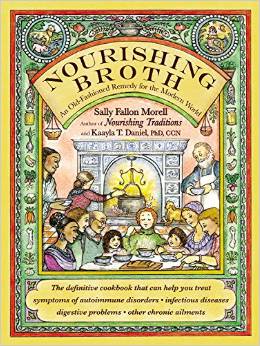 NOW, HOW TO MAKE YOUR STOCK AS NUTRITIOUS AS IT IS DELICIOUS (Check out the book at the right by Sally Fallon and Kaayla Daniel):
- Never use aluminum stock pots – aluminum has been strongly linked to health problems. (More about that in a future post. For now you can Google it if you're curious.) I use Stainless Steel.
- Don't be afraid of using sea salt in your cooking. Even some with high blood pressure are able to use sea salt with no problems. And good quality sea salt is full of beneficial minerals.
- TRY to use good quality meat and bones to make your stock. When animals are raised and fed well (pastured, not in confinement!), it's a no-brainer that their meat and bones will have more nutrients. Chef Glenn may disagree with the grass-fed part, because I think they even advertise that their beef is grain-fed. I believe this is known as being very flavorful. But good flavor can be found in grass-fed as well, and it's MUCH better nutritionally.
- Don't be afraid of butter! This one doesn't relate to broth so much, but when Chef Glenn said in the class that he uses a lot of butter in his cooking (which is one reason why he's a great chef!), he said it a bit apologetically. Butter isn't the bad guy it has been made out to be. Don't let what “they” have told you about butter and other healthy fats stop you – always use healthy fats in your kitchen! In big restaurant kitchens, cost may prevent them from using only healthy fats, but in your own kitchen it is a MUST for good health. (Read the bolded links for more info.)
- The best, most beneficial stocks (nutritionally) are those that, after cooling overnight in the fridge, have the consistency of jello – so don't freak out if you see this – it's a good thing! If you're making stock for health reasons, you may want it to be more concentrated (more boiled down) to reap more health benefits from the gelatin. Read more about this in Part 1.
Don't boil the stock, just keep it on a low simmer.
- You should always add a splash of raw vinegar (I use Raw Apple Cider Vinegar) to your stock when you begin boiling, as this will draw more minerals out of the bones. NOTE: I just found out that once you get the water and vinegar in with the bones, you'll draw many more minerals from the bones if you let it set like that for an hour before heating it up. Grrrr, I've been making stock for years and didn't know this!
- Filtered water is best. (Where to buy water filters.)
- Which bones to use? This is what Sally Fallon has in her “Broth is Beautiful” recipe: “About 4 pounds beef marrow and knuckle bones, 1 calves foot, cut into pieces (optional), 3 pounds meaty rib or neck bones”. There may be something special about those bones, but I just ask for *any* bones (or use whatever bone is in the cut of meat I'm making for dinner).

WHAT TO DO WITH YOUR STOCK:
So you've got your quality bones, your Mirepoix, your splash of vinegar and water in your pot. When you're done boiling (see times above), strain it well. Chef Glenn uses a very fine strainer for a clear broth, but if you don't have a fine strainer, your broth just won't be as clear – not a big deal in my kitchen, but for some it's important. After it cools, freeze in baggies or in ice cube trays – never put hot foods near plastic! (After the cubes freeze, toss them into baggies for smaller amounts to use when sauteing veggies, or in anything you want a little extra flavor and nutrition – I can't remember who gave me that tip, but thank you!) Now use your stock for soups, stews, when cooking rice, with noodles, or anytime you're making a white sauce. (Sometimes if I don't have enough stock for my recipe, I'll also add some organic stock to it from the store.)
WHAT DID I MISS? Do you have more tips to share about making stock, or other ways you like to use it? Comment below!
- More about how to make stock and details on making chicken noodle soup
- I recently updated my French Onion Soup post with info from Chef Glenn – he gave some good tips on making it as tasty as they do at Reds. (I love how he's so open about how they do things there!)
- A useful Kitchen Tip from Jeanne for making vegetable stock
Because I like to ramble… here's more you might like…
- Our “thank you” dinner at Reds
- Reds is in this neat building in downtown Rockford, the Promenade, designed by my friend, Robert, and it's right on the river in a beautiful setting.



Peggy Lippold Gates says
Kelly the Kitchen Kop I love my Instant Pot for one hour broth. Any concerns about not being able to skim the initial foam that is supposedly full of “impurities” according to WAPF? What I read on the internet is that it’s just proteins and the only concern is aesthetics. Gathering various inputs on this. 🙂
Jill-David Boman says
Personally, I rarely bother with skimming the foam.
Jennifer says
Just curious what your thoughts are on homemade chicken broth that was left out all night? Is it safe as long as I reboil it for 15 minutes? Thanks!
KitchenKop says
Wellllll Jennifer, I can’t tell you what to do or what is “for sure safe”, because I don’t know. All I know is that I MAY have been known to forget and leave it out all night, and then just boil the heck out of it in the morning and we’ve been fine. But you may want to research it some more to be sure!
Kelly
Edward says
SusaJayne I lost two batches of stock so I went mad dog in my quest to find out what was doing it. My freezer looks like a arctic wasteland. Sometimes I take old plastic liter bottle and fill them with water and freeze them. I put them in the pans to help cool the stock down. Also with winter coming up what I do is take the cooling pans and make an imprint in the snow. Then fill them with the stock and put it in the snow. I know it seems like what I am doing is a lot but it takes me a whole day to make stock.
SusaJayne says
The cooldown may seem unimportant but it is key from a food safety perspective. Do not leave it on the counter or put it in the fridge in the pot. Even the freezer is not safe if you have any other food in there that will thaw (plus it wastes electicity). Put the whole pot into your sink and fill around it with cold water and ice, being careful not to splash any water into your stock. Leave it uncovered, stir occasionally, and change the water/ice to keep as cool as possible. Within an hour your stock will be nice and cool and you can put it into individual containers and refrigerate or freeze right away.
Edward says
Here is a MAJOR tip. After I make the stock and strain it and put it in the fridge over night to infuse the flavors. Well I noticed after a day little bubbles were forming and the stock went bad. Long story short. I put the stock in the fridge in a covered pot and took forever to chill down. Now normally stock simmers at 140 and when it hits 90 until it gets to 40 it is the perfect media for germs. So what I did is put the stock in a casserole pans and put them in the freezer until it hits 40. Then I transfer it into a clean and cool pot and put it in the fridge.
T-van says
I think I am going to use my crockpot.. have everything to go… making the beef broth plus with veggies…
How long and what settings are recommended.. my bones are fairly big?
I was thinking starting it up on low but just not sure from there..
And how much vinegar is recommended? I am using a big crockpot
KitchenKop says
Literally just a splash… Maybe 1/8 – 1/4 cup?
Low for many hours is good. 🙂
Kelly
Edward says
I know on chicken and beef you let it simmer for a long time but I don’t simmer turkey that long. It seems to pick up another flavor I don’t like. Let me explain. I take turkey thighs and necks. After the thighs are cooked I pull them out debone then and put the skin and bones back in. Then I let the necks and such simmer for a while. Usually it makes a rich stock in about 4 hours.
Commenter via Facebook says
I use veg scraps which just add more nutrients as far as I know.
Commenter via Facebook says
Sounds like I’m doing it right, except I don’t usually add the veggies. The veggies are just for extra flavor, right? Also, beef broth is only overnight? I thought it was up to 72 hours for that one.
Commenter via Facebook says
@ Melissa Nienhuis Boersma – I have the one she said was lead-free, Hamilton Beach I think.
Commenter via Facebook says
Ambyrhawke Shadowsinger – I usually let it cool on the stove top for a while, or in the winter, I set it on the deck.
Commenter via Facebook says
Kelly – which crockpot do you have? Not sure if mine is lead-free or not. I have the BIG Cuisinart one.
Commenter via Facebook says
Melissa Nienhuis Boersma – I have the lead-free crock pot, so I’ll still use it for my broth, it’s super handy.
Commenter via Facebook says
Jill Nienhiser – I wasn’t letting the bones sit with water and vinegar for an hour before turning the stove on.
Commenter via Facebook says
Corie Fritz Layton SERIOUSLY?!! Guess I need to crack that book open even if I *thought* I knew how to do a recipe! LOL!
Our Small Hours says
Oh, wow! So much good stuff about making broth! Thanks for sharing.
Commenter via Facebook says
You should buy the book ‘sauces’ by james peterson-perfect every time and gives various techniques for all bone broths and all sauces derived from them. Awesome.
Commenter via Facebook says
Thank you everyone for all the info. I am cut and pasting this conversation for my recipe records. Very good topic!
Commenter via Facebook says
I’ve found something that makes stock much better than veal…beef feet. think bout it there’s more gelatin in those hooves for a delicious stock then there is in plain bones…just saying.
Commenter via Facebook says
I always add lovage to my stock, gives a wonderful flavor and adds extra minerals and most of the time I use bay leaves too and leeks, especially with chicken broth. The lovage is very important and really makes it tastier, this winter I had just enough in my freezer, when I ran out, my lovagein my garden just started growing again:-)
Commenter via Facebook says
You’ll know that your stock/broth is ready when two things happen – First – the bones crumble when you try to break them (this means that all the collagen is gone from the bones and into your stock), Second – your stock sets up like Jello when you chill it overnight. If your bones are not crumbling and your stock is not gelling, you are either not cooking it long enough (12 hours is the minimum), or you are not using too much water for the amount of chicken scraps that you are cooking. I had been making homemade “bone broth” for 20 years before reading NT and the part about soaking in vinegar. I imagine this speeds up the process a bit, but extra time in the pot will work as well. I wouldn’t worry to much about any arbitrary maximum time. I just let mine go until the bones show me that they have given their all.
Commenter via Facebook says
Yeah that’s how I made my stock using the recipe from Bauman College of Holistic Nutrition and Culinry Arts: I did roast at 400 degrees for about an hour to brown the bones, then let the bones soak in cold water with 1 Tbsp Brigg’s raw apple cidar vinegar for 30 minutes, then use a slow cooker to simmier for 48 hours, adding Mirepoix at the last hour or two. I have tried both with or without roasting bones and I will tell you the flavor is way much better when you roast the bones. I also have tired using neck/kuckle bones (what the butchers call the “stock bones”), or marrow bones. I found that there is very little, if any, gelation from the marrow bones, but very gelationous from the stock bones. Marrow bones contain a lot of fat though.
Commenter via Facebook says
I can’t seem to find Part 1 in search ??
Commenter via Facebook says
You shouldn’t let the stock cool in the fridge though. It raises the temp of the fridge to dangerous levels and doesn’t cool the stock quickly enough. Instead, put the stock pot in the sink and fill the sink with ice water to the level of the fluid in the pot. Stir often so that the hottest liquid in the center of the pot is dispersed to the sides to cool. I learned that from the latest volume of the Culinary Institute of America’s “Professional Chef.”
Commenter via Facebook says
Well said, Amy!
Commenter via Facebook says
I think the concern with crockpots is that some contain lead, and that the vinegar would cause leaching. There was an excellent article a few years ago about this very thing in Wise Traditions. You can go to the WAPF website and type it in the search box to read the article. There was also a follow-up article. This is not just an issue with crockpots, but also stainless steel pots. It just depends on the quality of the pot. The article concluded that you could switch to a basic enamel pot for stock, or that you could research crock pots and find one that is lead free. I THINK Hamilton Beach is lead free but I am not sure. GNOWFGLINS uses a crock pot for a continuous pot of stock, so it might be worth checking with Wardeh to hear her thoughts on it. Soaking the bones in vinegar before bringing the stock to a boil is *the KEY* in making a nutrient dense bone broth because that is the very process that leaches the important nutrients out of the bones and into your stock. It is specifically included in the recipe in NT for chicken and beef broth. It also says that you should cook the stock as long as possible, for a minimum of 12 hours to a maximum of 24 hours.
Commenter via Facebook says
How long should you cook chicken bones when making broth? It says overnight so I’m guessing 8-10 hours?
Commenter via Facebook says
I don’t see any mention of crockpots in this post ?
Commenter via Facebook says
Question: was he using raw bones?
Commenter via Facebook says
Now I must tease you. It says to let it sit right there in NT. pg 122, you know, the directions for beef stock;) pg 116 she explains why. Goofball
Commenter via Facebook says
isn’t a crockpot ok to use?
Commenter via Facebook says
I always use a crockpot. Tell me why that’s a bad thing? I’m open to learning!
Commenter via Facebook says
Yes, Kelly, tell me what you were doing wrong; I cannot tell from reading the post!
Commenter via Facebook says
I was doing 2 things wrong…..not letting the vinegar sit for an hour AND i’ve been making it in my crockpot. AH! Time to make some changes.
Commenter via Facebook says
i love making stock 🙂
Commenter via Facebook says
What was u doing? – I can’t get to the link on my silly small not so smart phone…
Maryjane says
Just FYI: the above link to Red’s called “laying flavors” is broken.
KitchenKop says
Bummer, I tried to find it but I think they took it down.
Thank you for telling me though so I can take the link out!
Kelly
Alicia says
Wow – there is so much excellent information here. I actually came to this page looking for some specific information. Namely, what organ meats can or should be used in beef stock? I see from the comments that some people are using liver. I actually have a number of beef organs because I did a cow share with a friend (using a local producer of grass-fed beef) and I ended up with a bag of bones and organs. I am a little nervous about using the organs in the stock, even though the woman who runs the farm said I should put them all in. I only see liver being discussed here. Can you give me any clear feedback on which organs should NOT be used? Thanks for this great post!
KitchenKop says
Hi Alicia, sorry but I don’t know if there are any organs that can NOT be used, but my guess is that you could throw them all in. Sorry I don’t know more!
Kelly
KitchenKop says
Not sure exactly how long it would last in the frig, we usually use ours within a couple weeks or I freeze it. 🙂
Caroline Warner says
I made broth with feet and heads on Halloween eve and felt like I was making a witches brew! I could barely look in the pot 🙂 I let it simmer all night with the vinegar and onion and sea salt and other goodies. Whole house smelled good. The guy at Farmer’s market said it made the best stock and I said I’d take his word for it but I felt a mixture of revolt and curiosity. It tasted good enough – I’m trying a broth cleanse for a couple days so it is all I”m eating. But when I got a toe (with nail) in my mouth I heaved. I guess my strainer wasn’t straining enough. OMG! Anyway it is totally gelatinous in my fridge and I’m wondering if I can freeze it in that state or if it is better to reheat the whole thing (strain again 🙂 and put in containers when it is more liquidy? I hope you get this soon. I think the gelatin lasts for a while in the fridge though too – yes? THANKS
KitchenKop says
Ooooh, that is dusgusting! But perfect for Halloween, LOL!
Yes, you can freeze it just like that (I just glob it into freezer baggies), unless you WANT to strain again, which you might want to if a nail got through, sick! (Just be sure to cool completely again if you’re using freezer baggies.)
Kelly
Caroline Warner says
thanks – I love this bloggie dealio. is the gelatin apt to be more concentrated at the bottom? Also do you know how long it lasts in that state in the fridge?
Brenda says
I’m interesting in making the bone broth, something i’ve never done. My question is this..after making the broth would I be able to can it using a pressure canner for long term storage?
I’ve just recently found your website and am finding lots of interesting information here, love it!
Thanks
KitchenKop says
Yes, I think a lot of people do that. I just freeze it, though. 🙂
Kelly
Shantell says
I only read about adding liver to stock about a month ago. I have been “hiding” turkey innards in my stuffing for years. Even my mother-in-law who swore she would know never knew until I told her. When I started making chicken stock, I naturally used the same process of finely chopping and mashing the innards, only with stuffing I use a fork to grind minced garlic into the organ meat, with stock it seemed pointless. I suppose there must be a richer flavor from the minerals in organ meat, but with so much water, it’s quite diluted. Today I’m going to use half of a calf liver just to see if the family will notice, doubt they will though, they rarely just drink beef stock. Perhaps using the stronger organ meats in this way will slowly allow our children to have small samples of the flavors introduced over and over and they will not balk at the idea of the meats or foods we are so afraid of trying as adults.
Dellaina says
Yay, the conversation hasn’t died! 🙂
I’ve got my first beef stock on the stove now. I’m a Cracker Jack with chicken, but never attempted beef until today.
My question for next time: Did adding liver affect the flavor of anyone’s stock?
Dellaina
olivia says
I’m a bit confused. When I make a soup using a chicken, bones and meat, it is always gelatinous (cooks only over 1 hour) but when I make broth just from the bones, either from a previously eaten roast or the chicken carcass I get from a farm (not cooked/roasted) it does not often gel (cooking over night). Any ideas why this is?
KitchenKop says
Normally this happens to me only on the 2nd or 3rd “run” of the bones. (I’ll boil them once, drain off the stock, and usually go again.) The other time it happens is if there’s just too much water that hasn’t boiled down enough yet…
I think there is more about this in the comments of part 1.
Kelly
Tammy Jo says
Wow! That was a fast reply! Thank you! Especially, since I am right in the middle of trying to make my first fish stock! I wish there was a camera filming this process! I am sure you would all laugh at me. I have never ever even processed a fish. I am also sure all the organs are still in there since I am not sure what is what! LOL! I will let you know how it turns out. Thanks again!
KitchenKop says
Tammy Jo, I know, isn’t Stanley awesome?!!! Thanks again for your help, Stan!
Kel
Stanley Fishman says
I always use the skin, bones, as much of the whole fish as I can get. Especially the head and its contents, which are especially rich in nutrients.
Liver and kidneys are traditional foods, which are full of nutrients. Toxins do not actually pass through or get stored in the liver. The liver creates substances that help take the toxins out of the body. The kidneys are part of the elimination system. The actual waste is only in the tubes, which should be removed before cooking. However, the toxins in any broth float to the surface as scum, which should be skimmed away and discarded.
That said, I do not add liver or kidneys to broth, because of the strong flavor they add. I have not heard of anybody using the gall bladder, which I think would add a very bitter flavor.
Tammy Jo says
I was curious if you us the skin on the fish when making broth?
Also, on a side note I am not sure about adding liver. The liver, kidneys, and gall bladder are all part of the eliminations system, which means they process toxins. It seems common sense to me that to eat any of these organs means we are more than likely ingesting toxins. Yuck!
KitchenKop says
Heather, absolutely!
Heather says
Can you can the stock instead of freezing it? I don’t have a lot of freezer space…Thanks for any answers 😉
Jessica says
I’m trying this for the first time today. While I was out, someone must have bumped the burner knob, because when I returned the pot was back up to high heat! I quickly reduced it again, but the liquid is down to about half the amount as when I started.
2 questions:
1) Does reboiling destroy anything?
2) Is liquid reduction normal?
Thanks!
KitchenKop says
#1 That’s OK.
#2 That’s to be expected, just the natural process of a liquid turning to steam as it heats. Keep in mind that how much liquid boils off will affect how gelatinous your stock is. As it boils down more it will be a thicker gelled stock.
You’ll love it!
Kelly
Jessica says
Thanks Kelly,
My stock turned out good…however, it’s quite cloudy.
After doing some research, I also that my stock was cloudy due to overboiling and possibly simmering too high.
During the first boil I let it boil too hard before skimming, therefore missing my chase to skim the majority of the foam.
Also, because it was turned back up to high accidentally while I was out (I’m assuming it was on high for a few hours!…bummer) the impurities got reincorporated into the stock.
Next time I make stock I’m gonna skim skim skim (!) – being careful not to stir – and I definitely want to make sure the simmer is on as low as it can go without turning off (my gas burners don’t have a simmer setting so it’s tricky!).
Thanks again!
Jessica
KitchenKop says
Thanks for sharing what you found out with us! 🙂
Sue says
If the stock ever “gets away from you” and reduces too much, you can always add more water and let it keep cooking. Also – the cloudiness actually happened because it boiled, not because it boiled before you got a chance to skim. The boiling water agitates the soften bones and you get particles in the water – causing the cloudiness. It’s not pretty, but it tastes just fine. There are ways to clarify the stock using egg whites, but I have never tried them.
Kelly says
Mark, thanks for all the good info, but next time it might be easier on you if you just put it all into one comment, with separate paragraphs. Just a suggestion.
Thanks again!
Kelly
Mark says
According to Nourishing Traditions cookbook Sally recommends add bones (roasted) to cold filtered water and add vineger to them and allowed to soak while you are preparing the mirepox. The combination of the cold water and vineger helps open up the cells of the bones.
Mark says
A good way of skimming off the fat that has been left behind once your stock has cooled enough to put in the fridge is to leave it in overnight and the fat will harden up enough that you can lift it right off the top of the stock.
Mark says
Katie, I have found meatloaf as a good source of hiding liver in it.
Mark says
One good point about simmering stocks overnight is to not cover them with a lid. This would help prevent the stocks from spilling over the sides of the pot and possibily causing the liquid to burn. We have a gas top as well with a simmer setting on the knob. One thing also to look out when simmering overnight is to make sure the stocks stay out of the danger zone of 40 F-145 F or when cooling them down. I have down batches of stock that have cooked for a consistent 72 hours straight. A good clean up tip: Line your stove top liners with heavy duty aluminum foil.
Mark says
There is alot to cover so I will just start at the top and work why way down posting responses to some of the questions. Jeanne very good point about using cheese cloth (unbleached) to help strain out the impurities that are left behind from the bones/meat etc. One other point that I would like to add is try using a chinoise collander (w/a stainless steel mesh) not plastic as a straining tool as well. Within the first few hours of cooking a stock you will have a crusty film (impurities) that form on the top should be skimmed and discarded. If the impurities are not skimmed off the stock with get very cloudy and have an off, almost muddy taste to it. Important step. Once the stock has been skimmed and the stock is (simmering 165 F-180 F, not boiling) then it might be a good thyme to add it other items such as (from previous posts) apple peels, herbs, root vegetables etc.
Kelly the Kitchen Kop says
Coming soon: a post from Katie (above) with the whole scoop on her sneaky liver experiment! (If you’re coming across this comment a week or two later, use the search button and put in “sneak liver” and you’ll find it.)
Kelly says
Okaaaay, you’re getting me more motivated to try this…my liver is in the freezer waiting for me!
BTW, I never get as much gelatin the 2nd time around, either, but enough to make it worth it on the 2nd go ’round – would never try 3 though…
Katie @ Kitchen Stewardship says
Phase two: I’ve now hidden liver in two different meals, spaghetti and pepper steak. I used my food chopper to chop the liver into bits, pea sized and smaller. It looked like cat food. Yuk. Not something you let your family get a visual on. I put about 1/4 cup into jarred spaghetti sauce with some homemade meatballs, and since the meatballs fell apart a little, there were chunks of meat throughout. No one noticed the difference! I added some to leftover pepper steak (meat and sauce), and it also wasn’t detected. I froze the rest, chopped, in ice cube trays, awaiting my next trickery. I’m sure you could put it in meatloaf or any casserole without anyone knowing; I think I’ll try it in turkey burgers tomorrow!
Another experiment: I read somewhere in the blogosphere recently about someone who make chicken stock, then used the bones over and over and got gelatin every time in the stock. Since this was my first go at beef stock, and the bones are not as cheap as chicken bones (free with chicken!), I thought I’d try it. I strained the stock to cool and put the bones right back into the pot, just covered them with water and vinegar, and gave it another overnight simmer. There was actually *some* gelatin content, although not nearly as thick as my first batch. I threw in some veggies and will use it as filler stock, in recipes or with rice or something, but I don’t think the flavor is good enough to actually use it as a base for soup. Interesting experiment, anyway!
Thanks for the offer of housing — glad I’m not kicked out yet!!
Katie @ Kitchen Stewardship
Kelly says
Katie, that’s a good question…seems like it must provide extra whopping nutrients to have liver in the stock, but I’ve never tried it!
You’re going to try liver with your tacos??? Oh boy, I don’t know about that one…let me know if you need a place to stay. 🙂
Katie @ Kitchen Stewardship says
OK, phase one: liver in stock = can’t tell anything scary is in there! Made some Yum-O beef/vegetable/barley soup tonight and got rave reviews. I’ve rescued the liver from the stock…and tasted it — first organ meat tasting for me!! — and it’s not nasty, although the texture is iffy at best. I’ll chop it with my food chopper and freeze in 1/3 cup portions, I think. I’ll stop back after we have tacos! 🙂
I imagine that some super-duper nutrients from the liver must be in the stock…right? If so, this is a good way to go to pump up the stock nutrition and use liver w/o getting kicked out of the home. ??
Katie @ Kitchen Stewardship
Kelly says
Katie, I’m afraid to try it, you try it first and let me know if you get it by your kids!!!
Katie @ Kitchen Stewardship says
Kelly,
What do you think about cooking liver in the stock? I’m afraid my family will revolt if I serve liver and onions, but I have some in the freezer already…and I wonder if I can cook it in my stock to add nutrients and maybe flavor (?) and then chip up the meat really small and add it in tiny portions to ground beef things like tacos or spaghetti. Anyone have any comments?
Katie @ Kitchen Stewardship
Genet says
Katie. . . .
I often add liver that I grate (frozen) up with ground beef. It stretches that ground beef and no one has been the wiser. About 2 oz is what I add to a short pound of ground beef. With the spices, no one should know. I even add it to meatloaf. Actually, I think it makes a fabulously moist meatloaf. I got this idea from Cooking with Traditional Foods blog that Karie Ann does. 🙂
Sue says
I actually just mentioned this before I saw your question. I don’t know from personal experience, but my mother always made a point of warning me not to do this (usually as she was watching me put my stock pot together after Thanksgiving dinner). She said it would bake the stock taste “funky” and “bitter”. It was never worth ruining a whole pot just to test her claim, though.
Kelly says
Whimsy, toward the bottom of part 1 you’ll see a definition with the difference between stock & broth! 🙂
FYI: I just tried following you on Twitter, but the link at your site isn’t working.
Kelly
whimsy says
I like to roast my vegetables with my bones. I keep a container in my freezer and toss in all my onion, carrot, and celery ends and pieces. Then use them up in my broth (or stock… i haven’t read the different yet) 🙂
Diane says
Kelly,
astragalus root is found in herb stores. Mountainroseherbs.com is where I bought mine.
Kelly says
Kelly & Kim, what I do is just cool it down a bit before putting it in the fridge overnight, or if it’s winter, I’ll set it on the deck overnight (covered). Then I get it going again in the morning. 🙂
Kim says
Nourishing Traditions says up to 72 hours for beef stock. Also, herbs should be thrown in for just the last 15 minutes (herbs are delicate and CAN be overdone…sounds like bones CAN’T). Mine was on electric stove on very low all weekend (while we were out and while we were sleeping). I just make sure there’s nothing flammable anywhere near the stovetop and have never had a problem. (My firefighter brother may have a fit tho…haven’t asked him what he thinks!)
Kelly says
I was just curious, how does everyone cook their stock overnight and actually sleep without worrying about burning the house down? I have a gas range, which I love, but I would not feel comfortable leaving it on unattended all night. Any tips?
Gudrun B says
Kelly, i have gas and have kept things on while either out or over night; i use a flame diffuser and the lowest setting (and make sure nothing is close to catch on fire)
SusaJayne says
Also a crockpot is great for this!
Kelly says
Jill, apple peels? Hmmm, I’ll have to try that!
Laura, good question, I hope someone else knows, because I don’t have a clue! I doubt it would be harmful though…?
Judy, what an interesting experiment! I have trouble getting gel usually on the 2nd time around!
Judy says
I like to skim off the fat early in the long cooking process. I forget why, but I like to know the fat hasn’t been cooking all night. I store this fat for frying hamburger or other lean meats. I put it in a jar and scoop/chip out what I need. I’ve tried an experiment with broth. I drained the bones and added cold water which I cooked again for hours and let it reduce a bit. It was very gelatinous. I’ve tried this 7 times on the same beef or lamb bones and got jell. I’m wondering if there is anything un-nutritious about this…..like maybe you begin to destroy something. The gelatin becomes less flavorful as I go on so I was thinking I’d use it for a jelled dessert or just add it back into a soup. I don’t always do this, but it was a science experiment.
-Judy
Laura says
Does anyone know if you can cook a stock for too long?
Jill says
I always add lots more to my giant pot – usually a whole head of garlic, a handful of peppercorns, maybe some parsely or other herbs sitting around (thyme is great), LOTS of leaves from the celery, sometimes a handful of apple peels. Leeks are great, so are green onions (esp the tops). Never add peppers or broccoli or cabbage!
I cook my chicken, turkey or beef stock overnight or for 8-10 hours.
Kelly says
Jeanne, what a lucky cat you have, and a healthy one, too! 🙂 Thanks for the ideas.
Diane, I’ve never even seen astragulus root, but if I did, I’d take your advice and toss them in!
SusaJayne says
It is dry in the herb section. You can also add reishi, a medicinal mushroom.
SusaJayne says
I mean the astragalus root! (Sorry, put my reply in the wrong place). Also, I mean the bulk medicinal herb section of the health food store.
Diane says
Great post! I find I tend to be doing more poultry stocks than beef but when I get around to doing another beef stock I’ll be sure to roast the bones first. I also like adding leeks in combination with the onions And call me wierd, but I throw in a few astragalus root slices as well. Astragalus root helps nourish the immune system. Great for this time of year when all I hear are people coughing around me.
jeanne says
Okay Kelly,
A couple of thoughts . . . I remember in a nutrion/ cooking class at college learning about roasting your beef bones before making broth, but I had forgotten this step. I am sure this would make my beef broth rich, darker, and bring out another “layer” of flavor.
Also, I can’t believe I never new about adding the splash of vinegar! (Although my kids loved to experiment and put a chicken bone in vinegar and then in a day or two it turns rubbery, I never made the connection that the vinegar allows all the “good stuff” in the bones to leech out!).
A tip about straining your broth, put cheeseclothe in your large holed colander to catch all of the bits and pieces, so your broth stays clear.
Last thought, when I am doing chicken or turkey broth, I always throw in the neck bone and the organ meat. When the broth is strained I chop up the organ meat and it is a treat for our cat.
Sue says
My mother always told me that it was okay to put the neck, kidney, and gizzard in, but not the liver. She said that the liver would make the stock taste funky. I never tried it myself, though. Also- you don’t have to go to the trouble of pre-roasting, if you just save leftover scraps from meals where you roasted meat. Save scraps until you have a pot full and then just make the broth.