
I really wanted to like more fermented foods, and fermented vegetables, but when I tried a couple recipes from Nourishing Traditions I just didn’t care for them. One was the pineapple compote and the other was fermented salsa. They both tasted like beer and I just don’t want my fruit or my salsa to taste like beer. Thankfully I didn’t give up forever. I tried Homemade Nourishing Traditions Sauerkraut last summer and it turned out really good! Next I made fermented cranberry relish – yum! (Remember these are condiments and not side-dishes, so you only need a little bit with meals to help with digestion and add beneficial healing bacteria to promote gut health and a strong immune system!)
Then at the Weston Price/Wise Traditions conference in November I got some fermented carrots and kimchi to bring home.
Oh-my-gosh, those things were DREAMY. So much for fermented vegetables only being a condiment; these became almost a main dish I ate so much. I was hooked and found myself craving them in the weeks after the conference. (Here's where you can buy fermented vegetables if you don't want to make your own.)
I decided to do a comparison, I wanted to try making my own and see how they tasted up against the ones I purchased.
For my version I used the recipe from Nourishing Traditions, only I used less salt since I’ve heard from a few sources that 2 Tablespoons was too much: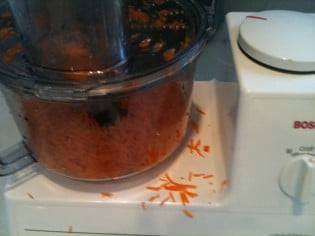
- 4 cups grated carrots (My Bosch made this go fast.)
- 1-2 T. freshly grated ginger (I like a lot)
- 1 Tablespoon sea salt
- 4 Tablespoons whey
- (See my note below about what I'll use next time.)
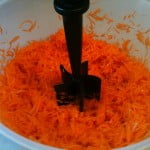
Nourishing Traditions directions: “In a bowl, mix all ingredients and pound with a wooden pounder or meat hammer to release juices. Place in a quart-sized, wide-mouth mason jar and press down firmly with a pounder or meat hammer until juices cover the carrots. The top of the carrots should be at least 1 inch below the top of the jar. Cover tightly and leave at room temperature about 3 days before transferring to cold storage.”
Isn’t that simple?
THE VERDICT?
I loved them both! And the weirdest thing happened, I seriously couldn’t get enough of any of the vegetables and decided this will be my new way to eat veggies all winter long! Over and over I felt myself drawn to the fridge for “just a little more”. I wonder if these cravings were my body’s way of getting what it needs?! (You know how that happens when you’re pregnant? Not that I AM…)
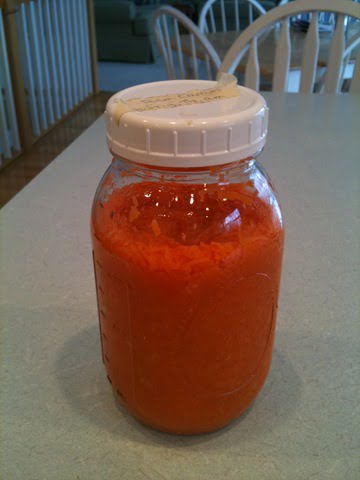
Here’s a picture of the kimchi I tried from the conference:
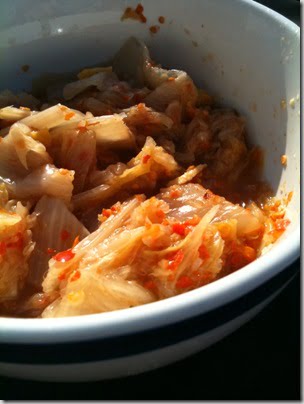 This was SO flavorful and had the perfect “bite” to it. It tasted like a spicy sauerkraut. Two of the kids ate (and loved) my carrots, but none of them would eat the ones I brought home. Again, here's where to get raw fermented veggies online.
FOOD THAT IS ALIVE
I love knowing how beneficial these foods are for my body and that unless you have health issues and need a stronger therapeutic strength probiotic, just eating traditional fermented foods is SO good for us! The living enzymes, the beneficial bacteria, all the other nutrients in the veggies, I love it.
DIE OFF? (And what I'd do if I made these again)
Something tells me that the veggies I purchased were full of more of the “good guys” because I didn’t have the same, um, reaction after eating mine. They were obviously clearing my body of some toxins. (Kent suggested I refrain from being more specific, lol.) So they’re definitely doing something better than I did. Maybe I need more whey? Or I think I’ll try using fermented food starters next time so I’m sure to get all the little beasties I need and so I can be consistent. (Click here to get a fermented vegetable starter online with more instructions there too.)
There’s no use in making just a shredded carrot salad when I can be just as easily making a superfood!
Want a video?
Here's a good video showing how to make this recipe. 🙂
More you might like:

- Try making these superfoods, they're so easy: sourdough and dairy kefir!

- Find more fermented foods info and recipes here!
- Have you tried homemade fermented soda pop yet?
- Fermented Lemonade Punch



Robin Webster says
We are new to GAPS. Literally on day 1 today. We have been drinking Kombucha for a few weeks before we went full blown today. Can we use that for our fermented liquid to introduce into our soup during this introduction or does it need to be saurkrout or pickles? any help is appreciated. Thank You. Robin
KitchenKop says
Hi Robin,
I don’t think so but I’m not sure so I’ll put it up on Facebook to ask others, watch for it there soon. 🙂
Kelly
Robin Webster says
Thank you.
Commenter via Facebook says
@ Cindy Landskron – Haven’t seen Wardeh’s recipe, I’m using mine from the link above.
Commenter via Facebook says
@ Tara Buss – thanks for the great scoop!
Commenter via Facebook says
Even fresh is ‘thready’. Just it t in pieces (I do 1/4 – 1/2 in.) and it’ll sink down to the bottom. Are you using Wardeh’s recipe? By the way, the longer you leave them, the more tender they get.
Commenter via Facebook says
I read online somewhere that it should be rock hard, smooth and not at all wrinkled. I’m so bad about identifying what really fresh ginger is though. Still learning.
Commenter via Facebook says
@ Tara Buss – I wonder how we can know when it’s too old or not at the store…?
Commenter via Facebook says
It always seemed like cutting meat to me. Go against the grain with a very sharp knife. Cutting with the grain made it stringy. Not sure I was even aware of the similarity or even noticing the way it grew till now LOL
Commenter via Facebook says
I thought ginger was always stringy. Maybe if it’s older, and tougher, then the strings don’t get chopped up as well in the food processor. Whenever I grate it by hand, I always have to grate on the small end, because if I grate it on it’s side, the strings come out.
Commenter via Facebook says
i just assumed ginger was stringy! That’s all ive ever had
Commenter via Facebook says
It’s old. Still edible but not desirable. I had one like that a while back.
Commenter via Facebook says
I always experience stringy ginger. It’s really annoying.
Commenter via Facebook says
@ Charity Dasenbrock – I food processed it, but it got so small that most just flew up on the sides, so I did the same, just pulled the “hairy” pieces out, ewww!
Commenter via Facebook says
That happens quite often. I just pull the strings out and use the softer stuff. It probably is old ginger. not bad, just old. Did you grate it or how ? Sometimes I just chop it with a knife. Because it ferments, it gets soft so doesn’t really need to be such tiny pieces as in a stir fry.
Commenter via Facebook says
Thanks—also want to ferment more veggies
Jennifer says
Darn! I wish I had seen this posting sooner! I just tried my first fermenting recipe from NT and my ginger carrots came out way too salty! I wasn’t sure if this was the way they were supposed to taste or not. After reading the posts I see now that 2 Tbsps is way too much salt. I hate to throw them out 🙁
LaurenT says
Has anyone ever gotten asthma eating fermented carrots or other fermented foods? Just ate 5 sticks and feel like I was having trouble breathing. Don’t know if its just the probiotics healing my acid reflux from my throat, chest down or panic attacks…
Kelly the Kitchen Kop says
Lauren, I’d never heard of that so I asked Simon, from Wise Choice Marketing, home of Caldwell’s Fermented vegetables, and he hadn’t heard of it either, here’s what he said, “Haven’t heard of any asthma-like reactions, but some people can experience various die-off type symptoms as a result of ingesting active and effective good bacteria.”
Let me know if you get any more clues as to what happened!
Kelly
Jeanmarie says
I’m going to try these. I followed Sally’s recipe once and it was definitely too salty.
Bob Kampman says
Hello, I just came across this page and learned a few things. I also thought I’d share some things I know, as I’ve now made a few batches of cultured vegetables on my own (last batch was 12 quarts! Btw, if you’re going to do such a large batch, expect to be busy for around 4-5 hours! whew).
First, to Kelly, I have an answer for you on your carrots (though I’ve never made CV without cabbage). You say yours was sweet, not sour like Caldwell’s? Well that is a clear indication of a lack of lactic acid — the primary (and very beneficial) biproduct of culturing. Cultured vegetables SHOULD be sour. If they are not, they are not cultured. It’s actually kind of amazing that they didn’t go bad. Either they would have if you’d have left them out much longer OR if you’d have left them out longer, they’d have cultured. With that said, I think it is imperative to use a culture starter of some sort. As I understand, this could be obtained by using a portion of a previous batch as your brine. Otherwise, you could buy a culture starter such as the very popular one offered by bodyecology.com. That’s what I’ve done so far with great success, though I am going to try and just use a bit of my last batch the next time.
One other important thing that should be noted by anyone reading this. VEGETABLES ARE NOW BEING IRRADIATED by food companies and/or grocery chains in order to exstend the shelf life of the vegetables. This destroys the bacteria, both good and bad as well as enzymes. This means that culturing vegetables in the old fashioned way, using salt, just won’t work consistently (irradiation won’t necessarily kill ALL bacteria and enzymes though it may very well. At any rate, culturing is greatly affected by this). The answer is simply to buy organic. That’s it. It’s more expensive but I think it’s well worth it.
Anyway, I love carrots and can’t wait to try this. I wasn’t quite sure if one had to include cabbage or not. It seems that every recipe for CV I’ve ever seen includes nearly half cabbage. Hmmmm… Well I’m giving it a try. I must say I get a lot of enjoyment out of the whole process — the experimentation, the wait, the occassional opening of the jar to “smell the progress”…lol..and finally the first taste of a new recipe (I give it about a week at room temp. btw..That seems to be best).
KitchenKop says
Great scoop, thanks for sharing all you’ve learned! And I’ll bet you’re dead-on, that my carrots maybe only fermented a little bit if at all, I’m for sure going to use a starter culture from now on.
Thanks again!
Kelly
shannon says
Woo Hoo. I made this today and the worst part about lacto-fermented foods is waiting 3 days. I’ve got sauerkraut, salsa and these ginger carrots and with the food processor, it is so fast. I can’t wait to try them.
My garden is just not doing that well and I’m loving lacto-fermented foods because I don’t think I’ll have enough of anything to can. I’ve been freezing some foods and also love the convenience and ease of lacto-fermenting.
virgi says
I contacted Caldwell and they suggested that I
1) put a weight on top such as a ziploc bag filled with water and maybe some aquarium stones
2) put the jars inside a pie plate filled with room temperature water (find a cool place with good ventilation as well
3) add some extra salt to help with mold
4) no mention of reducing the time,but out of curiosity I will be checking after 7 days!
5) also recommended a couple of their jars which I will take a look at
Thanks!
Virgi
virgi says
Newbie here but been fermenting for several months now. I just used caldwell starter for a pepper relish. My home is in Florida so the temp in the house has been around 78*. The caldwell starter directions say to let it ferment for 7-10 days but at a temp of 70*. Should I ferment for less time since the house temperature is higher than 70*?
(Started the recipe on Friday evening the 18th and it is now the evening of the 22nd. About an inch and a half of liquid is visible below the veggies in the jar.)
Thanks for your help! Virgi
KitchenKop says
Hi Virgi,
My best guess would be “yes” to your question, but I’m not an expert fermenter so I don’t know for sure. Maybe check with Caldwells??
Sorry I’m not more help!
Kelly
Julie @ Culturesforhealth.com says
I wouldn’t adjust the time significantly. 8 degrees isn’t a huge jump and is still within what is generally considered room temperature (if a bit on the warm side). 7 days should do the trick.
waggie says
Can you do the same thing with out adding Ginger…. While I love ginger I don’t know what they would think about it. Just don’t know if the ginger is necessary for the fermentation.
KitchenKop says
Without ginger would be fine, but then it just might taste like sour carrots. I think the ginger gives it a bit of a sweet tang.
Amy Williams says
Whoo hoo! I just tasted my first try at fermenting – your fermented carrots recipe – and it worked!! I’m not a ginger fan, so that part is kinda weird, but I’m just so excited it worked!
Kelly the Kitchen Kop says
I’ll add my “woo-hoo” to yours!! 🙂
Sheila says
Sounds like everyone has the same question about salt! What I’ve always heard and experienced is that the saltiness decreases as the fermentation goes on. I’ve had them be too salty and not sour enough after 3 days of fermentation, but if I leave them for a week or two, the flavor is much better! In any event, don’t be deceived by the saltiness in your unfermented mix … the flavor you’ll end up with after fermentation is different.
The salt is necessary to keep the bad beasties at bay while waiting for lactic acid to build up, but if you have very good whey/starter or use more of it, you may need less salt. More salt = safer, less likely to have a bad batch that you have to throw out.
Sorry to dig up an old post, but I thought perhaps that would help everyone who was wondering about salt. 🙂
KitchenKop says
Molly, I’m guessing it’s probably fine, but you may want to check with someone who knows more about fermenting. Maybe the Nourishing Traditions Yahoo group? (Google it, should be easy to find.) Or go to Sandor Katz’ site? (wildfermentation.com)
Sounds like you had some good fermentation going on!
Kelly
Molly says
I am half way through the 2 day ferment for Fallon’s pineapple chutney. The jar was leaking at the lid and I was afraid it might explode, so I opened it carefully. The fruit popped up about 1/2 an inch over the rim and I gently pressed it back in, took out some of the fluid, pressed all the fruit down (there was about 1 1/2 inches of fluid at the bottom of the jar.) I put the removed fluid back in and closed the lid tightly. Did I spoil it? Would it have exploded? Will it be safe to eat tomorrow? How can I tell?
Thanks
Kim says
Thanks for the info. Am definitely interested in making beer by wild fermentation! Thanks for passing along my Question Kelly!
Chandelle says
It IS possible, however, to make beer by “wild fermentation” rather than commercial yeasts, and this product can be beneficial like other probiotic foods. My partner has been making beer by this method for quite a while, using the methods and recipes described in the book book Sacred and Herbal Healing Beers by Stephen Harrod Buhner.
Julie @ CulturesforHealth.com says
Fermentation refers to “an enzymatically controlled anaerobic breakdown of an energy-rich compound” (according to Merriam-Webster) so many foods, including beer, definitely qualify. There are different types of fermentation though. For example beer is normally fermented using an added yeast. This is different from something like lactic acid fermentation which is how foods like yogurt, kefir, sauerkraut, etc. are fermented. So beer would be a great deal closer to bread made with commercial yeast than it would be something like sourdough. Normally when we talk about the benefits of fermenting our foods, we are discussing lactic acid fermentation which results in lots of beneficial yeast and bacteria. Beer is a bit different but certainly the process has its benefits in terms of breaking down the grains, etc.
KitchenKop says
Kim, that’s actually NOT a dumb question at all! Beer IS a fermented beverage, but I don’t think it’s as beneficial for us as other fermented foods, and I’m not sure why. I’m going to ask an expert this and see if she’ll comment here. Thanks for bringing it up!
Kelly
Kim says
This may be the dumbest question you were ever asked, but here goes: Is beer considered a fermented beverage? Cant wait for the answer!
Shelby Galutia says
Can I half this recipe and if so would I half the salt also?
KitchenKop says
Shelby,
Here is my official and expert answer: I think so.
Aren’t I helpful?! (That’s what I’d do, hopefully someone smarter will answer.)
Kelly
Sustainable Eats says
Hi Kelly, no not at all. I meant I wouldn’t make it with less salt than SF calls for. But I think that using some of the starter from your last batch will increase the number of probiotics over time. I have absolutely no proof of that other than the fact that my buttermilk starter gets stronger over time, especially if I don’t use a clean jar (essentially increasing the starter).
KitchenKop says
Annette, sorry to be dense, but you’re sure that less salt = less probiotics? Maybe that’s why I got the die-off symptoms with Caldwell’s but not with mine…?
Kel
Jeanmarie says
More salt slows down fermentation. You need enough to keep bad microbes at bay, but not so much that it’s either inedible or takes too long to ferment. I think the exact amount takes trial and error.
Sustainable Eats says
Hi Kelly,
I would just add a T of the liquid from the jar to your next batch to speed things up. I know when I don’t clean out my kefir or buttermilk jars they set up in just a few hours instead of a day and the buttermilk has explosive power in the pancakes that doesn’t just fizz up and die out. I make a double batch of pancakes each time to freeze the extra: https://www.sustainableeats.com/2009/03/22/whole-grain-buttermilk-coconut-pancakes/ which takes awhile to cook so when my buttermilk is weaker (if I haven’t used past. milk in awhile on the starter) it fizzes then dies out before I’m done. So I’m guessing the amount of probiotics increases as you continuously reuse the starter. I would follow the NT recipe as far as salt goes. BUT if it’s too salty that way you can always put the carrots on top of salad or mix it into an asian style coleslaw (I would use sesame oil & cabbage & rice wine vinegar.) That way you get all the probiotics in the carrots without it being too powerful. If you rinsed the carrots off before eating you would lose some of the probiotics. I hope that makes sense.
KitchenKop says
Annette,
So I just add the carrots and all, like a couple tablespoons or ?? from the last batch, and then just that helps the process?
And you don’t think I should use only 1T. of sea salt in this? Any more and I doubt I could eat it either, like Elaine said… And I think it would be a pain to have to add extra unfermented carrots to this every time we wanted to eat some, instead of just grabbing out of the jar…
Thanks for your help!
Kelly
Sustainable Eats says
Kelly, if you use a little bit of the last batch when you make the next one you’ll boost the good guys that have developed and speed up the process (sort of like adding the Caldwell starter).
Eileen, you can add extra fresh carrots to it when eating to cut the salt factor. I wouldn’t go below the amount of salt that SF recommends though.
Shannon says
Thanks so much for mentioning “the reaction”! When I first started eating fermented veggies and tried the grain soaking I found the reaction disturbing because I couldn’t find any confirmation that it was normal, I thought I had done something wrong. I gradually figured out that it was normal, but it’s nice to hear someone speaking openly about it. :0) The carrots sound delicious. We’ve only done a few variations of saurkraut around here and they are definitely keepers.
Eileen says
I love the fermented veggies, but continue having inconsistent results. Thank you for posting about the culture starts, I’m going to try that. I just tried these carrots and even putting in only 1 Tbsp of salt, it about puckered my mouth off my face! Is there any way of knowing how little salt can safely be added to these ferments? Also, any ideas of how to salvage this jar — what might it be mixed with to help tone down the salt but still retain the good bennies? The ginger was a really nice touch!
KitchenKop says
Sorry Eileen, but I’m not expert on fermenting. Hopefully someone else will jump in. 🙂
Kimber says
Kelly,
I’m so excited! Remember all that salsa I mentioned making last week? Well, I gave away a few quarts to friends, and kept a 1/2 gallon for home, hoping I could convince my husband he NEEDED to eat it. (He can’t even handle the smell of my cortido or spicy carrots…) Well, he has willingly eaten it the last three days in a row! Yippee!! He’s had it with his eggs & toast in the morning twice, and yesterday when he finished his eggs & realized he forgot, he actually had some with chips later in the afternoon to make up for it. Double yippee!!
I’ve also got my first batch of kombucha working. It will be ready to be bottled for the secondary ferment later this week. My hubby WANTS, yes wants, to start drinking that, too! Ah… what a successful probiotic week this is turning out to be!
KitchenKop says
I don’t have to buy it often (the plain stuff), but when I do, it’s usually Stonyfield.
Kelly
KitchenKop says
Meagan,
When I need to buy store-bought yogurt I always buy organic whole milk yogurt. No low-fat stuff for sure! But you knew that. 🙂
Kelly
Meagan says
HAHA – yes, no low fat stuff 😉 The world tastes so much better that way! And our bodies are nourished. I was more asking about BRAND, as I know to buy organic WHOLE milk yogurt. Would Stoneyfeild or Redwood Hill (goat) be best since they are unhomogenized? What brands do you restort to?
Chandelle says
Meagan, I’m using Redwood Hill goat yogurt right now – we prefer unpasteurized but our goatshare is currently dry. This yogurt is wonderful for whey because it naturally separates a bit on its own. Every time I open the container I just pour off the liquid and save it in a jar. I just used it to ferment anchovies into nam pla (Thai fish sauce). So I would say that RH plain yogurt is a good source for whey if you like that yogurt.
Meagan says
How do most of you make your whey? When I am home I strained homemade raw milk yogurt, but what is the best yogurt to buy in the store for this? I do not have access to good raw milk yogurt as I am studying at school.
Amy @ Finer Things says
You are WAY over my head with the fermented veggies. I’ll just have to trust you that they are tasty. 🙂
Kim says
Hi,
I am a rookie so be gentle! 🙂 About how long do fermented veggie last in the jar(s)? So if I am the only one who likes them in my house how fast do i need to eat them?
Alex says
Michelle, yep, you use that plain old whey–or as i like to call it the lovely elixir of life! 😉
its so simple! just drain the yogurt into a cloth covered colander and bottle the “juice” as my kids call it–then save that great yogurt cheese for something else–most times i squeeze out even more from the yogurt cheese then mix in a small amount of herbs, sea salt, pepper and a tiny bit of dehydrated garlic–its GREAT on sourdough bread or bagels! i like it way better than regular cream cheese…
and then, you use the whey to ferment your veggies!
Enjoy!
Michelle says
I’ve never fermented a single vegetable before, so I’m going to apologize in advance for the basic question, but can I just use the whey that I drain off of plain whole milk yogurt? Or do I have to get some kind of special whey?
Alex says
a note about the carrots….and any really “sweet” veggie–if you use a food processor to “grate” them, you actually are releasing a whole lot of the sweet juices, and this makes the process go very fast and thus the fermentation is kind of like a slash and burn instead of a slow build…this affects the final taste of the product…
The swiss do a lot of lactofermented carrots and vitronox (sp–the swiss army knife people) makes a special grater just for this purpose–its kind of fun to use–and it doesnt release a ton of juice–then you just pound a little and the carrots end up tasting great…you can also use a hand grater, using the big holes, or a salad shooter using the big holes…
sweeter veggies need the salt to make sure that the process goes slowly…cooler temperatures will also make it go slow…
to start with fermented veggies, the easiest is probably the sauerkraut–or kim chi…i think its also easier to get used to the taste because they are not sweet veggies and the tang isnt as distinct as when using a sweeter veggie…
🙂 i like to make sauerkraut mixing red and white cabbage–it turns pink!!!
Martha says
Thank you, Kelly. When I am able to order that accessory, I’ll be sure to go in from your site. I do that for Amazon now. 🙂
Musings of a Housewife says
I’m intrigued. My doctor (found one who uses holistic methods!! so excited!) advised me to eat lacto fermented veggies as condiments but I got skeered off by the salsa I tried. I don’t particularly care for carrots so I was afraid to try them but I might try to make this. It doesn’t taste vinegary at all?
Jessie says
I do not find it to be vinegary myself. It doesn’t take a lot of special equipment to try it & carrots & ginger are pretty cheap. So maybe it’s worth an experiement to you to try the ginger carrot recipe?
The temp affects the ferment a fair amount. When it’s hot (like in the summer & over 80), the ferments can be extra ‘zippy’.
When I first had the lacto fermented ginger carrots I found them a little strong, but they grew on me & I did like eating them better with other things & not by themselves. (They make a nice “salad” combined w/raw apple for example).
Good luck!
KitchenKop says
Jessie, that is just a quart size Ball/Mason jar in the pic, but I do use old pasta sauce jars or whatever for lots of stuff too.
Kelly
Jessie says
I have just made the fruit chutney (using apples) from NT and the turnip recipe & both are good. Fruit chutney started out spicy, but seems to have mellowed a bit in the fridge.
Question – Kelly it looks like from the picture you used a non-mason jar. Did you do that? I’m wondering because I have some other glass jars sitting around that I’d like to find a use for.
I think the ambient temp plays an important role in the process. If the temp is too low, it may not work right. We can keep our house really cold & so my solution for that was to use a water bath my husband has for photo development. I fill it with water & pop the jars in (w/water below the rims / lids) and keep it at an even 75-78 degrees.
I have only used whey & it has worked for me.
Jessie says
Oh – I use salt & whey – not only whey. I was meaning to say that I don’t use starter cultures & everything has worked great.
KitchenKop says
Peggy, so you were the opposite of us, you liked the chutney and not the carrots?!
Martha, I just used the slicer/shredder. FYI: you can get to Marilyn’s site through my resources page under “kitchen appliances”, and thank you if you do go there that way as I get a little bit per click. 🙂
Julie, keep in mind that the 1 T. was for FOUR cups of carrots, but if you’re worried, definitely use 2 t. the first time you try them again! (I’d feel bad if you had another bad experience because of me! LOL!)
Sue, I’m telling ya, there’s something about these, you gotta try them!
Kate, that’s great that you love kombucha, now that I’m onto Kefir soda I never make kombucha anymore, I loooove the kefir soda. I’ve had bad luck with pickles. They get slimy and don’t stay crispy. I’ve tried grape leaves – no luck.
Kel
Kate says
I have become obsessed with kombucha (I need to get a mushroom because buying G.T. Dave’s is getting expensive!). Pickles are up next! I WANT to like fermented veggies but I’m just starting out.
Sue E. says
Kelly,
You crack me up! Fermented carrots——“DREAMY!”…..?! Either I am just not at the fermented vegetable stage yet and need to broaden my horizons, or I need to get off my sweet tooth and stop naming brownies and creme brule “dreamy”….! Ha ha ha!
Blessings on your day!
Sue E.
Julie L. says
Okay, Kelly, if *you* say so…then I will try my hand at the fermented ginger carrots again! We tried them once loooonnng ago, and unfortunately thought they were ghastly. The recipe in NT says to use 1 tablespoon sea salt, which I have been told to pare down to two teaspoons. I didn’t want to try it again after wasting all of those organic carrots, but if YOU say so…:) What surprises me is that you used the full tablespoon of salt and still seemed to like it! Maybe the extra ginger was the positive kicker…and two of your kids loved ’em, too?! Wowza!
I will try to garner up the courage to try these again. My fermented cukes (pickles) have been a hit with my son, but my daughter isn’t too keen on them and neither care for the sauerkraut. Sigh. Maybe some day…:)
I will forever remain hopeful!
🙂 Julie L.
Martha says
I hope to do some ferments this summer when we start getting our CSA veggies again. Thanks for the encouraging post on it! Do you need a special attachment to do the carrots in the Bosch? I have one, but wish I had a list that showed me what attachments to use for the all the uses Marilyn Moll shows in her catalog.
Peggy says
We didn’t care for the carrots, either, but loved the pineapple chutney (we are cilantro eaters.) I need to get more veggies going. After hearing Cheeseslave’s podcast, I’ve been considering getting some veggie fermentation starter from Cultures for Health. It never really occurred to me (even after reading Wild Fermentation) that different places have different cultures and my fermented carrots might be icky because of the little bugs that create the fermentation! It might be nice to try some culture that is tested and known to be yummy for a change. Hm…
KitchenKop says
Leah, I’m new at all this so I don’t know! Maybe someone else will jump in.
Lydia, yes! Thanks for reminding me about Jenny’s book! (Her pictures are always amazing.)
Jeanne, how neat to have a traditional family recipe to go by.
Alex, “capturing wild ferments” sounds so fun and geeky, I love it! 🙂
jeanne says
My mother in law, who is german, makes a wonderful carrot salad. I never realized that it is a ferment vegetable. She makes it a couple a days ahead and leaves it on the counter. She uses a really good vinegar instead of whey.
Thanks for reminding me of it . . . I have carrots to use up and will make her salad.
leah says
Kelly, I have a question for you or any other lacto-fermenting experts.:) I have made the NT gingered carrots recipe several times and love it. But this last time that I made some, it turned out really slimy. It tastes and smells fine so I am rinsing it off and eating it anyway, but the consistency is gross. Did I do something wrong? I followed the recipe pretty carefully, only I did cut back on the salt.
angie says
I had that happen with my last batch of sauerkraut. Somewhere on the internet I found that it was due to not having enough salt. The claim was that too little salt can allow the wrong kind of bacteria to flourish, making it slimy. Mine tasted a bit cheesy/milky too. One site said it was still OK to eat, but most said to throw away anything that is off. Sorry for no links. I google searched “slimy sauerkraut.”
leah says
Ahh, that makes sense. I have notices that the longer they sit in the fridge, the less slimy they are, for some reason. Anyway, at least they’re still edible!
lydia says
Hey just a note, Jenny over at Nourished Kitchen has a free e-book with fermented recipes that are really good and her photos are gorgeous, it’s called Get Cultured: Probiotic foods from a Nourished Kitchen. Check it out!!!
Alex says
LOL Kelly, you are so cute with your TMI comment…yes, fermented veggies can clea In you right out as they say up nawth!!! 🙂 I have loved eating and making these lovely concoctions for years before i even got involved with NT/WAP..because my granny would make them-i even have her old wooden mortar and pestle that she used for crushing the veggies…lately, i have made kimchee, sour kraut and i have a bunch of beets/turnips to ferment shortly–your carrots reminded me of the lovely carrots made like that in switzerland, so i am going to make a batch next…
you really dont need any starter to tell you the truth…but it is easier and more consistent–i like to capture wild ferments, but mashing the veggies in my bread bowl and leaving them uncovered overnight in a clean area…then add one more day to unrefridgerated fermentation–you will get great results that way if you are willing to live on the wild side 🙂
KitchenKop says
You guys are all so fun. I love it when I post on something nerdy like fermented vegetables of all things, and still get great comments from other geeks like me who like to talk about this stuff! LOL 🙂
Kimber, the cranberry relish isn’t mine, here you go: https://oceansofjoy.wordpress.com/2009/11/25/fermented-cranberry-relish-dairy-free/
Tracy, that’s why I’ve heard it might be good to go with a fermented starter, so you get more consistent results.
Chandelle, I also use my whey a lot for soaking grains. (In case you need more ideas for what to do with it.)
Meagan, you can do ferments with salt only, but I tried once and it tasted too salty, but it could’ve just been a bad recipe. Check out the wildfermentation.com site for tips. I should’ve included that link here…
Sarah, I’m SO checking out that recipe!!!
Sandy, the glass bottles are just ball jars that you can get at hardwares or big grocery stores. The plastic lids can be found in the same spots and come in 2 sizes, regular and wide-mouthed. I use them a LOT.
Laryssa, Mmmmm kim chi, now I need to go get more thanks to your comment! 🙂
Kaitlin, you big SWEETHEART. I appreciate that SOOO much.
Thanks all!!
Kel
Kaitlin Alfermann says
Hi Kelly! I appreciated your blog so much! Just wanted to stop in and let you know I’ve been buying from Amazon through your link!
Laryssa @ Heaven In The Home says
I know just what you are saying! I really crave my cultured veggies too. My kids and I made a gallon of Kim Chi about two weeks ago and now we are down to half a quart. 😉
Sandy says
Hey! I love reading your blog! I was wondering where did you find that glass bottle with the plastic lid. I’ve looked around and haven’t seen any like that around here. I’ve been searching for a while, but admittedly not too hard. Thanks!
Sarah says
I’ve been thinking of making the gingered carrots . . . might have to try your recipe! I make a LF pico de gallo salsa that I can’t keep in the house we go through it so fast, it’s on my site if you want the recipe and it has never tasted like beer, just salsa!
And I too crave the LF foods and kombucha from time to time . . . always a great reminder to listen to our bodies!
Best,
Sarah
Meagan says
Can this be done without whey?
Chandelle says
That looks so yummy! I’ve been saving the whey from goat’s milk yogurt hoping to use it in a fermented recipe. I’ve never used whey before – just salt – but I’ve never fermented anything that could be problematic given its density, like carrots. So I’m excited to try using it with this recipe. Thanks for posting it!
Tracy says
Hi Kelly, I have been waiting on your post for ferments. Just started doing them myself about 2 months ago. I have noticed every batch I do turns out different since it is usually what I have on had. Never thought about my extreme fatigue and bloated belly as some sort of diet off but you made me think. Especially since I too , keep going back for more.
Kimber says
Yay, I ‘m glad you finally made the leap to lacto fermented veggies & fruits. We haven’t tried any fruits yet, but your cranberry relish idea sounds yummy! Is the recipe from NT? If not, would you mind sharing? At the moment, I have about 5 qts. of salsa, and 2 1/2 qts. of spicy carrots “working” on the counter. Yum!