

Margarine is SO 1960's… Does Margarine in Restaurants Make You Crazy Too?
Do you ever get frustrated with how ‘behind-the-times' so many restaurants STILL seem to be these days? Thankfully, many places are finally beginning to get on the real foodie train (usually only part-way, and it's happening very slowly), but it's staggering the number of places we come across who are still completely in the dark.
I'm republising this post from 2013 because we're visiting Florida right now and went to a crab shack place. You guessed it, they only had margarine there to dip your crab in, so we took a hard PASS on that!! I really truly wanted to get up and leave, but the kids were already uncomfortable with me even asking about the butter. You'd really think they'd be used to me by now. The waitress “gets it” though. I know this because as she was walking away she said sort of under her breath, “Welcome to America...” A European restaurant wouldn't DARE offer anything so disgusting to their patrons.
There were terrible ads that pulled people in…
I saw one that said, “Tonight's the night Mrs. Ed Flynn starts Polyunsaturating her husband, with a big assist from Mazola. For years, millions of Americans have been eating a diet that is improperly balanced in terms of fats. Mrs. Flynn is no exception. Today, however, she's doing what medical authorities are suggesting. She's serving her family a balanced diet, one which includes cutting down on total calories and fat calories, and replacing solid fats with the more highly polyunsaturated vegetable oils.”
Here are two more examples…
1. A few weeks ago Kent was up in Traverse City on a mountain biking trip with friends, so the kids and I were on our own and decided to order a pizza. We had been wanting to try this new place in town because it looked to be family-owned (I hate food chains), so I used my own little “test” to see if they were any good.
Their online menu listed cheese sticks that came with garlic butter. Perfect. I called to ask what was in the garlic butter and when the gal on the phone didn't know, the owner came on. He listed off some herbs and then said:
“Margarine.”
“Margarine? Why not real butter?“
“Because margarine whips up easily,” he said.
“So does butter when it's room temperature!”
That got me a curt, “We use margarine here.”
I closed with, “OK, bummer, well thanks anyway.”
We ended up ordering from the place downtown that is more expensive but they do use real food, so it's worth it, and I'd rather give them our business anyway.
2. Another time we were with friends at Uccello's, and we only chose that place because it was right by the football game we were all going to afterward. I requested real butter for my potatoes and they didn't have any, NONE.
I don't know why that still shocks me, but it does. We won't go there again either. (They're opening a new one very close to us, too. Maybe I'll have a chat with the owner and see where it goes.)
The other thing I see at a lot of places lately…
Quite a few places are using a “blend” now of both real butter and margarine. I'm sure it's because of the cost savings, and this way they can say that it's real butter if they're asked, even though it's not. Ughhh. So be sure to clarify: “It's not a butter blend, right? Is it JUST real butter?”
The butter issue is a good little indicator for me.
Kent and I love to go out to eat for date night, and we're both foodies so that makes it entertainment and food all in one, but we just won't go places that are still so not with it that they would use margarine. The part that really freaks me out is this:
If a restaurant doesn't even know enough to use real butter, what else is going on behind the scenes in their kitchen?!
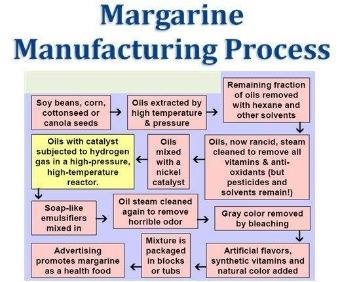
Margarine was sooo 1960's. Look at that chart above, it's obvious that it's nothing but chemicals.
Even if it makes your kids roll their eyes, don't be afraid to ask questions about the restaurants you're thinking of spending your hard-earned money at, I'm convinced that the more of us who DO, the more restaurants will get their heads of out their… join us in the 21st century.
Here's more on margarine…
My friend, Jeanne, loaned me her old nutrition textbook to look over. She knew I would find some very interesting tid-bits in there. What especially caught her eye was the definition of margarine back then…
First read the present day, more “PC” (politically correct) definition from Wikipedia:
Margarine, as a generic term, can indicate any of a wide range of butter substitutes. In many parts of the world, margarine has become the best-selling table spread, although butter and olive oil also command large market shares. Margarine is an ingredient in the preparation of many other foods. In some regions people may refer to margarine as butter in informal speech, but in several countries laws forbid food packaging to refer to margarine as “butter”. Recipes sometimes refer to margarine as oleo.
Now read the definition from her textbook, originally written in 1940. (Lots of editions since that day, so I don't know specifically when this part was added…)
Margarine is a plastic food made from one or more optional fat ingredients churned with cultured pasteurized skim milk. It is a water-in-fat emulsion and must contain not less than 80% fat according to the standard of identity for margarine that has been published by the U.S. Food and Drug Administration. Soybean and cottonseed oils, refined and partially hydrogenated to produce a desired consistency, are extensively used in producing margarines.
They even called it plastic right in their book!
AND it's made with cultured pasteurized skim milk <– click that link to learn more about why you should never ever use anything but WHOLE milk. And they don't tell you that soybean and cottonseed oils are made from genetically engineered crops, not to mention that they're highly processed dangerous seed oils that give you heart disease. Also, remember, “partially hydrogenated” means trans fats.
Doesn't sound very natural or appetizing does it? Can you see why margarine in restaurants makes me CRAY-ZAY?!
And it's not just that margarine is so gross.
Butter not only tastes better, it's truly a health food!
Our bodies need the healthy fats and nutrients in butter (and other healthy animal fats)–this is what helps your body fully utilize all of the other nutrients in your foods, and I'm convinced this is why I fall asleep easily at night and then wake up feeling great every day with loads of energy!
- Read all about healthy fats here, or at least read this: Biggest Myth in Medical History!
Stick with real butter and other healthy fats and your body WILL thank you.
Check this out–12 Reasons Butter is Better from the Weston A. Price Foundation:
1. Protection from heart disease (you read it right!).
2. Anti-cancer properties.
3. Strengthens immune system.
4. Joint health: The Wulzen or “anti-stiffness” factor is found in butter.
5. Essential to the proper absorption of calcium for strong bones and teeth.
6. Vitamin A in butter is essential for proper thyroid function.
7. Cholesterol in butterfat promotes the health of the intestinal wall.
8. The fatty acids in butter have strong anti-fungal effects.
9. Butter plays an important role in the treatment of candida overgrowth.
10. Does not cause weight gain, its fatty acids are used for quick energy.
11. Fills you up—confers a feeling of satisfaction when consumed.
12. Many factors in butter ensure the optimal growth of children.
More you might like:
- Don't know what to use instead or what ARE the healthy fats? Get my book for help with choosing the right fats to eat and cook with: Real Food for Rookies
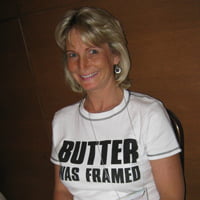
- I have you seen this one? I almost got into a butter fight.
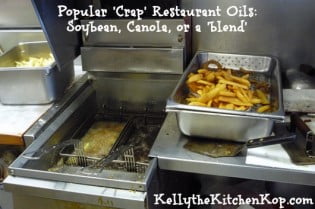
- Here's another one: I probably shouldn’t have told the Chef that he’s using ‘crap’ oils in his fryers…
- “Fast food” at home options for busy nights when there's no time to cook and you do NOT want to go through a drive-thru…




james says
In the 60s, I read a Jean Sheperd story describing how margarine users had to mix the stuff with yellow food coloring. I educated myself about margarine and refused to eat it. My parents liked the spreadability and “health benefits”. Yeah, they later died of artery-clogged strokes. I said I’d rather have a heart attack than cancer, bring me some butter. It’s hard to go to pot lucks, or friends’ places to eat, because I hate being picky. I read some waiter’s Facebook tale of going to the store for his boss to buy Cool Whip, another yucky food artifice. It’s a prime steak chain you’ve all heard of. If they serve Cool Whip instead of whipped cream, what’s sizzling in the platter with the steak? Goo article!
tina says
You know, Kelly…you might actually be on to something in the above comment when you said that perhaps you could get a few other people to call. We have a grocery chain here that is fairly well known locally ( not WF or TJ, but still well received in New England/East Coast) They have questionable ordering practices sometimes and don’t like to carry things that aren’t on their computer models for profitability. You can’t suggest to a person, it has to be in writing or on line…( guess they don’t trust their
employees to pass on such important messages). One of the employes did say that they usually wouldn’t change practices or ordering unless they had requests or complaints from 10-12 different people. Maybe if we had enough people requesting that restaurants make changes, it will get through to them.
Jennifer says
Every year, we attend the Midwest Homeschool Convention in Cincinnati and stay in the Hyatt Regency hotel. For several years in a row, I opted to pay for a very pricey breakfast in the hotel’s restaurant (their breakfast restaurant), as they touted their ingredients as coming from fresh from a local farm. For several years in a row, I was able to get a wonderful, fresh-egg omelet (gorgeous orange yolks!) cooked in real butter and loaded with lovely ham, bacon, fresh cheese, etc. and even some organic fruit.
Despite the hefty price-tag, this breakfast was critical to me, as the convention itself offers very little in the way of decent food (the best they have is a chicken caesar salad, but nothing in it I’d ever pay money to eat), and the nearest “good” restaurant is at least 20 minutes away, which means missing at least 2 sessions at the convention. They ask you not to bring in outside food (though many people do), and I struggle with the line between setting a good example as a Christian in following the convention center’s rule, and in feeding my family decently. So far we’ve just done with the breakfast, then tried to “make it” on the garbage offered at the convention until after we’re done for the day, then finish off with something we’ve brought to the hotel.
(sorry, I know this is getting long)
Anyway, this past year, I had read that the hotel was under construction on the lower levels, so I called specifically to find out if the breakfast restaurant would be open. They assured me that while its “normal location” was under construction, they had temporarily relocated it to one of the ballrooms and that it would be open for guests. So we didn’t take much food with us (just some nuts, dried fruits, a few veggies and some Nick’s Sticks). The first morning, I was horrified to find that they were charging the same price for breakfast, but only serving a slightly-buffed-up continental fare. No gourmet fresh omelets made-to-order. No oatmeal with fruit and nuts. No bacon. No hard-boiled eggs. No cream. No BUTTER! Not even when I asked…just margarine. The only yogurt was fat-free (HFCS-full) yoplait – blech!
The best I was able to do that first day was a bagel loaded with full-fat philly cream cheese and I ran back to my room for my fruits, nuts and veggies to carry around with me. I almost drove the 2-hour drive back home that night to pick up a gallon of milk, some KerryGold butter and some other food, but finally just went to Whole Foods to stock up on enough “breakfast” for the rest of our convention stay. I did complain about the restaurant to the hotel management, and they comped us for that entire breakfast (4 people). And I was assured that it would be back to my “standards” when we return in 2014.
Don’t let that scare you away from the convention – YOU SHOULD COME! I’ll even give you a personal introduction to my favorite speakers! 😉 But I’m definitely on the other side of the fence with regards to our eating when we go. Though my husband and kids seem to do okay with one greasy-burger-and-fry from the convention center meal a day, I felt awful for days after our last trip. We will be packing a FULL set of meals for our 2014 trip. Better to have to take stuff back home than end up there without it!
KitchenKop says
I do want to go to a homeschooling conference someday! I’ve been so spoiled as most of the conferences I’ve ever been to are WAPF and the food is PHENOMENAL as you’ve probably heard. 🙂
Kelly
Jeana says
Kelly. Hi. I’m local here in Ada/Greenville. I live in Greenville work in Ada. I think we get our milk at the same place;)). Anyway, I work at Nonna Cafe in Ada. Real butter, real food. We are small and just opened in May but if you appreciate real food you must visit. Scones are ALL butter and best coffee in town hands down.
Jeana says
And sourdough toast;)
KitchenKop says
I’m sooooooooo going to come there, is it right in downtown Ada? Maybe I’ll bring the kids next time we do the milk run! 🙂
Thanks for telling me, Jeana!
Kel
Jeana says
Yes. Right between the bike shop and Scoop’s on the north side of the street. 7am to 4pm kitchen closes at 3
Oregon Chris says
I tried to explain this to my sister, but she is stuck on her Margarine. YUK!
jmr says
My airline provides crew meals on longer flights. The passenger and pilot meals have a pat of butter with them. The flight attendant meals consist of a pat of margarine, a white roll, brownish iceberg lettuce with a slice of processed cheese and processed turkey on top, along with a tub of salad dressing made of ingredients that aren’t food. Yum! Even the non-foodie crewmembers won’t touch those meals. Why do pilots and passengers get butter and we’re left with margarine?
KitchenKop says
Oooooh, that must burn you up! Can you organize a big rally of complaints?!!!
Soli says
I love that I live where I do in Connecticut and that so many restaurants are ready, willing, and DO use better quality fats. I think some of it comes from the fact that historically my area had a huge influx of immigrants from Italy a century ago and retained many of their food traditions.
Allen Bennett says
There’s a place down here in Tucson called “Bread and Butter”. Three guesses (and the first two don’t count) as to what they don’t have!!!
KitchenKop says
Wow Allen, I hope you’ve talked to them about this?!
KitchenKop says
Allen, where do you live? Maybe I can try to get some others in your area to call them as well?!! Wouldn’t that be fun?