
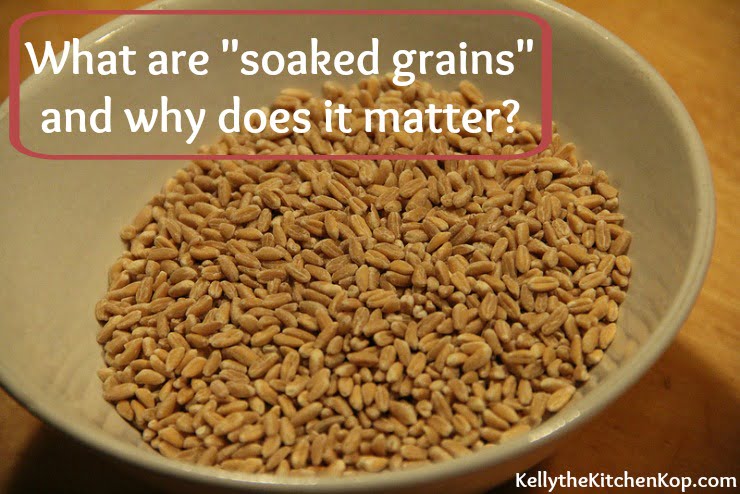
What are “soaked grains” and why does it matter?
So far I've written not only about the importance of getting alternative grains into your diet, and about why you might want to limit your grains, but I've also touched on the fact that we should try to eat properly prepared grains, so today I'm sharing more about “soaked grains”.
Properly prepared grains include sourdough breads (which I have bombed a few times on) or grains that have been fermented, sprouted, or “soaked”.

Update: See this new sourdough bread recipe post! Sourdough is the healthiest bread and you can make it using the recipe at that link, but if you buy it at the store, make sure there are no funky ingredients in there, and no yeast, otherwise it's not a true sourdough. A true sourdough bread is one that needs a long, natural rise. The only ingredients should be pronounceable and clearly recognizable. Preferably organic. I've seen some with just water, wheat flour, starter and sea salt, but others may also have apple cider vinegar too.
And have you seen this on properly preparing your nuts?
So what are ‘soaked grains'?

Many of you are probably like I was, and have no idea what I'm even talking about, or have never heard of this traditional and more nutritious way to include grains into your diet. Traditional cultures have used proper preparation techniques for their grain, nuts and seeds for centuries. In Nourishing Traditions it says that some grains were sprouted just from the way it was weathered in the field before threshing.
I've explained the “HOW” in various recipes here at my blog, like my homemade soaked bread recipe (more recipes are linked below), but I haven't yet gone into detail yet about WHY this is important.
Here is some more info for you:
- Read a quote from this site: “Grains and beans all contain an acid, myoinositol-hexa, or phytic acid. Phytic acid blocks the absorption of calcium, phosphorus, iron and zinc. A diet high in unfermented whole grains can lead to mineral deficiencies and bone loss. Although this appears to contradict all that we have learned about whole grains, it really only means that it has taken decades of research for us to get back to eating the way our great-great grandparents knew how to eat. We now understand that their process of fermenting grains and beans before eating them neutralized phytic acid. It also neutralizes enzyme inhibitors and breaks down gluten, sugars, and other difficult to digest elements in grains and beans. And these nutritional benefits don’t apply exclusively to humans. Herbivores often have as many as four stomachs, as well as an extremely long intestinal tract, allowing fermentation to take place within their bodies after they have eaten.”
- Jordan Rubin says: “Soaking and sprouting your grains, beans, or seeds prior to use is simple and the nutritional benefits are worth it.”
- Here's more about healthier grains from Sue Gregg, including how long various grains should soak (oats take up to 24 hours — here's more on oats), and also info here on the benefit of some phytates in our diets. An important note: “Just because you've switched from white flour to whole grains, doesn't mean you are getting all the nutritional value.”
- Another one: Do we really need to soak our grains? Is physic acid ever beneficial?
- One more, a more detailed article on properly preparing grains.
A few more random notes:
- When it comes to using flour in recipes, soaking grains is only necessary when using whole grains, as the phytates are found in the bran, which is taken out of white flour. (This also takes out the other most nutritious parts of whole grains, too, though.) Because of this I'll sometimes use all-purpose einkorn flour in my baked goods instead of whole grains, or at least half all-purpose and half whole wheat, because soaking grains for baked goods is tricky.
- I've read many reports about people with gluten or wheat allergies who have no problems digesting soaked grains or alternative grains besides wheat, interesting huh? Also, some who have trouble digesting grain have been able to eat Einkorn with no problem, read what einkorn is and why it's better: Could THIS be the answer to the gluten sensitivity epidemic?
Overwhelmed?
If all this seems to you like one more thing to add to an already busy life, or an already busy kitchen where you make plenty of homemade foods, then just take a deep breath and implement more when you can. (Check out these Rookie Tips, too, and remember, you're not the only one who feels overwhelmed at times!)
If you have begun using soaked grains in your recipes, let us know how it's going, and how difficult was it for you to start implementing this? For me it has been a very slow process, because early on it seemed like everything I tried tasted too sour or it flopped all together. With practice, and some trial and error, it has gotten easier, check out my recipes below and I'll keep sharing as I learn more.
Let me know how it goes as you get started with this concept!
Here are recipes using “soaked grains” or “properly prepared grains”:
- Do we really need to soak our grains?
- My original Pancake/waffle recipe using properly prepared grains
- Blender batter waffles/pancakes using 100% soaked whole grains, they're so good!
- Organic soaked oatmeal
- Homemade oatmeal bars/granola recipe
- Healthy Bread Choices – Rookie Tip
photo, Creative Commons, 2.0



Kathryn Hicks via Facebook says
I remember that we used to soak rolled oats overnight before making the porridge – the result was the most creamy, smooth and tasty breakfast. I’m not even sure that you can buy ‘rolled oats’ that haven’t been altered these days! I believe it was the overnight soaking that made them so creamy, and digestible.
Susanne Whitaker via Facebook says
Jaclyn Marra Diane Johnson Marra This is why I was talking about soaking almonds before eating them. 🙂
JK says
What I meant in my comment earlier was whether sour cream could be used as the acid medium to soak with the whole grains.
Tks
JK
JK says
Hi Kelly
Would like to check if I can use sour cream as the soaking medium for whole grains (eg oats, wheat etc).
Tks!
JK
Kelly says
Hi Becky,
Don’t do it! You’ll ruin your other appliances if you try to grind your wheat in there. Sorry, but you need a grinder.
Here’s mine and I love it: https://kellythekitchenkop.com/2008/11/nutrimill-for-really-fresh-homemade.html
Kelly
Becky says
Hi, I tried your bread and my family loved it , my son 15 asked me to make wheat bread and they don’t like wheat bread! I used oil the first time and now found the coconut oil for my next batch, but my question is I bought whole wheat “berries” but I don’t have the grinder can I use a blender or food processior to grint the berrries into flour? I also used whole wheat bread flour and regula all purpose flou but it was all organic. thanks I love your blog! Becky
Kelly says
Hi Elisha,
Forgive me for not having any specific advice for your question (lots of comments I’m going through before my eyes fall shut!), but what I would suggest for saving more money overall is this post:
https://kellythekitchenkop.com/2009/03/nourishing-frugal-healthy-meals.html
There you will find MANY good links to different posts JUST on eating frugally, and I’ll bet there will be some info specific to stretching your meat dollars.
If you do find anything to help you specifically with your meat question, will you post it back here in the comments?
Thanks!
Gracyn says
Isluci I’m out of lgeaue here. Too much brain power on display!
Elisha says
Ok, I am venturing into properly prepared grains, and I enjoy them in as much moderation as possible, but one thing that really makes it hard to get away from things like “soaked” oats in the morning, lentils at lunch or PBJ on something like ezekiel bread, barley or rice in soups, is that I need budget stretchers. More meat and fresh veggies = higher cost. My husband and I are living in socal on only 42,000 dollars a year for reasons I won’t go into, and struggling financially. Neither of us are over weight and we don’t really have to “try” and lose weight, but I would love to learn how to incorporate more meat in a thrifty way. I make my own chicken stock, which is “supposed” to stretch your meat further for soups and such, but any other suggestions would be great. I am really picky about the meat coming from free range, grass fed, and organic sources, which only makes the price higher… sigh. Are there cheap cuts of meat, that can be prepared in tasty ways? I’m trying to learn. Thanks for any ideas or tips.
Kelly the Kitchen Kop says
Duh! I just found out why “comments” wasn’t showing up here – I had accidentally clicked comments off for this post – sorry everyone!!