
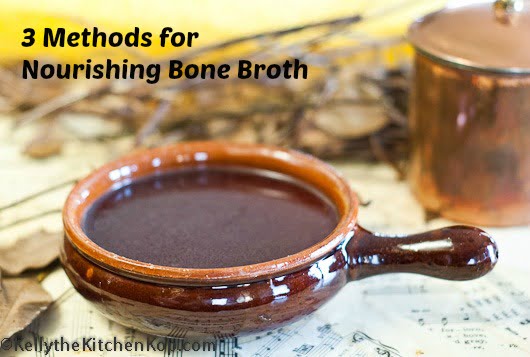
How to Make Bone Broth: nourishing bone broth recipe for rookies (3 methods) — plus see below for what to use it in!
Just don't think you'll make it? Want some on hand for when you're really crunched for time? Get some of this bone broth — it's 100% grass-fed with a bunch of gelatin, organic ingredients, it's in glass jars and it's shelf stable! I love keeping their beef and chicken broth on-hand for quick recipes because they make it just like I do here, and without the nasty msg-like ingredients, additives, or preservatives that store-bought has. Also see my newer post here for more info: Bone Broth Benefits and What’s Wrong with My Stock?!
Here's a super quick explanation on how to make bone broth:
Add chicken, beef or pork bones plus veggie scraps if you have them and a splash of ACV to a pot (ceramic is best). Simmer/don't boil for a few hours, skim any foam that comes up in the first little while of cooking. (It can give it “off” flavors if you don't skim, but I forget most of the time and it's still good!) Sometimes I do this in a crock pot so I can leave it on as I'm running errands or whatever. Once it has simmered a few hours, strain it and season it up however you'd like. Sea salt, pepper, garlic powder, onion powder, little thyme powder, anything you prefer!
Then either drink it, add it to recipes, or cool completely and put it in baggies for the freezer. I know, I hate using plastic too, but I only use it once it's totally cool, and they're easy to store in there that way. If I'm running out of freezer space, I'll simmer the broth down even more and make a concentrated broth that takes up less room, and I can just add more water later when I'm using it in a recipe or whatever.
Scroll down for more great info and good details on 3 ways to make broth, but first, a little back story…
 My friend, Jill, and her husband, David (pictured here), recently found out that his sister Leana has lung cancer, and their world was rocked as you can imagine. I've been blessed for a couple of weeks now to watch these two real foodies jump into action, and do all they can (even though they're many states away) to help Leana battle this disease. Neither of them are the type to blindly follow mainstream advice, and they research everything in-depth. Thankfully Leana and her husband are open to alternative options, along with the radiation and upcoming chemo. They even went to a Naturopathic doctor recently, to learn more about how to support her body in every way possible in the coming months. Here's another post about incorporating natural options along with conventional cancer treatments.

Soon Jill and David are packing up and heading out to help them as Leana begins chemo. Below is an email Jill sent to the family in the meantime on how to make bone broth.
I've added a few of my own comments in italics. Here's Jill:
So, everyone bear with me, because I can't help delving into the deep, nutrition-oriented recesses of my mind…
One of the things we learned when Hannah (their daughter) was on her allergy-healing diet protocol (which focused on gut health), is the value of something called “bone broth” for soothing and healing the gut lining. From all we've read, we've learned that chemo is rough on the gut, and with the intense antibiotic therapy Leana's been on, this could be helpful right now for that, too. I just wanted to throw this out to everyone because, 1. I'm not there right now to make it, which is driving me crazy, and 2. It's really easy, so I wanted to share the how-to's, that way if anyone is inclined to do so, they could add it in with their meal preparations.
Bone broth is broth made from the bones–especially bones that have joints in them–from chicken, turkey, beef, and even pork or fish — I usually just make chicken and beef broth myself, unless it's after Thanksgiving. 🙂 You can make it with a whole chicken including the meat (or meaty beef soup bones, ribs, oxtails, or a combo), OR you can save your bones from chicken, turkey, and beef ribs/other bony cuts (or get bones from a butcher). The joints and connective tissues are loaded with collagen and gelatin, which, when dissolved in water, is extremely soothing to the intestinal tract, and actually helps to rebuild a damaged gut. Bone broths have a lot of great nutrition as well (like dissolved minerals from the bones and nutrients from marrow) that is very easily digested and absorbed.
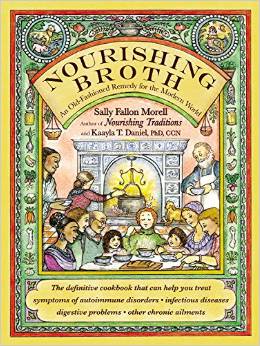
Here's a link to a great article, including recipes on how to make bone broth (but I think my crock pot way is easier). Also, check out this book by Sally Fallon and Kaayla Daniel: Nourishing Broth. Or read my review of that book here.
-
Nourishing Bone Broth Recipe Method #1 (crock pot method with the meat):
Place a whole chicken, chicken parts, or meaty soup bones (with meat) in a ceramic slow cooker like this one. Add a couple tablespoons of this apple cider vinegar (the acidity from the vinegar pulls minerals out of the bones and into the broth) and cover with cold filtered water.
Add a teaspoon of sea salt (or to taste), some peppercorns if you want, and a cut up onion or two, a handful of smashed or chopped garlic cloves, one or two carrots and celery stalks (use organic celery though since it's on the “Dirty Dozen” list–the produce items with the most pesticide residue). The veggies are optional, but it adds flavor and some nutrition. The most essential parts, though, are the meat with the bones, vinegar, and water.
Turn the crock pot on low and after it starts simmering, skim the gunk that forms off the top. (Sally Fallon says this gunk is from larger molecules – impurities, alkaloids, and large proteins called lectin, which could give the soup strange flavors.)
Leave it for 12-24 hours — 24 is best, but I've found that if you debone the chicken/soup bones by 12 hours or sooner and set the meat aside/refrigerate for later, returning the bones, skin, and connective tissues to the pot, that the meat itself will have a better texture and flavor–use the meat for soups, stews, enchiladas/taco salads, meat salads, etc. Beef bones can actually go longer than 24 hours–up to 3 days. If you want, you can add a bunch of fresh parsley or fresh carrot tops (related to and tastes just like parsley) during the last 10 minutes, for extra flavor and minerals. I rarely remember though.
Strain the bones from the broth and there you have it! You can use the broth in soups, sauces, and other recipes, or simply drink it.
(If seasoned well this is a nice hot drink on a cold afternoon, especially when you MIGHT have already had enough coffee for the day… But the KEY to making it taste dreamy at this last stage is in your seasonings! Add sea salt, pepper, garlic and/or onions — fresh or dried powder, fresh herbs, just play with it and see what you like. Still doesn't taste good? Add more salt!)
Depending on how chicken is raised, you may end up with a lot of fat on the top of the broth–which is kind of gross when it's a lot–if that happens, just skim most of it off (easiest to do once it's cool). Pastured chickens will have the least fat.
-
Nourishing Bone Broth Recipe Method #2 (crock pot method with just bones):
Using just bones/or the carcass from chicken/turkey with the meat removed (the leftover part that normally gets thrown out)…
Whenever you eat meat/chicken with bones, save the bones in a ziplock bag in the freezer. When you have a bag full or almost full, make broth. Of course if it's an entire chicken carcass, that's plenty for a pot of broth.
Put the bones in the ceramic crock pot like this one, along with a couple tablespoons of apple cider vinegar and enough cold, filtered water to cover. Add salt/pepper, and veggies if desired. (Kelly here: I throw veggie scraps in a baggie into the freezer whenever I'm chopping onions, garlic, celery or carrots, then when I'm making broth, I toss some of this into the pot. It adds flavor and more minerals to the broth.) Turn it on low and let ‘er rip for 12-24 hours. Strain bones. Voila: instant broth. (If you're in a hurry, even after a couple hours you'll have some good broth, but just be sure to save the bones and add more water to boil them again later to make more broth.)
-
Nourishing Bone Broth Recipe Method #3 (using a big pot on the stove):
Instead of a crock pot, use a soup pot (never Teflon and best not to use stainless steel as the metals could come into the broth, I love this one) and use the same basic instructions above, or follow the basic instructions at this link. Just simmer on low for a few hours. (Kelly again: I keep mine partially covered while simmering, but you will still need to watch it and add more water now and then. I've ruined a few batches by letting it boil down to nothing without realizing it, grrrrr…)
Here's a video I did about making super nourishing bone broth (plays after the ad):
A few important notes:
 * When Hannah was on the GAPS diet (which is not recommended for cancer patients, by the way), it was actually recommended to drink some bone broth with every meal to improve digestion. But as often as remembered is great, of course. (If you want to heal allergies, behavior issues, or other auto-immune disorders, Get the GAPS book here or even better is this entire GAPS beginners kit – it's no longer on sale, but it's still a great deal. This diet is for any type of healing! Also you may want to read: Gut Health 101: 6 Questions and Answers About A Strong Immune System and the GAPS Diet.)
* Bone broth freezes really well, too. (After cooling completely I use ziplock baggies labeled with the date so I use the oldest first.) If you freeze it in glass jars, though, just leave a large amount of head space, so that when it freezes and expands, it doesn't bump into the jar's shoulder and break. Refrigerate first, before freezing, and leave the lid loose until it's totally frozen. Here's an article on freezing liquids in glass jars without breakage.
* If it congeals when it cools, that is an awesome thing–it's an indication of the presence of lots of gelatin. If it doesn't congeal, that's fine–it still contains gelatin (and much better quality than Jello!), as well as all the other good stuff. Also, you may notice that chicken bones will become kind of soft and some of them may even fall apart in places (like the ends)–that's because the minerals that were in the bones are now in the broth. (Right where we want them!)
(Want more of the beneficial pastured gelatin? Use this brand, just sprinkle it into your broth and whisk!)
* If you use beef soup bones, the flavor with be much improved if you actually brown the bones first in the oven. Just put them in there on 350* until they brown up–about 30 minutes to an hour. Then add them to your crock pot. (I rarely remember to do this.)
* Bone broth is not called “Jewish penicillin” for nothing. Really, this stuff is extremely soothing and nourishing when TLC is in order. It also happens to have large amounts of amino acids that we typically don't get a lot of in modern diets because it is no longer common to “use the whole animal” in cooking. So it fills a nutritional gap as well.
* Bone broth makes a great cooking liquid. For example, quinoa or rice tastes MUCH better cooked in broth than it does cooked in water. Plus the broth enhances the digestibility of anything its eaten with. (Much like healthy fats!)
* If you make fish broth, choose a mild-tasting, non-oily variety of fish, and try to include the heads if possible, because the thyroid gland is in the head, and it will infuse the broth with lots of natural iodine. Also, fish broths cook more quickly–if you decide to make it, maybe see the attached info/recipe link above.
* Often you can get 2, and sometimes even 3 runs of broth from your bones, especially if your first run was only 2-4 hours.
It's me again (Kelly) – who wouldn't want these two in your corner if it was YOU diagnosed with cancer? Thanks David & Jill!
One more option: Click here for how to make FAST bone broth in a pressure cooker!
More links to look over:
- Again, if you don't want to make it, or want some on-hand for when you're really crunched for time, try this bone broth — it's 100% grass-fed with a bunch of gelatin, organic ingredients, and it's shelf stable. I love keeping their beef and chicken broth on-hand for quick recipes because they make it just like I do here, and without the nasty msg-like ingredients, additives, or preservatives that store-bought has.
- Part 1: Health Benefits of Bone Broth / Homemade Stock (Beef, Chicken, Turkey, etc.) – my original post on why to make it.
- Part 2: How to Make Delicious and Nutritious Homemade Stock / Bone Broth – my original post on how to make it.
- Also, if you just want to add more beneficial gelatin to your stock (or if you want to use it to make homemade jello!), you can also get this gelatin from pastured animals. I also use it when my 2nd or 3rd run or so of stock isn't as gelatinous as the first. Or to add extra nutrients to any soup, sauce or stew.
If you have anything to share about how to best support your loved ones (food or supplements or whatever!) when battling cancer, please comment below, and I'll add it to my upcoming post along with Jill and David's info.



Lisa says
Hi Kelly thanks so much for posting this about bone broth, I’ve made it in the past without skimming the top after A few hours and noticed it tasted weird, so now I will try your way and skim after A few hours. Is there A limit on how long the bones can stay frozen before making the broth? Also which Cod liver oil do you recommend, and have you used 100% black seed oil, it has some amazing benefits. Happy New Year to you and your family. Again thanks for all the good info you share. LB
KitchenKop says
Hi Lisa,
I don’t think there’s a limit to how long bones can be frozen before making broth, but if you leave them too long they may make broth that has a bit of a freezer taste to it. I’ve left mine a year or more but really try to use them before they’ve been in there 6 months or so.
No I’ve never used black seed oil, I’ll have to look into that.
As for CLO, here’s a post about the three I recommend: https://kellythekitchenkop.com/which-cod-liver-oil-should-you-take/.
Hope that helps!
Kelly
Yvonne Kelley Gipson says
Just made a second crockpot full of bone broth today from my second turkey…it was fantastic! 🙂
Jill-David Boman says
Making mine now!
Hannah Rae Boman says
I put a few jars in the freezer this morning!
Mary Ann Berning says
I couldn’t agree more….!!
Kelly the Kitchen Kop says
Emily Darling Will you tell me more about the ginger & the curry?!
Emily Darling says
Absolutely! 🙂 I buy a few pounds of fresh ginger root and put it through my juicer, then pour it into ice cube trays and freeze. When I feel a bug coming on, I put a cube in a mug, add the juice of half a lime, a dash or two of cayenne, and a heaping tablespoon of raw honey. Add hot water and drink it down. Two to six mugs a day chases the nasties away! I got the original recipe from Stephen Buhner’s book, Herbal Antivirals. HIghly recommend that book and his book, Herbal Antibiotics. It has honestly worked for me every single time, and he prescribes it for the flu as well.
Emily Darling says
As for the curry, that is my own concoction. 🙂 I saute about a pound of ground meat in coconut oil in a stockpot (chicken, turkey, beef, lamb) until brown, then add a large onion, finely chopped, 6-8 large cloves of garlic, minced, 6-8 thick “coins” of fresh ginger, minced, a couple of 3″ long turmeric roots, minced, 2 ribs of celery, diced, a whole red pepper, a whole green pepper, a couple of heaping tablespoons of curry powder, plenty of freshly ground black pepper, and salt to taste, a few teaspoons at least. Continue to cook until the veggies soften a bit, then add a variety of chopped vegetables to fill the pot. I usually use a combo of winter squash, zucchini, yellow squash, green beans, peas, cauliflower, kale, and cabbage. It varies, depending on what the store has or what I have on hand. MIx it all up, cover, and cook a bit longer, stirring occasionally until the veggies give up their juices a bit. Then I add a container of coconut cream, a can of diced tomatoes (or fresh ones if I have some in the freezer from my garden), and sometimes a can of pumpkin meat. Top it all off with a quart of so of homemade stock of any variety….beef, poultry, or lamb. Stir to combine, bring to a boil, cover and simmer on low for several hours (until your house smells like an Indian restaurant). I freeze in individual serviings so I can reheat as needed. You can add extra coconut milk and ground cayenne to your bowl before you eat. This is guaranteed to get your sinuses running and soothe your throat plus warm you up!
Emily Darling says
Yes! I try to always have several jars of broth in the freezer as well as some cubes of fresh ginger juice and some nice spicy curry to relieve congestion.
Allyson Bossie says
what do you freeze it in? plastic bag or canning jar, or?
Jill-David Boman says
I freeze mine in canning jars. Just be sure to leave space below the “shoulders” of the jar (where it begins to narrow) for the liquid to expand when it freezes to prevent the jar from breaking. I’ve been trying to avoid plastic when I can.
Allyson Bossie says
Jill-David Boman Thanks. I always wonder. Last few times I actually canned it, but that seems a bit of a process to drink some broth 😀
Jankniz says
I use an electric pressure cooker to make my bone broth. The entire process takes about an hour, and I get the most beautiful, clear, gelled bone broths with incredible flavor. I leave the bones whole because I like to CAREFULLY chew on them and suck the marrow out myself. (Throwback to my cavewoman days, perhaps).
When someone is ill, I freeze bone broth in ice cube trays and bring them a big bagful of the cubes, with a promise to replenish as needed. This means that the patient can easily and quickly have as much or as little broth as desired. I have gotten more compliments on my broth cubes than any other thing I have done for someone who is ill. Since I never know if someone is restricting salt or not, I don’t salt the broth but always remind people to salt to taste.
SL King says
I am glad for people who have had grest success with their own version of alternative but to bash Gerson snd Buryknski while holding up Wikipedia and Sloan Kettering shows a great deals of ignorance. Gerson Diet has saved hundreds of thousands of people, many of whom allopathic meficine had already given ip on. It is a strict program many choose not to follow, but he was murdered for his cures.
I found that rather upsetting.
.I just had a client have her tumor msrkers drop to almost non-exsistent ising soursop/graviola.
There ar hundreds of cures for cancer that have been repressed.
Karen Marie says
I have been making bone broth, chicken and beef, since receiving Nourishing Traditions for Christmas several years ago. But I have a question to ask everyone: I followed the instructions to add vinegar (I’ve tried white and apple cider vinegar) and I feel they give the broth an “off” taste. I still make the broth, but omit the vinegar. My last pot of beef broth, made from bones from a local farmer who raises grass-fed beef, looked like 16 quarts of beautiful beef jello after being strained and cooled! Any suggestions on how to avoid the odd flavor would be much appreciated as I feel I am not getting all of the mineral benefits from these great bones.
Peter says
The following study showed that adding an acid (such as vinegar) has no appreciable effect on the release of minerals (salts) from bones during broth-making:
R. A. McCance, W. Sheldon, and E. M. Widdowson. “Bone and vegetable broth.”
One practical interpretation might be that it is safer, quicker and more beneficial to make a quality vegetable broth (simmered for 1-2 hours) that has some gelatine added towards the end of cooking.
KitchenKop says
Hi Peter,
I’m not sure if I believe that study, though. The kids and I have done experiments before with chicken bones in apple cider vinegar, and it doesn’t take long for the bones to get soft and break down due to the minerals being pulled out of them.
Kelly
KitchenKop says
Karen Marie,
I wonder if you were just using too much vinegar? I use only a little splash, and it smells at first, but I put the lid on and after it boils a while there’s no more taste or smell of vinegar at all. Be sure to season it with plenty of garlic and onion and sea salt and pepper and other goodies to make it smell and taste delicious!
Kelly
SL King says
I make broth lots…but I left my chicken in for 24 hours…it was inedible…it tasted horrid.
What am I doing wrong…
josh lev says
(I roast the chicken first, and simmer, not boil, also carrots, onions, pepper, ginger, at least)
Jill says
Also, debone the chicken when it’s falling off the bone, but long before it’s cooked to smithereens. Sometime between 4-6 hours maybe. Just put the bones and everything else back in the stock to simmer more, but set the meat aside in the fridge for later use. That will help the flavor and texture of the meat tremendously.
Josh Lev says
Not sure how much of the marrow actually comes out of the bones unless you crush them.
So I crush them.
First I simmer the chickens and other ingredients for 24 hours, then pull out the bones & cool them & whack. Then simmer for another 12-24 hours…
Heather says
Yes — you can totally cook chicken bones that have been previously frozen. I often roast a chicken and save the bones after we are done with the meal. I just throw them in a bag and into the freezer. Then when I’m ready, I pull it out and make stock — no need to thaw.
Another idea to use with the bone broth is this:
https://www.foodrenegade.com/tom-kha-gai-thai-coconut-soup/
I usually increase the coconut milk so it’s more like 1/2 cup coconut milk for every 1 cup broth, and I reduce the lemon juice by about half. There is something about this particular soup, so full of gelatin and good fats, that makes me feel like a million bucks. It might be a good thing for someone struggling to maintain calorie intake, as many do when on chemo.
Best of luck to Leana.
I
Tigrablack says
JUST COMPLETED CHEMO MYSELF for stage 4 metastatic breast cancer- I had extremely good results with a combo of real food & standard treatments. The docs kept asking me ” what I was taking” during treatments since I held up very well internally and externally. It took 3 full months of weekly treatment for my hair to actually start falling out, and average is the 3rd treatment. Nutrition certainly makes a difference- but be careful….
Please do not fall for Gerson Therapy or Dr Burzynski-or basically anything with clinics based in Mexico- they are dangerous therapies with a high death rate, much higher than conventional treatments. Soursop/Graviola fruit does not cure cancer & can even be toxic in large amounts- I had to research all this stuff myself just a few months ago and I didn’t have time to play with BS therapies as I had it in 5 places already. There are tons of ” natural/ alternative” therapies out there that are just not effective and or worse, scams. Please research VERY carefully: https://en.wikipedia.org/wiki/Alternative_cancer_treatments#Ineffective_treatments
What has been tested by Sloan Kettering: https://www.mskcc.org/cancer-care/integrative-medicine/expertise
What I did: Bone broth galore in lots of stews & soups. Raw grass fed milk – especially yogurts with fresh fruits. Einkorn flour baked goods/pasta only- Totally chemical free diet, only natural sugars and very little of them. Chemo will affect the whole GI tract from day 1. The longer you go into it the more important “easy to digest” stuff is. I focused on veggie & meat, fresh fruit smoothies with coconut water. As you go, often your taste buds will change- when this happened, my body rejected the taste of carbs of all kinds and anything sweet.. actually my taste STILL hasn’t fully recovered from that yet (I’m 3 months off chemo). To delay this, swish multiple times daily with sea salt & baking soda- will also prevent mouth sores. Please add anti inflammatory herbs turmeric & ginger, fresh if you can take the taste, if not, dried or powdered and add to each meal. Coconut oil & fermented cod liver were ok’d during chemo so I stayed on those. I did not take many supplements during chemo, as you want the cancerous cells to die off rather than be protected- but now that I am off that I am also taking Reishi, and antioxident blends, as well as probiotics to heal the gut damage.
Nail & hair damage can be lessened with Biotin.. check to make sure any vitamins etc do not interfere. Sometimes my docs are a little ” vitamins aren’t going to help” but every one I have tried- always as a side effect combatant, did make a visible difference for me, so, hey, try it.
Best of luck and I hope healing occurs as well as it did for me!!
Abby Beale says
Not sure if this will come through but I must take issue with the comment about “not falling for dr Burzynski”. I had the honor of meeting him and his wife in September at the wedding of a friend’s daughter who was cured by him. Her wedding date was actually seven years to the day of her diagnosis of an inoperable glioblastoma. She went to the u of Michigan for std chemo and radiation for a year after the initial diagnosis and they said they couldn’t do anything more for her and sent her home to die. That is when they found dr Burzynski and she participated in his phase 2 FDA sponsored clinical trial on antineoplaston therapy. This doctor has been dogged by the FDA and the pharma industry for the last 30 years that he has been treating AND CURING cancers. There are actually paid “skeptics” who are funded by big pharma to bad mouth him on the Internet and call him a quack and charlatan etc. this is so wrong. Aren’t we supposed to be curing cancer? Do you want to speak to people who have actually been to his clinic and treated by him? My friends live here in frankfort mi and would welcome your questions. They know why their daughter is still walking the earth. Stop being sucked In by those who are threatened by someone who has a cure for disease that brings in so much profit by not curing it. Abby Beale
Abby Beale says
After reading this post I realized you may want to tell them about a book that just came out by a traverse city holistic md whose husband had a rare sinus cancer ten years ago and is happy and healthy now. It details everything they experienced and also gives tons of great nutritional information on helping the body combat the effects of standard treatments. It’s called The Good fight by Katherine Roth and Greg Holmes. It’s on amazon. Another thing I would highly recommend is dr Burzynski’s clinic. I don’t think he is able to use antineoplaston therapy but he has been way ahead of the pack with gene targeted therapy.
Jill says
That book (The Good Fight) looks awesome! I think I might have to get that one!
auna says
Hi there! How long does the bone broth last in the fridge once it is completed? Thanks!
Jill says
I’d say a week at most, but really, if you’re not going to use it within a few days, it’s very easy to freeze, and so handy later when making a sauce or recipe to have it already made in the freezer. I freeze it in all sizes of jars, from 1 cup to 32 ounce. size jars to accommodate different amounts needed for different recipes.
Jessica says
Another great resource for cancer treatment is Max Gerson’s book, A Cancer Therapy – Results of Fifty Cases. They have a website, as well – http://www.gerson.org. The phone number is 1-888-4-GERSON.
Best wishes for a speedy recovery.
Domini says
Here’s a question: If chicken bones have been in the freezer for a while, will they still cook up okay for bone broth?
Soli says
I’ve never had a problem and it’s the only way I make up broth.
Martha says
Dr. Campbell McBride actually says to NOT do GAPS if you have cancer. But it looks like they plan to use stock for helping to heal the gut after chemo which is a totally different scenario.
Jill says
That’s correct. Not doing GAPS in this case, but just taking a tool learned when we did it and applying it here as a healing food. She is on an anti-inflammatory, Mediterranean style diet, as prescribed by the naturopath.
KitchenKop says
I just clarified that in the post!
jeanne says
How timely… I am making chicken broth today to replenish my freezer stock.
Although I have been making broth for decades, I have a question for you and your readers.
Can I freeze and reuse the bones?
Also, couple of years ago when I had a severe blood issue with anemia, I drank broth everyday for a couple of months to help in the healing. Now when I feel extra tired and run down, I make a point of have a cup of broth. I freeze it in 1 cup batches for quick and easy access.
KitchenKop says
Hi Jeanne,
I don’t know why you couldn’t freeze and reuse the bones, we’ll see if others have anything to add, though…
Kel
Jacqui says
I just skimmed through the above article because I’m good with making bone broth. I also did the GAPS diet for 4 months so I became an expert at bone broth and we still have it occasionally when I feel like it. The GAPS diet did not help me heal at all and I left that diet depleted as well as really CRAVING grains 🙂 and just to eat normally… as well as suprisingly needing gut healing. I had runny stools as a consequence of GAPS and also found myself with extremely dry skin and cracked heals. I have not fully recovered yet but am certainly MUCH better by refeeding since April 21013 and raising my body temps using Matt Stones advice. I have a consistent bowel movement at the same time every day and it is fully solid and very delightful to pass haha!! I’m very skeptical of using the GAPS diet on someone with cancer… Just wanted to share that so your friends can also think about it. I certainly would be doing as much reading as possible on the subject too. http://www.180degreehealth.com might not be what everyone wants to hear and it might not be presented in the most ideal way but that guy certainly has some good proven info on human health.
MrsD says
Thanks for the different point of view:) Always a good thing!