
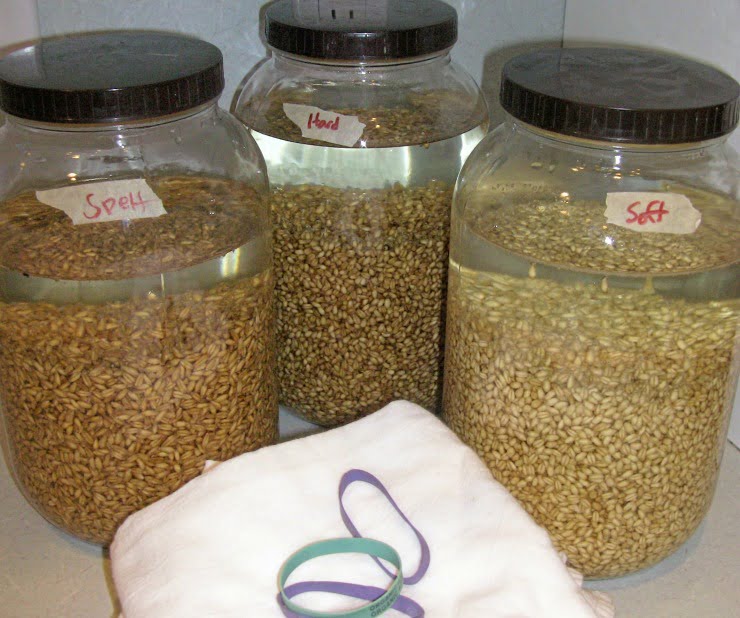
Well, there's no denying it now, I've officially turned into a weirdo. The other day when I saw the first white baby sprouts popping out of my grains of wheat, I was positively elated! I couldn't believe I did it. It didn't take as long as I expected and it was pretty simple, too.
WARNING: this is probably not a post for beginners.
All this would have freaked me out early on. If you feel yourself becoming overwhelmed, just head over to the Rookie Tips and implement one at a time as you can. You can come back to this later. Remember, it's all a process! I know I say that a lot, but I remember how it felt early in my journey toward healthier eating, and I want those readers to know they are not alone! Just think – I've been a freak about what we eat for almost 5 years, and I'm JUST now sprouting grains for the first time… But if you've been at all this a while, or if you're just curious, keep reading…
Part 1: Today I'll cover WHY you may want to sprout your grains (it's worth it!)
Part 2: Next you can read about HOW to sprout your grains(But if you just don't want to go there, here's where you can buy sprouted flour here.)
 See the cute little baby sprouts?
Why should I mess with sprouting grains?
A previous post explained why properly preparing your grains by soaking or fermenting is so important. But what can you do when you haven't thought ahead to soak your grains (happens to me often) and you need flour for various last minute recipes, or for those recipes that don't come out well with soaking? In those cases you can sprout your grains, then grind into flour to have on hand – I keep it in the freezer so it retains more nutrients, and try not to grind too much at once. Or you can buy sprouted grain flour, but it's very expensive – it's much more economical to do it yourself, and it won't take long to recover the cost of a quality grain mill.
Why are sprouted grains healthier?
There are some great explanations on the web about why sprouting grains is so beneficial, here is a good excerpt:
Sprouting radically changes grains by:
- Changing the composition of starch molecules, converting them into vegetable sugars, so the body recognizes and digests sprouted grains as a vegetable.
- Enzymes are created that aid digestion, complex sugars are broken down which can eliminate painful gas, and vitamin and mineral levels increase.
- Sprouting neutralizes potent carcinogens and enzyme inhibitors, as well as an acid that inhibits absorption of calcium, magnesium, iron, copper and zinc.
Just learning all that was enough for me. I'd love to hear your thoughts. Do you sprout your grains? Do you think it's easier to sprout your grains or soak your grains?
Don't forget, if you don't want to do any of this, but want the benefits of sprouted grains, you can buy sprouted grains or buy sprouted flour at those links!
Now jump over and read about HOW to sprout your grains.
- Pancake/waffle recipe using sprouted grains
- Experimenting with 100% whole grain recipes – blender batter pancakes (this is one of those recipes you do need to think ahead for)
- Check out the update to this Crème Brule recipe – I simplified it big time!
- I also simplified my cinnamon roll recipe
- Making 6 loaves of bread AT ONCE in my Bosch
- Why cod liver oil & coconut are SO beneficial in our diets!
- Find out how all these readers use coconut oil
- 4 tiny tips for beginning runners



Lynne Ninas says
Ok I’m convinced that sprouted grains are better. But, how do you go from the sprouted wet mess to flour? I have the nourishing traditions cook book and she says gring the wet mess, but my grinder won’t accept the wet stuff. I don’t think that nutrimill will either. I hear all the time about the benefits of soaked and sprouted grains but I need some simpler more complete instructions. Can you help?
KitchenKop says
Lynne,
Walk me through your steps so far so I know how best to help you.
Kelly
Rachael says
So I have been searching on line but kind find anything about feeding sprouted grains and beans to babies. Sally Fallon says no grains, even if soaked to babies under 1 year. But what if they are sprouted? Then they are a vegetable and easy to digest right? Therefore good for my baby? This is my reasoning, does any one know anything different?
KitchenKop says
I’m not sure, but I think these are still not that easy for babies to digest, and if you serve those, probably best would be just small amounts. Focus more on healthy fats, soft meats, fruits & veggies with plenty of butter, cod liver oil, liver, breast milk or whole raw milk, etc. 🙂
Hope that helps,
Kelly
marcee says
I used sprouted soft wheat flour for cookies, muffins, pancakes, and such. Sometimes half white/half sprouted w/w. But you do have to remember, if you use all sprouted (in my opinion), the result will be more crumbly , aka, lots of crumbs and the table and floor 🙂 I’ve tried to use sprouted grains for bread and tortillas, what a mistake!! Never turns out. And such a waste! I just go ahead and do soaking for tortillas and bread, and leave the sprouted stuff for on the spot cooking (cookies, brownies, bisquits, ect.) By the way, Rami Nagel, of “Cure Tooth Decay” does reccommend sprouting AND soaking to get the most of the yucky stuff out of the bread. Although, that may be 1 too many steps for me, I would just rather try to eliminate bread a little more often. I don’t want to spend 100% of my time in the kitchen 🙂
Lenetta @ Nettacow says
Whoa. Fascinating! I linked to this and Part 2 on my weekly roundup last week and am just now (yikes!) getting around to commenting. Thanks so much for sharing!
KitchenKop says
Jo-Lynne,
Don’t worry, it’s a lot to wrap your brain around!
You sprout your whole grains the way it’s described in part 2, then dry them well, and THEN you grind them into flour. Now you have sprouted flour on hand for last-minute recipes! The homemade bread recipe you are referring to is one that I start the night before with UNsprouted flour. (Since I don’t always have sprouted flour on hand.)
Kelly
Musings of a Housewife says
Yeah. I’m officially overwhelmed. So where does grinding your wheat come in? And can I soak the wheat for my homemade bread to make it absorb better? I need to check out your bread recipe again, I guess. 🙂
KitchenKop says
I just remembered an email exchange I had recently from Jenny at Nourished Kitchen:
“Hey Kelly –
You’ll know if your grains have been malted because they’ll give off an almost roasted smell after drying. They also tend to be much darker and more brittle than regular grain with an appearance that borders on the shriveled. I should send a pic of malted grain vs. regular sprouted grain.
If you bake with malted grain (aside from a tablespoon or two), the bread will be sweet and gummy and won’t rise well. No matter how long you seem to cook it, it will never seemed cooked through. I’ve made the mistake more than once! The good news is that malt can make a FANTASTIC dough enhancer and can contribute a beautiful dark brown color to your finished loaf so if you’ve gone and malted your grain, go ahead and grind it. But set it aside and use it very sparingly (1-2 tbs per loaf).
Take care –
Jenny”
KitchenKop says
Gramoni,
I haven’t had trouble with this but probably because (sadly), I’m still at about a 50/50 ratio of white flour to sprouted flour in my recipes, just to keep it tasty enough to get by the family. (Depends on the recipe, and in some things I get more whole wheat in.)
Maybe someone else can share their experiences with sprouted flour?
Kelly
Gramoni says
I have always had the same problems with sprouted wheatberries that Marci describes above. I know Sally Fallon says you can do the necessary soaking in the berry stage (before grinding)instead of the flour stage , but how does she (or anybody)figure that soaking the berry WON’T turn it into bulgar, which everyone knows is useable only as a cooked grain or ground as an additive to white flour recipes? What does the soaking do to the wheat to keep it from rising? Sprouting grain ahead of time is much more time-economical, I think, but it simply has never worked for me in making anything baked that I wanted to RISE with either yeast, baking powder, or baking soda. Has anyone had success with rising? What am I doing wrong? Only thing I can think of is that there is a magic number of hours, beyond which the grain becomes so saturated it loses its “riseability.” And that is really ignorant speculation…
Kelly says
Marci, such great scoop, I’ll try my recipe with your adaptations next time.
Thanks!
Kelly p.s. Youza, girl, you’re really going for it! p.s.s. Yes, soaking sprouted flour is very redundant.
Marci says
Hey Kelly,
Well, I guess I’m now an official weirdo too! And then, being the freight train that I am, I went from making “No-Knead” artisan bread last year (ciabatta made in a fish poaching pan is my speciality) to purchasing a Bosch Universal mixer (cherry red on ebay, baby!), sprouting my own wheat berries and baking sandwich bread all within the past 2 weeks!
First attempt: I used Marilyn’s recipe (UrbanHomemaker) for sandwich bread and soaked the flour in whey. The texture was OK, maybe a little gummy, but the sour taste was rejected by all. Not even toasting and thick slabs of dairy fresh butter could mask the horribleness! 3 loaves straight into the trash.
Second attempt: I used white and red berries (50/50) which had been lovingly sprouted, carefully dried and ground into flour to make my tried and true No-Knead ciabatta bread. I had to use quite a bit more yeast to get any action in the first rising and even then, it still came out as flat as a flounder…super sweet and yummy tasting but you couldn’t really call it “bread.” Ate half of it anyway.
Third attempt: I used your soaked recipe (adapted from Shauna’s) and changed as follows…I used butter instead of coconut oil (less expensive) and I used 2 eggs. I soaked 4 C. of whole weat flour in kefir and water overnight as directed. Before baking, I added the 3 C. white flour and used 1.5 C. of my sprouted wheat flour for the spelt or alternate grain. (My thought was that soaking sprouted wheat flour would be redundant, no?) In any event, it turned out great! I like that the bread is soft but it still seems to be a little on the gummy side – like small wads of it would make great ammo in a lunchroom. We have devoured 2 loaves – must make more soon.
Question: Has anyone successfully made a yeast bread using 50% or more sprouted wheat flour? I do not find the sprouting/drying/grinding process too laborious – I’ve just heard that it is difficult to make yeast breads using flour from sprouted wheat.
P.S. Banana bread made with 50/50 sprouted wheat flour/white flour was also delicious.
Kelly says
Hi Joy,
I don’t use whey at all when sprouting, I just get them wet overnight, then drain, wet again, drain, etc. throughout the day. Keeping them moist is what makes them sprout.
Where did you see that about using whey?
Kelly
Joy says
Just saw that it’s usually a 2c./4tbsp. ratio. Does the ratio change with different legumes?
Joy says
Do you sprout your grains and legumes in water with whey added? If so, what is the ratio of whey to water?
Ginny says
Thanks for the great sprouting info! I’m currently eating about 75% raw food and I love to sprout. But I also love to make bread, so I’m going to follow your sprout/dry/grind/bake process.
Isn’t sprouting a magical process. Starting with a few seeds and ending up with a jar-full of incredibly delicious little baby plants. Watching your pennies is always important, but even more so these days. And sprouting is a great way to get the most from your food dollars, both financially and nutritionally. Thanks, Ginny
stephanie says
Hello! I have just started sprouting grain, but I did read that you could use a coffee grinder (much cheaper!) to process your dehydrated grain into flour. I did my first batch of wheat and put a small amount into the coffee grinder and it worked perfectly. I only did a small amount because I want to wait until I am ready to make the bread before I grind it, but it looks like it could do about a cup at a time. So now I have about a tablespoon of my first sprouted grain flour in my freezer. *cheers for the weirdos!*
Kelly the Kitchen Kop says
Geesh, Andrea, I think you’re way ahead of me in the sprouting game!
-No, I don’t weigh it out, but I probably should, as I can see me bombing a few recipes down the road otherwise.
-Haven’t tried it with homemade bread yet (I’m soaking hard wheat berries now for that), but I made pancakes the other day with sprouted flour and they were great! No changes to my normal recipe, which I’m posting tomorrow…
-Haven’t made noodles yet, GIRL, you’re good. 🙂
Kelly
Andrea says
Hello! Thank you for the post! Now I know what I have been doing wrong in my attempts to sprout! Also, we have a nutrimill, and I had been wondering if you could grind sprouted wheat if you dehydrated it enough…now I know! 😀 I do have a question about using sprouted flour, though: We weigh out our flour for all our recipes (4 oz for a cup of soft white, and 5 oz for a cup or hard red), I don’t know if you use a food scale or not, but if you do, do you notice a difference in the weight of a cup of flour after soaking and dehydrating?Do you notice any differences at all in cooking bread? If you make homemade noodles with it, do they last as long in the cupboard or would you have to make them up right before using?
Thank you for the great info!
Kelly the Kitchen Kop says
Hi Erica,
I’m impressed with your relaxed attitude – I need more of that. No rush if soaking is working well. 🙂
Amy,
I don’t know the answer to that, but I don’t think so. Anyone else know? I THINK in small amounts you could use a coffee grinder, but I’m not sure. Or just borrow my grain mill!
Kel
green mom for Jesus says
I can’t wait to try this!
Do you have to have a grain mill to grind up or can I use something else less expensive?
It’s great to be a food geek, isn’t it?
Praise Jesus for His work in you sharing good nutrition with everyone!
Peace,
Amy
Erica says
I’m still a soaker, it’s worked out good so far. All in due time 🙂
We try eating as few grains as possible in the first place but sooner or later, I will try sprouting 🙂