
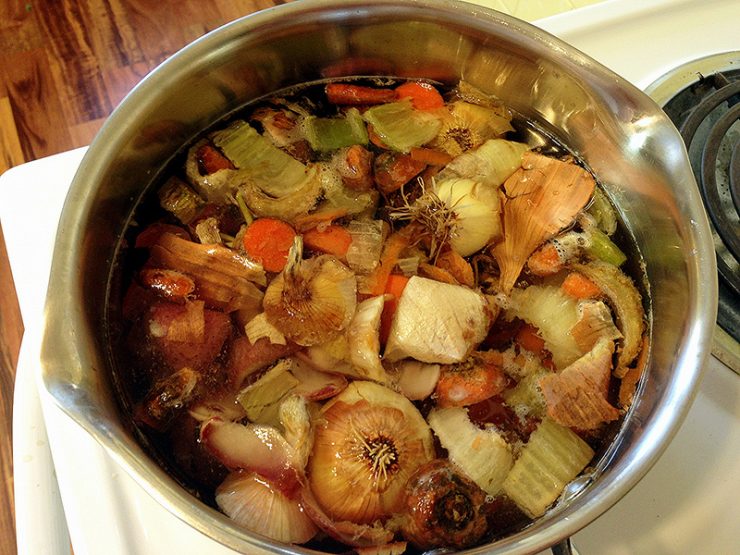
Today in part 1, I want to tell you WHY you would want to go to the trouble of making beef or chicken stock (or turkey, veal, etc.), and I'll also tell you about all the health benefits.
In part 2, look for HOW to make it, how to freeze it, etc. ***Or check out this newer post: Nourishing Bone Broth for Rookies.
(If you just don't think you'll make it yourself, you can order it online: Organic free-range & grass-fed bone broth.)
Also, if you just want to add more beneficial gelatin to your stock (or if you want to use it to make homemade jello!), you can also get this gelatin from pastured animals. I also use it when my 2nd or 3rd run or so of stock isn't as gelatinous as the first. Or to add extra nutrients to any soup, sauce or stew.
What's the big deal with homemade stock?
Once you learn all the health benefits, not to mention how great it tastes, you'll want to add it to everything you make. I put it in all my soups or stews (the aroma will just beg you to dip your homemade bread into it!), in my rice, with noodles, or in anything with a white sauce, and of course I use it to make gravy, but this is after letting it boil down. (Add your favorite ways to use it below!) I now know how quick and simple pressure cooker broth is so I can make some mineral-rich broth more quickly in a pinch. If you just don't think you will make it or want some on hand for when you're really crunched for time, try this bone broth — it's 100% grass-fed with a bunch of gelatin, organic ingredients, and it's shelf stable! I love keeping their beef and chicken broth on-hand for quick recipes because they make it just like I do here, and without the nasty msg-like ingredients, additives, or preservatives that store-bought has.
- “Science validates what our grandmothers knew… Stock contains minerals in a form the body can absorb easily—not just calcium but also magnesium, phosphorus, silicon, sulphur and trace minerals. It contains the broken down material from cartilage and tendons–stuff like chondroitin sulphates and glucosamine, now sold as expensive supplements for arthritis and joint pain.” From “Broth is Beautiful” by Sally Fallon Morell
- “The French were the leaders in gelatin research, which continued up to the 1950s. Gelatin was found to be useful in the treatment of a long list of diseases including peptic ulcers, tuberculosis, diabetes, muscle diseases, infectious diseases, jaundice and cancer. Babies had fewer digestive problems when gelatin was added to their milk. The American researcher Francis Pottenger pointed out that as gelatin is a hydrophilic colloid, which means that it attracts and holds liquids, it facilitates digestion by attracting digestive juices to food in the gut. Even the epicures recognized that broth-based soup did more than please the taste buds. “Soup is a healthy, light, nourishing food” said Brillant-Savarin, “good for all of humanity; it pleases the stomach, stimulates the appetite and prepares the digestion.” Also from “Broth is Beautiful” by Sally Fallon Morell
- From Cheeseslave at the post on the Health Benefits of Bone Broth: “The gelatin in homemade bone broth helps the lining of the intestine. Many of us today have leaky gut, diverticulitis, Crohn’s and other intestinal problems. By helping to strengthen the gut walls, this also supports immunity. It also strengthens digestion which helps you absorb more nutrients.Gelatin also helps people digest milk and dairy products.”
- Bone broth supplies amino acids that help the body detoxify.
- It supplies nutrients to help those with joint discomfort.
- Note: If you have any bone or joint issues, you may want to avoid nuts and grains for a while (since they're high in mineral-blocking phytic acid), and drink lots of bone broth!
Please comment below: What other recipes do you use your stock in? Have you experienced any health benefits?
- I use this grassfed gelatin when my 3rd run or so of stock isn't as gelatinous as the first. Or to add extra nutrients to any soup, sauce or stew.
- Read why in the world I recently put chicken FEET in my broth. Yes, it was sick, as these pictures show.
- Want to know the definition of stock vs. broth from Wikipedia? (I didn't know, either, but I use the words interchangeably, even after I read this, I still say it wrong!)
- How to make homemade chicken noodle soup
- “Good broth will resurrect the dead”/”Grandmother knew best”: Sally Fallon's article on the benefits of well-made stock
- Great info on healthy stocks for those that want to know more (I found this link through Bryan's site, thanks Bryan!)
- Interesting read about how an Amish butcher farm makes huge batches of stock to sell.
- Kimi talks about not letting anything go to waste – never toss bones out without making stock first!



Cam says
I can say I’m one of those people who had experienced the benefits of drinking bone broth. I’ve been drinking Au Bon Broth and it helped me with my joint pains and sleeping problems. Now I became more energetic because of it.
KitchenKop says
Thanks for sharing that Cam!
Kelly
DeeDee Wilson says
I have been making ‘burnt bone’ stock for well over 40 years. I even recall Jeff Smith, the Frugal Gourmet before his sex scandal did an entire show on the subject. I roasted two turkeys on Thursday, and disassembled it down to the carcass. Skin and fat got toasted to render the fat and make Happy Hour snacks, the carcass — bones, gristle, bits of meat, and everything else not specifically removed (white and dark meat separated) went into a large skillet and toasted at about 400 degrees until the bones were a beautiful golden orangey brown. Those went back into the roaster, set over two burners on the range. Celery, onions, carrots. Unlike the author, I use 1:1:1 on the onions carrots and celery. It has been simmering now for about 4 hours, and I’ll let it go for another 4 or 5 or 6 hours, remove the ‘debris’ and switch to a smaller pot to reduce the volume to a demi-glace.
The meat went back into the big electric Westinghouse roaster with gravy from the meal on Thanksgiving, to ‘crockpot’ and tenderize. I continue to shred the meat as it softens. To finish this product I throw in a couple of cups of crushed potato chips to absorb some of the stock that it produced.
Purely as an aside, shredded chicken (on in this case, turkey) seems to be a regional treat that is almost entirely restricted to northern Ohio. I ended up with about 15 pounds of meat after boning, which will all become shredded sandwich meat for my lunches for the next couple of months. There are few tastier sandwiches than a buttered hamburger bun with a scoop of hot shredded chicken or turkey on it. Simple, tasty, nutritious and provides a lot of sandwich meat for not much money.
I also ended up with about 5 24 ounce cottage cheese tubs of dark turkey gravy, and the stock pot will yield about 6 quarts of demi-glace stock. Not bad at all for a grand total of $24.50 for the two turkeys! Of course there is a lot of hand work and kitchen labor involved, but after all most of the work is of the ‘hurry up and wait’ variety.
Kathy Schultz says
I’ve made my own soup stocks and homemade soups for more than 30 years. Found your site while I was doing research for my own blog. Love your site. Keep up the good work. Hope you don’t mind if I quote you.
kym says
There’s one more thing you can do with those bones after you’ve made your lovely broth and removed them. Crush them and dig them into your garden fro ‘blood and bone’ fertiliser. I love that nothing goes to waste!
Stella says
I have been told that I can make a second batch of stock from the the same carcass, although it won’t be as rich as the first. Have you ever heard or tried that?
KitchenKop says
Yep, I do it all the time! 🙂 Sometimes I even go a third time if my second run is still gelling (jelling?) up well. I always add another splash of vinegar when I go again and usually more veggie scraps.
Kelly
olivia says
Maybe I’m not thorough enough at removing the scum. I’ll try better next time! 🙂
Mark says
First, I have never made stock in a crock pot and can try and help the best I can. What I believe is happening is when you first start making stock of any kind you will always have a film or what is called scum ,it is the by products from the bones that MUST be skimmed off. I think that is what causing the edges to go black and dry out and cling to the sides of the pot. Now with that said a true stock made with many varieties of beef bones the stock can be cooked up to 72 hours. Also once the stock has gone its course the look and the smell might not be that pleasing to the pallet but once strained, cooled, the fat cap removed and seasoned you will have the best stock that you can not buy.
Diane says
Olivia – Try to omit the celery until the end. Outer leaves of celery are very bitter. The tender ones on the heart are sweeter, but if you put them for a 24 hour period you will lose all taste. Especially if the outer leaves burn -More bitterness.
Worth a try. Diane
olivia says
Yes I do keep the lid on but I lose about 5cm of water, which doesn’t bother me, it’ll just make the broth more rich, but the edges of the pot go black with some ‘dried’ stuff. Not sure what it is, the fat maybe?
I think I’ll leave the celery to the end and not use the leaves next time. Hopefully that will work as I’ve already failed 2 pots of beef broth.
olivia says
I tried making beef bone broth but it always burns in the slow cooker/crockpot as I leave it to cook for more than 24 hrs. I find as the water evaporates I’m lefty with burnt bits on the edge of the pot and some of the veg burns at the surface of the water too. It gives it a bitter taste that we can’t eat. I wonder if it’s because of the leaves of the celery I use?
I do chicken bone broth all the time and it works out fine. I just feel the extra cooking time for the beef makes it burn somehow. Not sure what I’m doing wrong?
KitchenKop says
Hmmm, I’m not sure either…
Do you keep the lid on the crock pot? When my lid is on I don’t need to add much water throughout the day, but if it gets low I just add more here and there. If I leave for a while I just make sure it’s got enough.
I don’t know where the bitter taste would come from, maybe someone else has an idea??
Diane says
doyleen – Try entering “better to freeze or can” you’ll get a ton of opinions, pro and con. I have started making ham stock and the soup is devine. Anyone have any further ideas for ham stock? Diane
Doyleen Lavespere says
I want to know if you can use a pressure canner and can the stock for easier storage, and still maintain the health benefits.
KitchenKop says
Seems like I heard somewhere that Sally Fallon recommends not using pressure cookers (same as pressure canners or no?) but I don’t have time to look it up or google it right now. Does anyone else know?
KitchenKop says
I had an idea, I’ll post this on my Facebook page (facebook.com/kellythekitchenkop) and see if we get some good answers there!
Lisa says
Did you get some good answers to this question?
LaVonne says
How long can I keep bones in the freezer before useing in soup? (It takes me awhile before I have saved enough.)
KitchenKop says
I don’t have an “official” answer for you, like how long until you might lose nutrients or whatever, but I’ve got some in there now that have been there over a year… Probably best if you use them in under a year though.
tommy says
my turkey stock gets so jellied, i can mold with it lol, but as for chicken stock, for every whole chicken i use for stock, i add 1 turkey leg, that way the turkey makes it more jellied and works better. then i spoon it into ice cube trays and freeze it, then remove and put in a regular freezer bag, that way they are perfectly portioned, instead of a giant blob of frozen turkey jello lol. good luck.
KitchenKop says
That’s so interesting. It must have something to do with where they’re raised or what they’re fed or something then, because my chicken stock gels up great. Which reminds me, I have bones in the frig I have to get going!
Kelly
diane says
Kelly: So glad to see your site on holodets (images)
diane
Bill says
This is awesome stuff! I went on a solid food fast last week and decided to boil some bone-on chicken breasts with onion, celery, tomato, garlic, carrots, seasonings, etc. and strained it. I have brought the broth with me to work everyday for the past week to drink in my coffee cup! My co-workers look at me like I’m crazy.
But I have to tell you, I haven’t had the digestive problems I usually have and I generally just feel better. Losing 10 lbs in 2 weeks doesn’t hurt either, and the broth satisfies my meat cravings…at least for now. Anyone have a stock/broth that simulates a cheeseburger? I think I am now a broth/stock “maniac” as my wife says…and I’ll start stockpiling my veggie scraps for later ideas–great concept. THANKS!
KitchenKop says
Hopefully it’s back up for good now, my host company was having issues with a big segment of their customers…
Sorry.
Kelly
Diane says
Is anybody out there? Your site reads time is running out….What does that mean?
diane says
Kelly: Sometimes Russians site are fussy. Try entering “meat jelly recipes and history” and follow the links Wikipedia has a history of this food group. I never use veal for ethical reasonsssss ( multiple ss intended) Just sub. beef. I just made a batch and included leftover roast squash – the most amazing colur. Makes beautiful sauces. Let me know if you find info. I’ll do more snooping re: the Russian site. To Jon: The health benefits are many. Just keep it up. If you want some ideas for different seasonings I can pass a few on. To C.Kennedy: Chicken stock (jelly) has to be reduced more than beef stock and you will get jelly. Great health benefits here too. Diane
KitchenKop says
Diane, can you check the site address again? I couldn’t get that one to go anywhere and I want to check it out. Thanks!
Kelly
Diane says
Some North Am. are really put off by the term. Russians make holiday goodies call holodets. Nobility.russiancusine.us a great recipe. Click images then holodets, and WOW. How they are served, photos are great – Don’t go there before lunch or you will faint with hunger. diane
Kelly the Kitchen Kop says
“Meat jelly” – I’ve never heard it called that but LOVE IT! 🙂
Diane says
I was delighted to find your site. Many countries make meat jelly regularly .
this is what I do. Beef bones, meat (collected from left roasts etc.) stored in freezer. Bring to simmer for 6 hours, more if you like. Strain – don’t worry about the fat yet. To this I add onions , garlic,parsley stems, parsley stems, pepper corns. Simmer this until reduced by at least half ( I do more). Cool down fast using a ice bath or a pile of snow in the winter – watch for dogs! Strain into a 2 l. milk carton, in fridge over night. The fat will rise creating a raft to be lifted off. Save this for Yorkshire pudding, mummm. I spoon the jelly into ice cube trays and freeze. I save some and spread on toast, or melt into a drink. I drink 8 oz. a day for joint pain.
Erin says
I have some bison bones and beef bones in my freezer. Is it OK to make stock with the different animal bones at the same time? I’m trying to save time and money….thanks for your help.
Kelly the Kitchen Kop says
Erin, I can’t think of any reason why it would matter, go for it! 🙂
KitchenKop says
Oh no! Paula, I’m so sad for you!!!!!!!!!!!!!!!!!!!
But if that’s the worst kitchen mishap you ever have, you’re lucky! 🙂
Paula says
I’m sick. I threw out my “jelly” turkey stock today thinking it was all fat. I smelled and tasted yummy, but I only saw the gelatin as fat and not good for my family. If I only had waited and read this blog first. Ugh! (I had added leeks, carrots, celery, turkey and chicken carcus, peppercorns, thyme and salt) Live and learn. I can’t wait to try again now that I know better. Thanx for the info.
LaVonn says
Thanks very much for that link. I also shared Part Two of your blog with my husband. We both enjoyed the soup made from the stock even more after learning that the jellied look is a sign that the stock is super nutritious!
KitchenKop says
LaVonn, here’s a good one:
https://www.westonaprice.org/foodfeatures/brothisbeautiful.html
Take care!
Kelly
LaVonn says
Please point me to the post or website that will explain to my husband that gelled stock is good and is not fat. (I discarded the fat off the top already but the stock does have a fatty tongue feel) Thank You!
KitchenKop says
Hi Elaine, yes, you can use it the same (only be prepared for much better flavor!), but do heat it to liquid before adding it to your gravy mixture. 🙂
Kelly
Elaine says
I made turkey stock a couple of days ago from leftover turkey bones and put it in the fridge to let the fat rise to the top. Today when I took it out to freeze it I realized it was like jello. Thinking I’d done something wrong, I searched the web only to learn that’s actually a GOOD thing. Yeah! Now for my question…I made the stock to use in my Thanksgiving gravy which calls for six cups of broth. Can I use the stock as I would store-bought broth? Is is more concentrated? Do I need to heat it to a liquid before I add it to my rue? I’m not sure how to use it from this gelatinous state. Help! Thanks!
Shantell says
I’m glad to see how many bone broth enthusiasts there are out there. Growing up I never really knew why Grandma’s soup tasted better than anyone”s. Later, when I started using her recipes and wowing friends with my “old fashioned” cooking, others were impressed but I knew I couldn’t re-create what I had eaten as a kid. Something wasn’t right. When her cursive written recipes called for stock, I used store bought. Come to find out… much later… she had stock piles (pun totally intended) of stock in her chest freezer. I found this out from an aunt who remembers bread pans filled with broth that she had to help wrap in wax paper once frozen. Long story, longer… I now make my own stock piles and feel that I’m giving my family a tradition that was almost lost.
KitchenKop says
Kim, good job! It feels awesome, doesn’t it?!
I should have added this to the post, but I love to freeze it in quart-sized baggies (after it’s all the way cooled), and keep it on hand for the many recipes that I end up needing it in. I add it every chance I get to anything that it will remotely work in. 🙂
Kim says
I’ve just made my first batch of chicken stock and I feel very victorious. Now I don’t know what to do with it. I can think of a noodle soup or rice soup but does anyone else have other soup ideas. Are ya’ll eating it just plain? If so, do your kids eat it?
Kelly says
Wow, Jon, how amazing! Did you do anything else new at all? Like adding in more healthy fats or anything?
Thanks for sharing. 🙂
Kelly
Jon Reed says
I’m not sure if this is broth or not but if it is. it’s truly remarkable — I had a lot wrong with me health wise and over a short period I was cured of all! Just wanted to share. Thanks, broth enthusiast. Jon
Kelly says
Steve, thanks for the great info!
Kelly says
Jason,
I have a couple responses for you from the forum:
One person said this:
I think this one is impossible to answer, at least for homemade. It depends so much on how much vinegar you add to the bones, the temp at which you cook the bones, how many times you cook the same bones, how many veg scraps that have (or don’t) extra calcium, how far down you reduce the stock, etc, etc… It could be anywhere from modest to incredible, seems to me. And no guarantee that one assay will mean anything to the next batch. But it’s certainly more than if the bones aren’t in there.
Another person replied with this:
You’re right. Too many variables not to mention what sort of animal the bones are from, it’s age, and how it was raised. They’d have to check a bunch of different homemade broths and give an average or something.
No definite answer for you, but with real food it isn’t always easy to know exactly what you’re getting in nutrient amounts, but it’s still great knowing that traditional foods are much higher in nutrients than processed foods, that’s for sure. 🙂
Steve says
For those asking about jello…
For the best gelatinous broth you should try to use range fed animal parts. i.e pastured chickens with access to grubs, bugs and worms; cattle that eat grass, not grain; game animals etc…. As they say in Nourishing Traditions also be sure to include chicken feet and other parts that are particularly gelatinous. This is much better than adding gelatin after the event.
Kelly says
Jason,
An update: I’ve posted your question to two different forums now and found out that “someone” (I haven’t connected with them yet) is planning to have bone broth tested for minerals. I’m not sure when, but as soon as I hear anything, I’ll post it here.
Kelly
Kelly says
That’s a great question, but sorry, I don’t have a clue. I’ll try posting it to the Yahoo group, “Discussing Nourishing Traditions”, and see if someone on there knows. 🙂
Jason says
Does anyone know the approximate amount of calcium in 1 cup of bone broth made this traditional way? I understand it would be different depending on circumstances, but is there any information on the web or estimates?
Kelly says
Hi Kristina,
No, they don’t have to be organic, but the healthier the animals are raised, the healthier the broth will be. If you don’t eat a lot of meat, check with your local farmer (or butcher) about just buying the bones.
kristina says
Does bonebroth have to made from organic bones? Where do I get all the bones if I don;t eat that much meat?
Thanks,
Kristina.
Samantha says
If you’re interested in a vegetarian gelatin, you can use agar-agar, which comes from seaweed instead of animals. It can be hard to find unless you have an Asian market nearby, but it works just as well and doesn’t hurt any animals unnecessarily.
(I’m not even close to being a vegetarian, but I try to avoid animal products that aren’t…ethical, I guess.)
Kelly says
Janet, I totally agree!
Mark, thanks for the tips. What in the world do you do with 40qts. of stock a week?!
Janet W says
If anyone wants good stock made from Sally Fallon’s recipe, U.S. Wellness Meats sells it. They also sell chicken feet, grass fed meats including bison, Amish made raw cheeses, much more. It is not local, but if you don’t have access to locally produced foods, they are magnificent!
Mark says
One of the most important things after reading some of the posts is how to cool the stock down before refrigerating or freezing. Some tips: once you have decided the stock is ready to be strained and cooled so it can be refridgerated 1.) Place a clean stockpot into the sink and fill the sink up with cold water about half way up the stockpot and then strain your stock. You can ice cubes to the sink to help cool the stock down. It would help to stir the stock every 10-15 minutes this will help cool it quicker. By getting the stock out the stockpot you used to cook it in is important because the residual heat will stay in the pot much longer. This step is so important and I think it gets overlooked. The most important temperatures to remember when making stock’s are 40-145 F. Either keep it above 145 F or below 40 F. These temperatures are crucial and are consider the “danger zone”. This is where certain bacteria’s thrive and pollute your stock and since we are all making stocks for the health benefits we can not overlook this important step. I make about 40 Qts. of stock a week and found by investing in a product called “rapid cool”. It is a reuseable cylnder and you fill up with water and freeze it, it is like a big ice cube and once it melts it is sealed and will not dilute your stock. Further tips to follow. Thanks.
Kelly says
Jenny, when you said you always have stock going it reminded me that Joe (next door) says, “Seems like you guys always have some carcass goin’ on the stove.” 🙂
Kimberly, I LOVE your blog!!! And I agree, one of the best things about stock is giving it to sick family or friends. A few years ago I gave some to my friend, Amy O., and she still talks about it. She had been sick a long time and couldn’t seem to feel better. She said it tasted so good and was just what she needed to help her begin to finally feel better again.
Kimberly Hartke says
Hi Kelly–getting in the habit of making stock can be so rewarding! Just this week, my Dad who is battling cancer, came down with a cold. It just so happened, that I had just finished making turkey noodle soup from homemade turkey stock (from my Christmas turkey carcass that had been stashed in the freezer). I was able to insist that I bring him some soup. I was able to leave him a huge pot, so he could sup on it all weekend while regaining his health, in fact he had it for dinner last night!.
Today, the remaining soup was sent to the football game with my husband, and his brothers scarfed it up and were all compliments about my wonderful soup! I still have leftover stock which tonight I used to make a slow cooked whole chicken. I added some salsa to the stock and cooked it slow for 6 hours while I went to a meeting.
I have found stocks to be a lifesaver in more ways than one!
Kimberly
http://www.hartkeisonline.com
Please visit my blog!
Jenny says
We LOVE our bone broth. There’s inevitably some stewing away each and every day. We use it daily. Aside from the clear and obvious health benefits, the taste is unbelievably good!
Kelly says
Hi Shauna,
I never get a great stock from the 2nd go-round with my bones, what’s your secret?
Thanks, Kelly
Shauna says
I make stock all the time, especially in the winter. We have homemade soups 2-3 times per week, and I try to have dishes on the other nights that incorporate the stock. (i.e. I cook my rice in the stock instead of water; I make my curried lentil stew with stock instead of water; etc.) It adds so much flavor, and I attribute the fact that we eat gelatin-rich stock most every day in some form or another to the fact that our family is rarely plagued with intestinal illnesses.
You just can’t beat the flavor either!
Tonight, I made “White Turkey Chili” (had turkey leg quarters in the freezer, so I used those in lieu of chicken). I pulled the turkey out of the freezer this morning, put them in the stock pot, filled it with water and let it simmer all day. Tonight, I pulled the turkey out, deboned it, used the stock/broth for the soup base, and then saved the bones in a freezer bag to make into another batch of stock later.
Soups made from stock are so soothing to eat, extremely satisfying.
I did notice that my stock from turkey bones gels much more than chicken….. I didn’t make the connection with the size of the bones, as another commenter said above – good point! Glad to know that the gelatin is in there anyway.
Shauna
jeanne says
Laura, I have pretty good luck with my chicken stock turn in to gel.
The key to a good broth is very low temp for a long period of time.
Then place in a large bowl and refrig. By the next day it should gel.
Does anyone else add vinegar to the water before starting?
I like the idea of adding gelatin, has anyone else tried this tip?
Kelly says
We just got home and I cooked all day (more about that on Monday), so this is the first chance I’ve had to check comments. Thanks for answering the questions above, Christine!
Jeanne, did you see the other post I put up for today? It’s YOUR tip!
Thanks for your comments everyone!! 🙂
Kelly
Jill says
I started making my own stock 15+ years ago before I knew it was healthy! I just knew Martha Stewart said I should make it 🙂 It always bugged me that it turned to jelly, unlike the canned stuff. Well! 5 or so years ago when I read Nourishing Traditions I had that ah-ha moment! It’s supposed to be jelled! It’s a good sign!
Now I start my stock at night, and let it slow simmer for 12+ hours. I really like using chicken necks in it, they provide tons of flavor. Lots of garlic, lots of onion, celery leaves, herbs and stems from the garden, apple peels, even a hunk of lemon.
It really does heal! It really does cure! I swear by it and my family loves to gobble it up!
Christine Kennedy says
Laura, chicken stock will not gel as well as beef. The bones and amount of gelatin-giving cartilage are much smaller in size. Adding feet will help. Also, reducing the amount of water used to cook the stock will concentrate the gelatin more. Don’t really worry about it, the broth WILL have gelatin in it and all of the other important things as well, even if you don’t visibly see it gel.
Heather, you can use the fat that rises to the top for cooking, or do what I do. I separate my broth into 2-cup portions for the freezer. Each portion gets a piece of the fat. That fat will just get incorporated into whatever I’m using the broth for, ie., rice, soup, stew, etc.
Hope that helps!
Laura says
I make beef and chicken stock regularly, but I can never get the jello consistency in mine that people describe. Any idea how to get that gelatin out of the bones or do I have to add feet for that? I add vinegar to the water and let it soak before I boil it, but it’s still not very jello-y.
BTW, chicken stock smells great when it is cooking, but beef stock . . . not so much. It tastes good, but I’m glad that I don’t have to make it as often as the chicken stock!
Heather says
I am new reader and very interested in all of your postings. I just made some chicken stock. One question – what do you do with the fat that rises to the top?
jeanne says
Kelly . . . I have been making homemade stock for years and years. I also freeeze mine in ice cube trays. Then I can add a cube at a time to recipes as needed. What a coincedence that I had just emailed you about my vegetable stock. I keep a container in my freezer in which I put all my vegetable scraps . . . onion skins, carrot peels, broccoli stems, etc.
When it is full, I place in a pot and add water. Simmer for a couple of hours and then strain. I use the vegetable stock for homemade vegetable soup or for making rice for stir fry or casseroles.
alexsandra says
Oh Kelly….you must have read my mind….I was driving home tonight thinking about making broth from some bones I saved in the freezer!
Now that I know how good it is I’m even more excited! Wow…that’s amazing. Thanks as always, I really love your info.