
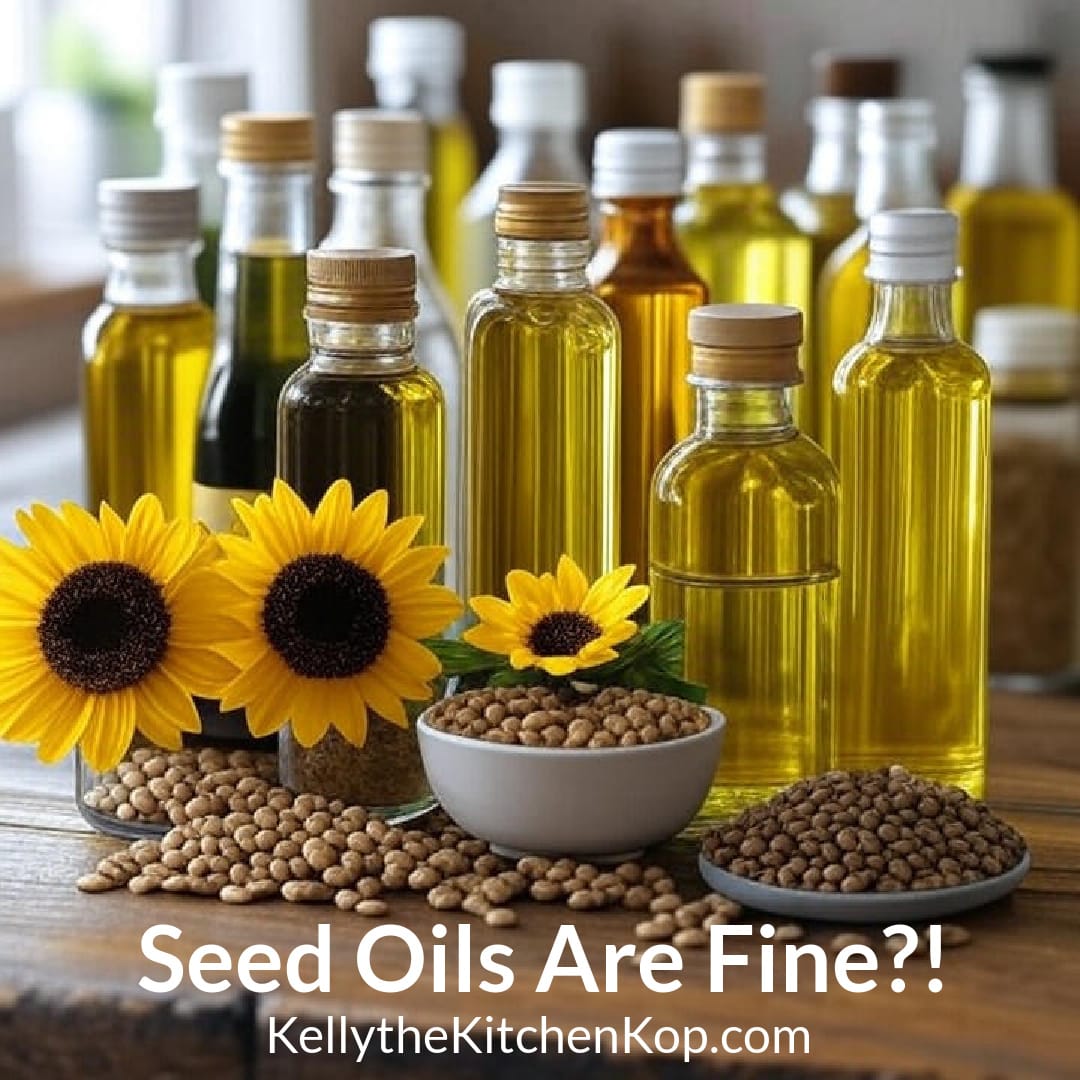
Seed oils are fine?!!
Below you'll fine an excerpt on seed oils that I wanted to share, there will be some sarcasm, which I love, ha!
If you don't follow Jeff Childers on Substack yet, you're missing out. (Sign up for daily emails here.) He started his column “Coffee & Covid” during the pandemic, and reading it was like a breath of fresh air and hope each morning back then and still is today! This is the only “news” I keep up on because his humorous and sarcastic commentary makes it all so palatable and interesting–even enjoyable. Especially lately with so much good happening as RFK Jr. cleans house! Because it's so relevant to my typical blog subject matter, I got permission to share an exerpt from a recent post about seed oils…
Here's Jeff on seed oils (in previous years, these were just called “vegetable oils” by the way):
Yay! Another sickening problem was solved yesterday in the Times’s editorial pages. The piece was penned by pandemic-loving “Dr.” Emily Oster, Brown professor of Economics (not medicine), and originally hilariously titled, Seed Oils Are Fine, Really. While I was working up the piece this morning, the Times stealth-edited the headline and slightly backed off. It now reads, “Stop Freaking Out About Seed Oils.”
The New York Times wheeled out economist Emily Oster to inform America that, while Robert F. Kennedy Jr. might technically be right about chronic disease and our broken food system, he is definitely totally wrong in blaming seed oils. Oster claimed the science pinning obesity and other health problems on omega-6 oils like soybean, canola, safflower, and sunflower is “flawed” — just another case of correlation, not causation. (Even more guffaw-producing, she admitted that “better data” might later prove RFK Jr. was right.) The real villain, Emily insisted, isn’t the oil, it’s the deep-fried Oreo it slid in on.
Dr. Oster is obviously a greasy science denier.
During the pandemic, Dr. Oster was a slippery chatty Kathy, forging an op-ed reputation for constantly advising parents and policymakers to trust “emerging data” even when it was messy, incomplete, and based on observational studies. She framed doing so as a moral imperative — we can’t wait for perfect data, kids are suffering now. Now, though, she dismisses the vast body of emerging and observational evidence against seed oils because, in her view as a professor of economics, it’s “flawed” and “can’t prove causation.”
Never mind that pesky precautionary principle!
Oster became a media darling during the pandemic, applying data analysis models and her economics-based risk-tradeoff framework to covid narratives, rather than conducting any actual biomedical research of her own.
As it turned out, she was wrong about everything.
Seed oils are exactly what they sound like — oils squeezed from the tiny seeds of plants like soybeans, corn, canola, cottonseed, and sunflowers. That all sounds very natural and healthy. I mean, aren’t sunflowers good for you (the jury’s still out on cotton and whatever canola plant is). But, as always these days, there’s a snag in the oil.
The snag is, seeds don’t easily surrender their oil.
They greedily prefer to keep it for themselves. So extracting the oils requires an all-out industrial assault: high-pressure mechanical rollers, solvent baths in hexane, repeated heating, chemical refining to strip out unpleasant odors and revolting colors, and finally “deodorizing” to make the end product palatable. By the time the bottle hits the supermarket shelf, it’s been through more processing steps than a gas-station chicken nugget and looks more like industrial waste than anything found in nature.
That’s why critics call them “factory foods.”
They’re not pressed like olive oil or churned like butter, they’re manufactured, the byproducts of an industrial chemistry set built to turn valueless agricultural waste into profitable, shelf-stable cooking fat.
Emerging science —the same kind of imperfect-but-actionable evidence Dr. Oster once cheerleaded— has been painting a consistently ugly picture of seed oils. High-omega-6 industrial oils like soybean, canola, safflower, and sunflower aren’t just inert cooking mediums; their polyunsaturated fats oxidize easily under heat and in the body, spawning reactive aldehydes that inflame tissues, damage cell membranes, and scramble mitochondrial function. They skew the body’s omega-6 to omega-3 ratio toward a chronic, low-grade inflammatory state, priming the immune system for misfires and front-loading the metabolism for insulin resistance.
Animal models and controlled feeding studies have linked high seed-oil diets to fatty liver, obesity, impaired satiety signaling, and cardiovascular dysfunction— especially when combined with refined carbs and sedentary living. In other words, they’re not the lone assassin of American health, but they’re definitely in the getaway car. (Dr. Oster finds animal models completely useless.)
Oster waved away thousands of seed-oil studies because people who unwittingly consume the greased products often also eat more ultraprocessed food, exercise less, and smoke more— the “co-causes” problem. But that’s exactly how multi-hit disease models work. Inflammation from omega-6 oxidation may not cripple you alone, but when paired with a high-sugar diet, micronutrient deficiencies, poor sleep, or chronic stress, it can multiply the damage from each of those other “hits.”
This isn’t unusual or new. For instance, asbestos exposure was far deadlier for smokers, and high salt does most of its harm to folks with low potassium. By demanding that seed oils prove themselves as a solo killer before taking any action, Oster ignored the well-established reality that most chronic diseases are gang crimes, not lone-wolf attacks.
Oster’s arrogant demand for a million-person, decade-long randomized trial before taking action sounds scientific, but it’s really a suggestion to wait another generation while the damage mounts. If we’d applied that same evidentiary hurdle to tobacco, we’d still be handing out Marlboros in maternity wards.
During the pandemic, Emily delighted liberal medical fetishists with glossy, numerically-driven risk–tradeoff math. She waded into the debates over mask mandates, school closures, mental health costs, and learning loss— always supporting the government’s conclusions and always arguing that you can’t wait around for perfect data. Her language was always clear, always urgent, and always even-handedly accepting of uncertainty— we must assume the imperfect mask studies are right to avoid devastating harms.
Now it’s like she’s not even trying.
Her article lacked even a whiff of numbers, of cost-benefit “analyses,” or discussions of the risks and rewards at all. It was just a litany of tired “correlation isn’t causation” critiques— all wielded in the name of humility, but landing as shrill demands that the field (nutrition) is just too messy to act upon. Although emerging seed-oil science is pointing at plausible biological mechanisms and consistent patterns, Emily requires a colossal trial that she approves before entertaining any lifestyle shifts.
Oh, and she says RFK is a fraud. For following the science. The science that this professor of economics finds insufficient. If only we’d known how to play the “those studies lack substance” game during the pandemic.
No thanks, Emily. We see you. You’re an AWFL pandemic fraud and a shill for institutional interests. Now that pharma’s feeding frenzy is over, you’ve shifted to working for big food. Sit down and shut up.
{End of excerpt}
Don't you love him?!!
More you might like:





Leave a Reply