
The Truth About Synthetic vs. Whole-Food Vitamins
Guest post by Kristen from Perfect Supplements. (My favorite and most transparent supplement company.)
You're doing the right thing. You're taking your vitamins, checking boxes, trying to fill the gaps in your diet.
But is your body actually using what you're giving it?
Not all vitamins are created equal. The difference between synthetic and whole-food vitamins isn't just marketing…it's chemistry. And it can determine whether those supplements are truly supporting your health or just “creating expensive urine” as they say.
Your Body Knows the Difference
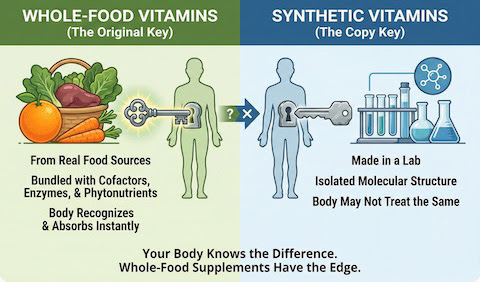
Whole-food vitamins come from real food sources–fruits, vegetables, herbs, or organ meats. They contain nutrients in their natural form, bundled with the cofactors, enzymes, and phytonutrients that help your body recognize and absorb them.
Synthetic vitamins are made in a lab. They're designed to mimic the molecular structure of naturally occurring nutrients, and while they may look identical on paper, your body doesn't always treat them the same way.
Think of it like this: a synthetic vitamin is like a key cut to look like your house key. It might fit in the lock, but it doesn't always turn smoothly. Whole-food vitamins are the original key and your body recognizes them instantly.
Even in cases where the body treats the synthetic and natural form of a vitamin the same, whole-food supplements have the edge because they supply the additional cofactors, enzymes, and phytonutrients that are not present in an isolated synthetic vitamin.
A Tale of Two Vitamin Cs
Let's use vitamin C as an example, since it's one of the most commonly supplemented nutrients.
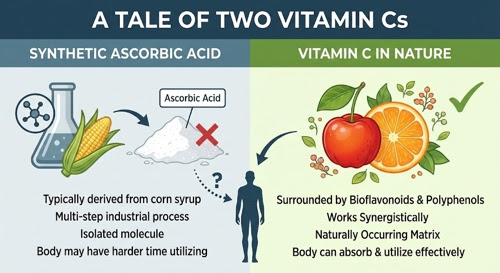
Most vitamin C supplements contain ascorbic acid, a synthetic form typically derived from corn syrup through a multi-step industrial process. It's cheap to produce and technically provides “vitamin C” on the label.
But in nature, vitamin C never appears as isolated ascorbic acid. In an orange or a cherry, it's surrounded by bioflavonoids, polyphenols, and other compounds that work synergistically–helping your body absorb and utilize the vitamin C more effectively.
The acerola cherry is a perfect example. It can contain 50-100 times more vitamin C by weight than an orange, and that vitamin C comes packaged with naturally occurring bioflavonoids and other cofactors. Your body doesn't have to guess what to do with it.
What to Look for on the Label
Reading supplement labels can feel like decoding a foreign language, but a few red flags can help you spot synthetics:
- “Ascorbic acid” listed alone – This is synthetic vitamin C
- “dl-” prefix (like dl-alpha-tocopherol) – The “dl” indicates a synthetic form; natural forms use “d-” only
- Chemical names without food sources – If the label says “Vitamin A (as retinyl palmitate)” with no food source mentioned, there is a high chance it's synthetic
- Nutrients in unnaturally high doses – 1,000% of your daily value is often a clue that it's not coming from real food
Whole-food supplements typically list actual food sources on the label–things like, “Vitamin C (from acerola cherry).”
Why It Matters for Your Health
Research suggests that nutrients from whole-food sources may offer better bioavailability, meaning more of what you swallow actually makes it into your cells. Some studies have also found that synthetic vitamins, when taken in high doses over time, may not provide the same protective benefits as their whole-food counterparts.
Beyond absorption, there's the question of what else comes along for the ride. Whole-food supplements deliver the full spectrum of compounds found in nature. Synthetic supplements deliver an isolated chemical, and often include fillers, binders, and artificial additives to hold the pill together.
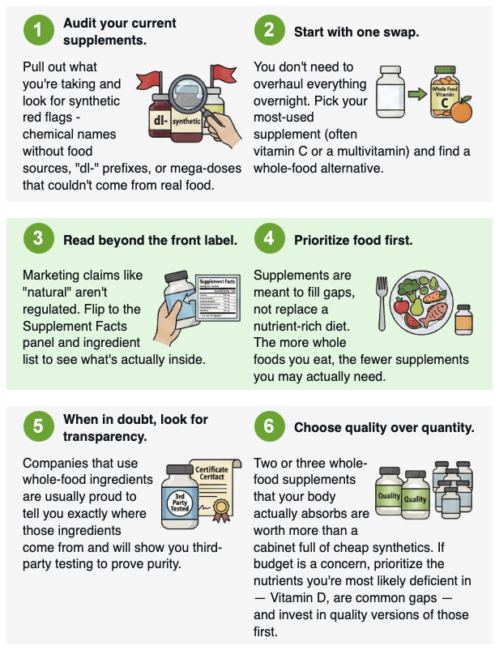
Action Steps You Can Take Today:
A Little Extra Support
 Perfect Acerola – Whole-food vitamin C from USDA organic acerola cherries. No synthetic ascorbic acid–just the real thing with naturally occurring bioflavonoids.
 Perfect ZinCerola – Combines plant-based zinc (from guava leaves) with vitamin C from USDA organic acerola cherries. Great for immune support without the synthetic additives.
 Perfect Desiccated Liver – Nature's original multivitamin. Grass-fed beef liver delivers highly bioavailable B12, iron, vitamin A, and more… all exactly as nature intended.





Leave a Reply