
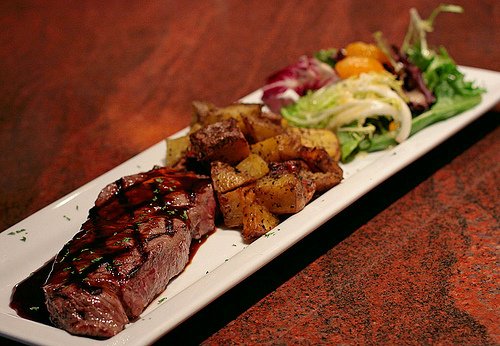
Kent & I have ruined a few expensive grass-fed steaks before giving up – there's a definite difference in how you cook grass-fed vs. conventional meat! But now that we've got some solid instruction from Kristen (the “Food Renegade”) in today's guest post, we'll be ready to give it another shot. Thanks Kristen!
5 Ways To Achieve Grass-Fed Beef Cooking Nirvana
Kelly has done a thorough job sharing the many benefits of eating grass-fed beef on this site. Hopefully, she's convinced you to make the switch. (If not, then what's holding you back?!) I remember when I decided to “go grass-fed,” I enthusiastically brought home packages of grass-fed beef from the farmer's market, only to be disappointed.
Why?
Because I was still cooking that marvelous meat as if it were the same as conventional meat.
So, if you want to know how to cook grass-fed beef, look no further.
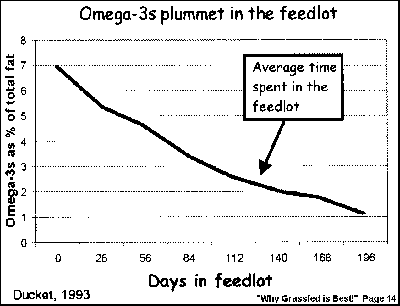
First, let me say this only applies to 100% grass-fed and finished beef. Many “grass-fed” labeled meats these days ship the cattle off to feed lots to finish fattening up on grain (even many organic operations). That basically strips away all the nutritional and health benefits of eating grass-fed beef, as even 30 days in a feedlot can undo the balance of Omega 6:3 ratios and virtually eliminate the presence of that miracle-working CLA.
Don't believe me? Take a look at the chart below, which I stole from Jo Robinson's book Why Grassfed Is Best!
5 Ways To Achieve Grass-Fed Beef Cooking Nirvana
The biggest mistake people make when cooking grass-fed beef is over-cooking it. Following these rules will help ensure don't make that mistake.
1. Lower the cooking temperature. Because grass-fed beef is leaner than its grain-fed counterpart, you need to cook it at a slightly lower temperature (at least 50 F) for 30-50% less time. Otherwise, you cook off the fat that's there and are left with a dry, tough, unappealing mass of meat that's lost many of its nutrients. (The more cooked your grass-fed beef, the more Omega 3s and CLA you lose.)
2. Invest in a meat thermomenter. You may know how to “eye” when conventional meat is done, but because grass-fed beef is leaner, you don't have the same kind of wiggle room for mistakes. A meat thermometer will ensure you cook your meat just the way you like it — every time. The desired internal temperatures for grass-fed beef are:
- Rare — 120F
- Medium Rare — 125F
- Medium — 130F
- Medium Well — 135F
- Well — 140F
IMPORTANT NOTE! To achieve the desired temperature, remove the meat from heat when it's about 10F shy of what's on that list. The residual heat will finish cooking the meat over the next ten minutes as you let it rest.
3. Start steaks and roasts at room temperature. This is a good rule for all meats, but especially for grass-fed beef. By starting your meat at room temperature, it will take less time to reach the ideal internal temperature while cooking. This gentler cooking method will help your meat stay juicy and delicious.
4. Don't play with your meat. Avoid the temptation to poke steaks or roasts with forks or pat burgers down with spatulas. This lets all that delicious fat escape, giving you a less juicy end result.
5. Give your meat a rest. When you're done cooking your meat, let it rest for at least 10 minutes before slicing into it. This allows time for the escaped juices to get sucked back into the meat. If you don't do this final step, you'll slice into your meat only to have all the juices dribble out onto your cutting board or serving plate. What good are they there? You want them in each and every bite of meat you eat.

Kristen is a nutrition & wellness coach and a passionate advocate for Real Food. She is the author of Food Renegade, a growing community of like-minded people dedicated to passing on practical wisdom about traditional food preparation techniques. She leads regular film discussion groups, offers real food consultations, and teaches semi-regular courses in traditional food preparation and grocery store navigation. She also blogs. Endlessly. If you’re a lover of raw milk, pastured meats & dairy products, locally grown and organic vegetables, and slow food, come join her at the Food Renegade Blog.
More you might like:
- Another good book: Grassfed Gourmet Cookbook
- Read more about grass-fed meat and why it's so good for you!
- Have you seen this short little movie about conventional farms and how they raise their animals? The Meatrix
- Another great post about grass-fed cooking: Dry- Aging Grassfed Beef




Sheila says
I really love the post. Very enlightening. I have this best recipe on grass fed steak that you might love also https://www.digitalcookingclasses.com/how-to-cook-the-perfect-grass-fed-steak/
AmandaLP says
First, older cows have a much different taste. Most grass fed beefs are around 2 years old, so older cows will have a stronger taste.
However, most ground beef in this country has a high percentage of dairy cow culls (older dairy cows sat their milk giving life). So most people are already used to eating this as ground beef. I would grind it all and use it for spiced sauces (tacos, spaghetti sauce, spicy meatloaf) and for thinner hamburgers.
Commenter via Facebook says
I just found your page and blog. We raise and sell 100% grassfed beef. The original post/comments said “she was taken down in the field.” If this means that she was killed and processed at home, it may be the “fresh” flavor. If the animal as slaughtered at an inspected facility, they are dry-aged and that changes flavor and tenderness. We home-processed a small steer before we started our own beef. I couldn’t get over the flavor of the FRESH meat. If it was an inspected facility, I’d guess they have a problem with their chill room. We’ve had that issue too. As for how to cook, I’d say lots of marinades and flavorings.
Commenter via Facebook says
The local beef we purchase is completely grass fed and finished – no grain. It is transported to the butcher to be processed and has never had an ‘off’ or gamey taste – it tastes BETTER than grain fed beef. As a matter of fact, everyone we’ve served it to marvels over how awesome it tastes and ends up buying from the same farmer too!
Commenter via Facebook says
Thanks. I agree with marinades. Do a few experiments and see what works. I am sure one of these ideas will. I bet it had more to do with the injury because we had to butcher a pregnant heifer and her meat is actually our favorite so far flavor wise.
Commenter via Facebook says
Try soaking in milk, or using acid marinades…good luck!
Commenter via Facebook says
Before too many comments ask if it’s just the “grassfed” taste, I remember the earlier post included information about how the cow had (a) a leg injury that stressed it right before slaughter and (b) was pregnant so all the associated hormones affected the taste, too.
As for what to do, I’m thinking that brining and strong seasoning are going to be her best bets (whether it’s through seasoned sausage, or strongly seasoned sauces). 400 lbs is a lot of beef to have to deal with that issue, though. Good luck!
Commenter via Facebook says
Nicole Gallagher it was a cull. Pregnant with broken ankle.
Commenter via Facebook says
Usually the gamey taste is stronger in fat and connective tissue. Trim it well, mix with another fatty meat and make sausages, meatloaf, meatballs, chili, taco meat, spaghetti, etc
Commenter via Facebook says
Does it taste “off” because you aren’t used to grassed meat or is it a mature bull?
Commenter via Facebook says
Yeah….I have misgivings about that too. I know some plastics are bpa free, but …
Commenter via Facebook says
I’ve wiped “off” meat with ACV and a rag to change the flavor. Perhaps cooking each piece of meat slowly with multiple spices (think chili, taco soup, spaghetti) to cover the gaminess. I’d also consider grinding it all and making sausage or smokies. That’s what we did with an old sow recently.
Commenter via Facebook says
The site we get all our sausage recipes from, will not open for you. Just google “3 men sausage”, and you will see it right away. Every recipe is top notch, especially the summer sausage.
Commenter via Facebook says
Farm raised beef has a much stronger taste than people expect after spending lifetime eating feed lot beef. Compensate by using a heavier hand to season the meat. If it did not get a full 14 days to hang at the processing house then you may want to soak the meat in milk or a salt water and vinegar combo to pull out some of the more ‘gamey’ flavor.
Commenter via Facebook says
Jennifer, the meat was given to them 😉
Commenter via Facebook says
Long marinades.
Commenter via Facebook says
I would contact the farmer who sold her the meat. My farmer is willing to buy back unused and unopened meat if it isn’t meeting expectations.
Commenter via Facebook says
Sausage and hams are not hard to make. Have someone double grind all the meat that you do not want made into ham. Make sure to get plenty of ground suet too.
I have links for seasoning sausages and for making hams. We live in Alaska and do all this kind of stuff ourselves every year. We are on the road kill list for moose, so often have large amounts of meat that need different care.
https://sugarmtnfarm.com/2006/04/16/how-to-brine-a-ham/
Commenter via Facebook says
We cook it using recipes that are highly seasoned like chili, spaghetti sauce, etc. You could also ‘cut’ it by mixing it with other ground meat. Be sure to try a roast from the front and a roast from the back and a steak before you declare it all icky. Different muscles are affected differently. Worst case scenario would be to thaw all the whole cuts and make ground beef. I have never had a problem with refreezing meat as long as its handled properly.
Commenter via Facebook says
She was pregnant and had a broken bone. Adrenalin will make for an off taste. The way we deal with gamey or off, but otherwise healthy meat, is to make sausage and hams.
Commenter via Facebook says
Hey all, Coleen, the reader who asked this question, isn’t so concerned about HOW this happened, she just *really* wants help in what to do NOW so they can eat it! I’ll also post a new question today here on my Facebook page and see if we get more ideas.
Commenter via Facebook says
I think I know the disgusting “off” taste your reader describes. We purchased several pounds of ground beef from a highly recommended farmer at a farmers market. That meat was so bad I nearly gagged and could not eat it. I tried a second package just in case the first one was defective, but no, it was equally horrible. My daughter-in-law who has some experience with cattle suggested that the animal was probably a dairy cow. She said they have a strong and unpleasant flavor and should be avoided. Maybe that’s why your reader was given the cow to butcher — the farmer knew it wasn’t worth paying to butcher it. I threw all that beef into the garbage and we found a new source with excellent grass fed ground beef. I’ve eaten grass fed beef from various farmers in several states over many years, and all were very good. Nothing at all like this one bad experience. Yes, grass fed has a slightly different flavor and texture, but very slight. I grew up eating rabbit, squirrel, quail, pheasant, venison…then later on had bison, and all were fine. I’ll be it was a dairy cow.
Coleen Steele says
The breaded is a friend of mine. She is a vegetarian but raises a few cow as profit and they are her pets
Coleen Steele says
Not a dairy cow
Commenter via Facebook says
It can be a ton of different reasons. It can be genetics, stress before slaughter, and age of the animal. Also, they can be raised on pasture, but not getting enough calories or protein to be on the gain when they are slaughtered. We raise grass fed beef and our animals will vary slightly from year to year even though they are all raised the same. Also, all meat that has been properly aged and/or grass fed tastes a bit different from the store, and that just requires a short period of adjustment. We usually just use our older cows/bulls for hamburger and not for cuts, because for sure, this meat is not as tender or tasty.
Commenter via Facebook says
Very enlightening. I’ve noticed with our latest grass fed cow that there’s an unusual smell to it, kind of like rendered fat is the best explanation I’ve read. I do find it distasteful.
Commenter via Facebook says
Most grass fed is not grass finished, they are fed grain the last few months. I buy grass finished from Novy Ranch and love their meat.
Commenter via Facebook says
ours never tastes gamey. I’m guessing stress hormones caused the off flavor – very odd! poor cow.
Commenter via Facebook says
I have noticed it tastes different, but we just cover it with steak sauce, sloppy joe or taco seasoning, etc. (homemade of course)
Commenter via Facebook says
The stress levels of the animals makes a HUGE impact on how the meat tastes. I have found this with wilds meats as well. A while back there were 2 farms we bought from that were almost side by side that raised the same breed of cows but that used different places to process the meat. They always tasted different, and the “off” place even had a much different texture. When they got complaints they changed to the same processor as the other farm and the meat was magically changed to a better taste and texture. It really makes a difference!
Commenter via Facebook says
We raise grass-fed beef (pastured pork and pastured chicken) for a living. I’m assuming she was majorly stressed right before butchering with an injury and also being pregnant. They release hormones when stressed and this will greatly affect the taste too. She was also a lot older than what we typically butcher at. We butcher about 2 years. Breeds will also play into the flavor too. For instance, I can hardly eat grassfed longhorn because its a very sharp and distinct flavor. Try it again for sure! Before we raised our own beef we were buying from various farms. Some farm’s beef we liked more than others.
Coleen Steele says
She was taken down in the field because she had a broken ankle. I don’t believe it was stress. But maybe a mixture of stress, being pregnant and grass fed
I just don’t want hundreds of pounds of beef to be wasted so the.
Coleen Steele says
So what do I do with 400 lbs of this beef? How do I prepare it in a way my family will eat it?
KitchenKop says
People who commented on FB won’t see your comments here. I’ll go comment there for you, clarifying that you don’t care so much HOW it happened, you just want help so you can eat the meat now.
Kelly
Commenter via Facebook says
I’ve had GF beef from one farm that tasted completely different from beef from another farm– I just always thought it must be the types of grass in each pasture.
Commenter via Facebook says
Da-Le Ranch Any input?
Commenter via Facebook says
I think sous vide food is amazing… i just wish there wasn’t so much plastic involved.
Commenter via Facebook says
Funny you should bring this up… we picked up a GF steak this week and I felt the same way about the gamey-ness. The whole stress factor/adrenal surge is interesting. I bet w a broken leg being pregnant, that cow was very stressed.
Commenter via Facebook says
Perhaps the animal was stressed from having a broken foot. Stress can cause the meat to change. My farmer has the cows taken down in the field, not rounded up and shipped in a truck to a slaughterhouse. This type of butchering is much less stressful on the cow, much more humane, and is supposed to result in much better quality beef flavor and texture.
Coleen Steele says
She was taken down in the field because she had a broken ankle. I don’t believe it was stress. But maybe a mixture of stress, being pregnant and grass fed
I just don’t want hundreds of pounds of beef to be wasted
Commenter via Facebook says
I believe it is the higher omega content. I have also noticed some people taste it and some don’t.
Commenter via Facebook says
I’ve had this very same conversation with my mother about the last pastured beef we ordered and the very tough and sharp taste. She is originally from Ireland and virtually all cattle are pasture fed there, they do not have this distinctive taste.
What I’ve learned… so far
each type of grass can affect taste, the breed can also have it’s own flavour profile. High stress before butchering will cause adrenaline surges which WILL affect taste. Age also plays a role.
Even a ride to the processor can stress out the animals. some practises may prevent that. I.E. no scents of blood to bother the animal etc etc.
There are a few schools of thought on cooking. Fast sear, low and slow or pressure cooking. Each has benefits/drawbacks. I Like sous vide which is a steam/water bath to soften meats, and slow cookers.
Commenter via Facebook says
The article doesn’t quite answer the question of the reader. My guess is that her pregnant hormones caused the off-flavor.
Commenter via Facebook says
If you think about it “corn fed beef” is probably the sick one. She was probably healthy.
Commenter via Facebook says
we’ve never tasted anything “bad” or “gamey” in our meat. we just had to learn to cook the grass fed beef and pork and venison really slowly
Commenter via Facebook says
Maybe she was sick…we eat pasture fed meat and it doesn’t smell or taste gamey or “off”
Coleen Steele says
She was very healthy aside the broken ankle not sick at all.
Commenter via Facebook says
Spices and red wine when cooking. Our taste buds have gotten used to the “corn finished beef” so we just have to retrain them. Which means learning how to cook differently!
Commenter via Facebook says
We soak a venison roast overnight in milk – this takes care of the gamey taste. Wonder if that would work for you?
Coleen Steele says
ill try the milk soak I had forgotten this. I love the taste of deer so when my children stopped complaining about the taste I no longer used the milk soak
Coleen Steele says
We were recently given a 4 year old grass fed cow to butcher. She was very healthy but had to be put down because she broke her ankle. She was also pregnant, it was all so sad. Everything was processed correctly. However, my problem is the very strong taste of the meat, not just a gamey taste but almost a rancid flavor. We are hunters and no stranger to game meat (deer, elk etc.) I want to know how I can maybe cure it or how I can cook it to help alleviate with this strong taste. I made some beef jerky but the taste still came through (maybe I didn’t add enough cure seasoning because I didn’t know grass fed was different flavor and was so strong).and I would hate to waste al the good cuts to jerky. I am just today starting the process of making some of it into corned beef and then into pastrami, but don’t know how this is going to turn out. Please can you help me? We have about 400 lbs of this wonderful looking beef. I hate for it to go to waste, I love a good grilled steak. Coleen Steele
KitchenKop says
Coleen, I’ll post this on my Facebook page tomorrow and try to get some good ideas for you. (If you’re not on FB, it’s ok, the replies will come through and post here.)
Kelly
KitchenKop says
One more thing that I’ll include on the FB post tomorrow, but I don’t know if it’ll show up here:
I believe the taste has less to do with if it’s grassfed (because the grassfed meat we eat now tastes great!), and more to do with what the animal might have gotten into or what else it may have been fed. I’ve also heard that stress right before they’re slaughtered can cause an off-taste.
I just don’t want you to think that all grassfed tastes super gamey.
Kelly
CC says
You could treat it like offal or mix it with other meat. I personally would feed it to my chickens and get the benefit through their eggs.
Jo says
We have power outages often so can most garden veges instead of freezing. Is there any special way or advice on how to can grass-fed beef? Thanks, love your article, no wonder my beef is stringy 🙂 Cooking it at 185 degrees overnight is so simple.
KitchenKop says
Hi Jo,
I’m not sure if Kristen still sees these comments so she could reply, but if not, try googling “canning grass-fed beef” or “how to can grass-fed beef” or something like that and you’ll probably find what you need that way. 🙂
Kelly
Stanley Fishman says
There was a study done this year that found that people who eat grassfed meat have much more Omega 3 s and CLA in their blood than people who eat grainfed meat, however the meat was cooked. This study appeared to show that Omega 3 fatty acids and CLA are not destroyed by cooking. Since they are components of the fat of grassfed animals, the fat that is still in the meat, especially well marbled meat, would have them. Apparently some of the fat cooks into the meat, rather than out of it. But if you want to get the most CLA and Omega 3s, you can always eat the fat itself, which can be delicious when cooked. However, cooking the meat rare appears to give the most nutrients.
Stanley Fishman says
Here is a link to a blog post I did on the study proving the benefits of grassfed meat. Irish people traditionally cook meat thoroughly, but even that did not destroy the Omega-3s.
Finally! Modern Study Proves the Benefits of Grassfed Meat
Virginia says
How do you cook a roast without diminishing the Omega 3s and CLA? I cook mine overnight at 185F (soup bones, shoulder roasts, etc.).
Elizabeth from The Nourished Life says
Thanks so much for sharing all these great tips! I had no idea there was so much you could do to get better results with grass-fed beef. Unfortunately my husband loves his meat well-done – I used to but have been willing to make the switch since reading Nourishing Traditions. But I try to be more careful when cooking steaks on the grill since I want all the nutrients still in the meat when I eat it!
Henriette says
Hay and maybe some root veggies like beets ( not beet roots 😉 )
Henriette
Kelly says
Hi Jeanne, usually I believe they give them stored hay through the winter, but everyone should call and talk to their farmers and get to know them. You can ask them this and many other questions. Most welcome this kind of dialogue.
jeanne says
I have a question . . . on 100% grass-fed beef. If it is from a local farm and you live in area that has cold/ snowy winters what do the cattle eat during that time?
Like Lauren I have been purchasing organic grass fed beef at local super markest for awhile now. I am disappoint to learn that this could be another misleading label!!
Jennifer (Conversion Diary) says
Timely post — I just had my first taste of 100% grass-fed beef fresh from a local farm last weekend. It was amazing! I didn’t know that it had more Omega-3’s but I’m not surprised. Very interesting!
Jennifer (Conversion Diary)
Kelly says
I second what Kristen said, I’m calling farms (and stores, etc.) all the time!
KristenM says
Lauren, I usually just write down the name of the ranch supplying the beef, then ask them. I know it’s an extra step to go home, look up the rancher online, and make a phone call, but most of these ranchers are completely willing to share how they raise their cattle. Sometimes their website will clear it up for you right away by advertising that the cattle is grass fed and finished.
KristenM
Lauren says
This may be a silly question, but how do you know the meat is “100% grass-fed” for sure if the meat that you buy in the store says grass-fed? I thought we were doing good purchasing the grass-fed organic meats, but now I am confused again!
Jackie says
Not a silly question. We raise 100% graas fed organic beef. You will know this because we Are certified by our organic certifier “MOSA” to be organic and grass fed according to the USDA Grassfed standards … Which means the animals get their mothers milk and a grass based diet for their entire life. We raise our cattle from birth until they reach your table.
Heidi / Savory Tv says
Excellent, and very helpful! I love grass fed beef, and am lucky enough to live in an area where it is highly available, thank for your cooking tips!
Heidi / Savory Tv
Rose says
We are very fortunate to have a place right next to us that raises grass fed beef. The web site is flyingsbeef.com We love it. It is very tender and lean and Penny is very friendly and helpful. She has helped us find a source for raw milk and cheese and we don’t have to travel too far for it.