
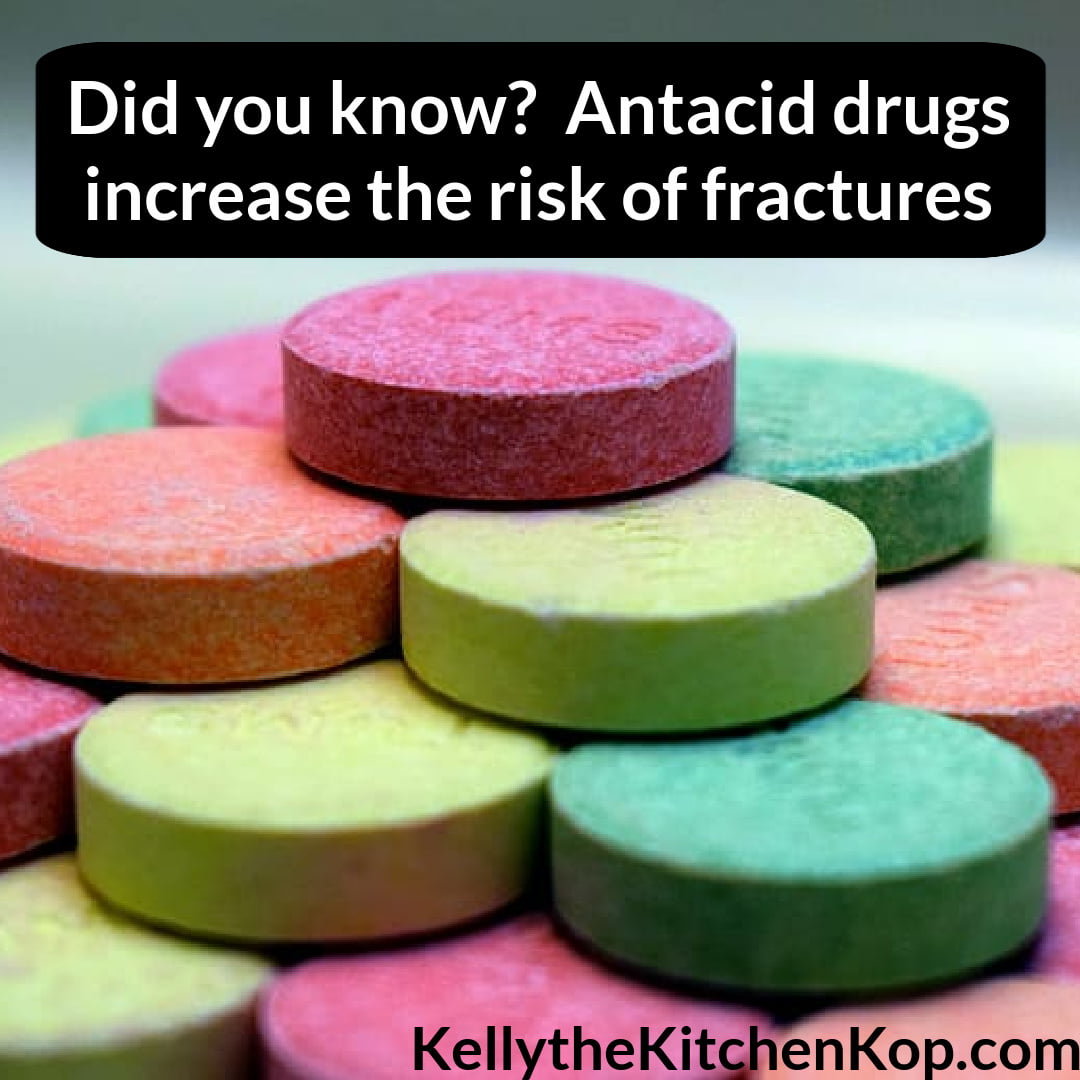
Antacid Drugs Increase Risk of Fracture–Did you know?
Do you or someone you love take antacids?
Today author Dr. Michael Teplitsky shares some surprising studies and facts that I hadn’t heard about this commonly prescribed drug.
Anti acids drugs are very popular.
It is estimated that about 10% of the population uses them regularly for heartburn, indigestion, acid reflux, and stomach pains. There are 2 types of antacids: proton pump inhibitors (Prilosec, Prevacid, and Nexium) and histamine-2 receptor antagonists (Pepcid, Tagamet, and Zantac). Some of these require a prescription, others can be bought over the counter.
These drugs work by preventing the production of stomach acid, which improves the symptoms, but only for a day or so. The manufacturers of antacid drugs recommend taking them only for a short period of time, 4 to 8 weeks at most. But many people find that the symptoms come back as soon as they stop taking their medication, so they keep taking it, very often for many years.
A 2007 study published in the Journal of the American Medical Association (December 2007) showed a 44% increase in hip fractures in people who took antacid drugs for one year or longer. The risk was 2.6 times higher in people who took higher doses over a longer period.
Two years ago, a study published in the Archives of Internal Medicine (August 2008), showed that there was a 62% higher risk of bone fracture in people who used antacid drugs for 5 years or more. After 7 years of use the risk of hip fracture was 4 times higher, that’s 400% higher than in people who did not use these drugs.
A study presented at the Digestive Disease Week 2009 meeting in Chicago in August of 2009 confirmed that people taking antacid medications have a higher risk of fractures. The risk increases with higher doses and longer duration of treatment.
Now even the skeptics agree that there is a very strong and well-documented association between antacid drugs and increased risk of fractures.
What is the reason? It turns out that you need to have a lot of acid in the stomach in order to absorb minerals, including calcium, magnesium, copper, boron, and others that are needed to build strong bones. Drugs that suppress acid production seriously hampers absorption of minerals, which leads to weakening of bones, also known as osteoporosis, which in turn leads to fractures.
If you suffer from heartburn, reflux, and indigestion and find yourself using these medications, please understand that they do not cure the problem, but only mask the symptoms. That’s why you have to keep taking them, day after day.
Here are a few suggestions for getting rid of the problem, once and for all:
- Examine your diet. Many foods can make symptoms worse, including orange and orange juice, grapefruit juice, coffee and chocolate, garlic and raw onions, spicy foods, carbonated beverages and alcohol. It may be a good idea to keep a food diary where you write down everything you eat for a week or so and note when you get the symptoms. You may notice an association between symptoms and certain foods that you eat.
- Eat small portions, eat slowly and chew your food thoroughly. Do not overeat. Do not eat before going to bed, because the undigested food in the stomach will start backing up and cause heartburn.
- Smoking can increase the symptoms, so it may be a good idea to quit.
Finally, most people who have heartburn do not suffer from high acid levels.
They actually have reduced amount of stomach acid. This may sound paradoxical, but it is true.
It is true that the symptoms (heartburn, indigestion, pain, etc.) are the result of acid going up to the esophagus, a pipe that carries food from the mouth to the stomach. But it does not mean that there is too much acid in the stomach.
Normal digestion works this way…
After you chew your food, it is transported down into the stomach through the esophagus. At the end of the esophagus where it connects with the stomach, there is a valve called the sphincter. This valve is supposed to be tightly closed at all times, except when it opens to allow the food to pass down. So normal traffic is always one way, from the mouth through the esophagus and into the stomach.
Once it enters the stomach, food is coated by large amounts of hydrochloric acid, which is absolutely necessary for digestion and absorption. As a result, normal environment in the stomach is very acidic.
Fortunately, the stomach is designed to handle large amounts of hydrochloric acid with ease.
Besides digesting food, the acid has another important function. It kills any viruses, bacteria, and other potentially dangerous organisms that may be present in food. The acid also stimulates the sphincter at the end of the esophagus to contract and stay closed.
As we get older, the production of the stomach acid falls in most people. As the stomach becomes less acidic, the sphincter relaxes and becomes partially open. This allows some of the stomach content to flow back into the esophagus. Since the esophagus is not designed to handle acid at all, even a small amount will cause symptoms. What is considered a small amount for the stomach is a huge amount for the esophagus.
That is why many patients improve when they use supplemental acid.
You can do an experiment very easily. Mix one teaspoon of apple-cider vinegar with half a glass of water and drink it after a meal. If your symptoms improve, try two teaspoons next time. If symptoms get better, this is a clear sign that you need more acid, not less.
I have also treated many patients with Zypan, which is a combination of hydrochloric acid and pancreatic extract, which provides natural digestive enzymes. It not only helps you digest food, but also improves the acidity in the stomach.
More you might like:

- More ways to use ACV:




Michael Teplitsky, MD says
Hi Rosina,
Keeping in mind that tablespoons differ in size, there is a convention that 1 teaspoon equals 5 milliliters (ml) of liquid and 1 tablespoon is 3 times larger, so it will be 15 ml. A typical capsule is about 1 ml, which means that you would have to take 15 of them to equal 1 tablespoon. That is why most people prefer to use the liquid instead of capsules. I have absolutely no experience with vinegar capsules, didn’t even know that they existed. I do know that the liquid form of vinegar works very well. Hope this helps.
Dr. Teplitsky
Rosina says
I have a quick question about the apple cider vinegar…
Is it alright to take the apple cider capsules instead of taking the vinegar with water? and if so how do you find out how many pills are equivalent to 1 tbsp. of the liquid?
Thanks for the help 🙂
Erin says
I’ve recently (in the last 2 years) been experiencing intermittent sour stomach/acid reflux and achieved temporary (but unnerving) success with Zantac. Thanks so much for taking the time to write this post, as I’ve been diligently searching for alternatives to Zantac (the symptoms are horrible, but the thought of taking anything like Zantac for any length of time is making me so nervous). Next time I have a flare up of these symptoms, I’ll definitely try the apple cider vinegar.
Rosina says
This is so interesting! My mom suffers from acid reflex and has been taking zantac for well over a year and before that she was taking an acid reflux prescription from her doctor. She just had her annual check up and questioned her Dr. about the risks of taking zantac continually and the loss of calcium in her body but her Dr. told her that she should continue to take them for as long as needed because they will prevent throat cancer that can come from the continual acid coming up and that the calcium deficiency was something that they could deal with later.
What worries me is that if the zantac is going to inhibit the absorption of calcium and the Dr. isn’t even worried about it now, how hard is it going to be for her to replenish the lost calcium if at all later? I’m going to tell her about the apple cider vinegar tomorrow and see if I can get her to give it a try 🙂 Thanks so much for a great article!
Michael Teplitsky, MD says
Corrie,
You should try the experiment with vinegar and if it seems like acid helps you, then by all means look into HCL tablets.
Dr. Teplitsky
Corrie says
What do you think about supplementation with acid for people who have had weight loss surgery? I had gastric bypass surgery (before discovering NT, sadly) and I know that I don’t produce as much acid as I did before, just because my stomach volume is reduced. Should I look into HCl tablets?
Olivia says
Thank you Kelly and Elizabeth for the feedback!
I have been slowly implementing NT in to mine and my husband’s lifestyle for the past 2 years (In fact, yours was the first website I found!). I’ve read about the GAPS diet quite a few times but hadn’t really considered implementing it because it seemed extreme and I didn’t know if it was necessary for me. But from reading the comments at your link, it seems more doable. My husband has horrible digestive issues, allergies, and eczema. In fact, he was very “colicky” as a baby and they think he might have also had GERD that just went undiagnosed. Same symptoms- arching the back, constant crying, couldn’t lay on his back, etc. Of course I know I could probably use it as well. My diet has been less than perfect for many years and I know I have gluten sensitivities. I feel so much better on NT higher fat/ fewer grains diet. And if this could help my baby along with any Future babies that would be wonderful. Is it ok to follow the GAPS diet while breastfeeding? The hard part might be convincing my husband… *Off to do research!
KitchenKop says
Olivia,
Elizabeth gave good advice in sharing that quote (thanks Elizabeth). What I was going to say is that I’ve heard of MANY cases of GERD in babies going away when the Mom did the GAPS Diet. (https://kellythekitchenkop.com/2009/08/apprehension-over-the-gaps-diet-real-food-wednesday.html)
Lastly, most likely your baby girl is just fine, all you can do is move forward from here with what you’ve learned, knowing that you’re a great Mom who is doing her best, that’s all we can do!
Kelly
Elizabeth says
Antacids neutralize the stomach acid that is IN the stomach. H2 receptor antagonists like Zantac actually prevent the stomach from secreting acid.
“Babyhood is a time of spit-upping. Since the sphincter at the top of the stomach is often loose, many babies spit up milk out of their mouths or noses. In otherwise healthy, happy babies who are growing well, the spit-up is mostly milk, rather than stomach acid, and nothing needs to be done (except a lot of laundry!).
In some babies, though, the acid makes the lining of the esophagus tender, red, and swollen. They might arch their backs in pain. The acid can also be inhaled into the lungs, irritating their sensitive linings. These children might not gain weight well, or might cry and cry from discomfort. Some might develop a chronic cough, wheezing, hoarse voice, or recurrent pneumonia. A few even stop breathing (apnea) to try to protect their lungs. All of these children deserve some relief from their reflux.
Usually the first place to start is with looking at how the baby is fed. Decreasing the volume and increasing the frequency of feedings is sometimes enough to deal with reflux. If the baby is already drinking from a bottle, thickening the feedings with rice cereal is an option to be discussed with your physician. This can mechanically reduce the amount of milk sloshed back up the esophagus. Some studies suggest that this decreases both spitting up and crying in babies with reflux. However, this does provide extra calories to your baby, and it may also make it harder for your baby to know when he or she has had enough to eat.
Food allergies may also cause reflux. The most common culprits are cow
Olivia says
What is your opinion on babies who suffer from GERD (Gastroesopheagal Reflux Disease)? My baby girl is 3 1/2 months old. She has been on liquid zantac (1 ml 2x/ day) since she was around 8 weeks old. I did NOT want to put her on prescription medicine. My husband and I tried everything homeopathically we possibly could to help her including going completely off dairy for 3 weeks (I’m breastfeeding) and nothing worked. It was severe and she was in constant pain after every feeding. Once her medicine is done for this month, we are going to try taking her off and see how she does. I take cod liver oil daily and also took it throughout my pregnancy. We have just started giving her a daily dose of CLO. Do you think we have harmed her bone structure in any way? This is a real concern to me because I had weak bones as a child and broke my collarbone at the age of one.
Stanley Fishman says
Eat real food. Follow the dietary guidelines of the Weston a Price Foundation. Stop eating factory food. Stop eating factory meat, and eat only grassfed and pastured. Don’t take any kind of drugs, unless you absolutely have to. Eat lots of real food containing probiotics.
This is what I did, and every trace of acid reflux disappeared.
Good food will normalize every body function, for most people.
April says
There was a time they recommended antacids as a way to get calcium; scary that it has the opposite effect. I don’t think they do anymore but DH takes them often because of heartburn (or when he over eats junk food and has a tummy ache). I think I need to have a little talk with him 😉
Ann Marie @ CHEESESLAVE says
What is the reason? It turns out that you need to have a lot of acid in the stomach in order to absorb minerals, including calcium, magnesium, copper, boron, and others that are needed to build strong bones.
This is so interesting — I never knew this!
I bet this is why my father-in-law ended up with osteoporosis. He has been taking antacids for years and years for his acid reflux and digestive issues.
Thankfully, my mother-in-law started giving him kefir. He started drinking a cup of kefir a day and he is now off all of his antacid medications.
He’s also drinking raw milk and taking cod liver oil — his bone density is better than it has been in years (maybe even decades).