
If rendering fat like tallow (beef) or lard (pork) is on your to-learn list for a healthy frying oil, I've got the scoop today…
I’ll tell you how I finally made some beautiful beef tallow the other day (yeah, I said it, it’s beautiful, especially after my last attempt which was quite the fiasco), but I’d love to find out if there’s an easier way…
(Have you seen this post? 4 Keys to Deep Fried Heaven — Healthy Fried Foods and Guilt-Free Frying.)
Just want to BUY it?
I may still just buy it. If you don't want to make it yourself, here's where to buy safe meat or beef tallow online from grass-fed cows (or get the bigger economy size of beef tallow here.) Here's where to buy pastured lard. UPDATE: see this post about which is more cost effective, rendering it yourself or buying it in larger quantities – hint: I was happily surprised! (Also be sure to read more at that link about reusing tallow and how to store large amounts.)
Why use tallow or lard?
Tallow and lard are traditional fats that won’t leave a nasty film in your mouth, or give you a stomach ache after your favorite fried food, with a few trips to the bathroom thrown in, too. It is also a healthy fat, contrary to what you’ve probably heard. Read more about healthy fats here. You can fry foods without the worry of killing your heart, like you have to worry about when eating McDonald’s French fries – the oil they cook in is disgusting, although it wasn’t so until 1990:
Before switching to pure vegetable oil in 1990, the McDonald's corporation cooked its french fries in a mixture of 93% beef tallow and 7% cottonseed oil. (Source)
What is Tallow? What is Lard?
Tallow is made from rendering fat from a cow, lard is made from rendering fat from a pig.
OK, but what the heck is rendering fat anyway?
I didn’t used to know this, either. The other night when I was standing over a pile of disgusting, sticky fat for an hour cutting it into pieces, I wasn’t sure if I was glad that I know now. The first time trying this I didn’t know I needed to cut it into pieces and I burnt the heck out of it, even though it was on super LOW heat for days. (The sick smell coming from our house and off our clothes was just plain embarrassing.)
Rendering fat is basically the following process: turning clumps of fat into tallow or lard that you can fry in.
- First you buy fat from a local farmer who has his animals out on pasture, and raises them without antibiotics, hormones, or other junk, and feeds them what they were meant to eat.
- Next you’ll need to get your big girl/big boy britches on and start cutting the fat into small-ish hunks. (I did about 1-2” pieces.) This takes a while, depending on how much fat you have. I did a lot at once so I didn’t have to mess with it again for a while. It took me over an hour – there were icky pieces that I didn’t want in there, including a layer of thin skin throughout. That was partly what was so time-consuming – do you guys get the gunk off, or do you just chop it up and throw it all in there? This job wasn’t easy for a city girl, but I got through it. (My beautiful tallow makes it worthwhile!)
- Put the fat in a big stock pot and cover with water. Simmer on very low heat until it’s all melted. It took mine about 4 days! I’d turn it off at night and get it going again in the morning. Does anyone know if this is a normal amount of time? Obviously, after the last time I was afraid to turn it up any higher. Part way through I used my potato masher to smoosh the pieces so they’d finally finish melting.
- UPDATE: I just heard two tips that I want to share with you. First, you can do this out on the grill on low and then your house won't smell as it's boiling. Next, as the fat melts, pour it into the container you're storing it in, and then the fat that's left will melt down faster.
- When it looked like it was done at last, I used a fine strainer to strain it into a glass bowl. This is how it looked – just a tiny amount of gunk leftover and a little over half of this big bowl full of beautiful tallow that I can now use to make real French fries, the best fried fish you’ve ever had, or the other night we had batter-fried shrimp and onion rings – get more recipes in this Deep Fried Heaven post. 🙂
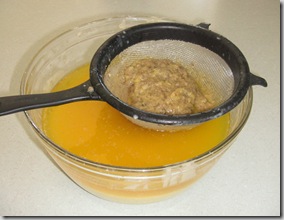 You’ll want to store it in something you can easily scoop some out of. A narrow top container doesn’t work well, trust me.
 You’ll want to store it in something you can easily scoop some out of. A narrow top container doesn’t work well, trust me.
I’d appreciate any pointers on the cutting-it-up stage!
More you might like:
- Recipe for deep-fried heaven!
- The BEST deep frying oil for guilt-free deliciousness
- Where to buy safe meat if you don't have a good local source
- Here's where to get beef tallow online from grass-fed cows (or get the bigger economy size of beef tallow here)
- Here's where to buy pastured lard.



Kay says
Hi Kelly, Have you tried using a grinder? I have an old one left to me by my parents.
KitchenKop says
No I have not, does that make it go faster?
Kelly
Bharat says
Do you know how long our ansestors simmered the beef/lamb fat to make tallow?
3 days is quite long :O . Can’t we just cook it for 3-5 hours in simmering temperature? I did mine few days ago and I got the tallow pretty well but not sure if there is so much left behind.
KitchenKop says
I think that if you cut it up into smaller pieces it goes faster.
Let us know if you try it. 🙂
Kelly
Carol D says
I got a bunch of free “dog bones” from a local butcher (we live in a very rural area), washed them up and put them in the crockpot on low for a long time. I got lots of nice rendered fat and I didn’t even remove any from the bones, just let it cook off. A little straining, a little cooling and I was set. Cost – whatever for electricity for a day or two of cooking! It was some time ago, I don’t remember if I used water in it too, I’m inclined to think so, because then – bone broth! So, free bones gave me bone broth and rendered fat I used for months. I need to do it again!
KitchenKop says
That’s great Carol! 🙂
KindFoodFarm says
Kelly, you can also render fat in a casserole pan in the oven, with or without added water. Just be sure to go low and slow, of course. It’s a pain to chop the fat into small pieces, but it saves time in the long run. I love the idea of doing it outdoors on a grill to minimize the smell.
KitchenKop says
Thanks Jeanmarie, that’s a great idea!
Kel
Christine says
I have been rendering tallow for over 2 years and wish I had been doing it decades sooner! It is fabulous stuff; it gives wonderful flavor to everything you cook in it. And, I use it in everything, from cooking fish, beef, chicken, pork, vegetables, breakfast foods, etc. to pie crusts, cookies, and more. It’s also soooooo good for you.
I got my fat from the steer we butchered, and was super surprised at the quantity!
I’ve never added water, but maybe I’ll try it next time.
I put the fat in a crock pot (usually 2) and slow melt all night and all day for several days (smells lovely, night and day). In the end, as I begin the cleaning process, I strain, measure, freeze, combine the 2 crocks into one and keep rendering,eventually end up using a 2 qt saucepan, on the stove, to finish, resulting in wonderful cracklings.
When I first started making tallow, I began by chopping it up into small pieces before I put it in the crock pot, but now I cut into chunks and break them up as I stir the pot (time saver). I cut the gristle and other non-fat stuff and that goes to the dog and chickens.
I freeze my tallow in small batches, 1 – 3 cup portions in small, wide mouth, sour cream type containers.
Lesson learned – I happily and generously gave some to friends and family but now I keep it all to my self because they don’t appreciate it in several ways: its nutritional benefits, the hard work to make it and the cost savings. All but one (a farm and country girl) , told me that they had to throw it out because it sat unused in the fridge for months. No more!
The farm girl loved it and wants more – I trade for raw milk. 🙂
KitchenKop says
What a great gig you have worked out with that smart farm girl! 🙂
Kelly
Ore says
I just rendered my tallow and it solidified into a huge block. I used it for deep fryiing (fish cakes) and it literally solidified in them! I absolutely hated it. Felt like I was eating chunks of butter as I was eating. Does it always solidify back in food if you use it for deep frying? Also it solidifies everywhere!!! In my sink, cooking counter, on my spoons, it;s such a pain. I was really looking forward to changing it as my primary source for deep frying. Sigh.
KitchenKop says
Christine,
Yes, if it’s room temp or cold it solidifies, that’s what animal fats do, but if it’s hot it’s not solid at all! It takes some getting used to, but pastured beef tallow is so good for you and tastes so good too it’s worth it. 🙂
I never feel like I’m eating chunks of fat like you described though so I’m not sure about that, but if I fried food in it, I’m eating the food really hot too…
Kelly
Steve Runyan says
We render our own, and have for years. The absolute best came from a fat bear. We had a 40 qt cooler full of fat we rendered. Costwise, get to know your local butcher. Many areas of the country still have very little market for fat. Find out which producers are raising clean, natural livestock, and offer to buy the fat. After rendering, pull off the cracklings, add a little salt, and enjoy a healthy, decadent snavk!
Kathryn Hicks says
Boy this takes me back! We used to do this in the days before shop-bought cooking fat was available and cooking oil wasn’t heard off (post war Australia). There were 2 ways to get clean cooking fat: save the pan drippings from your roasts, collect the fat from the top of stocks and stews, and render them;
or buy the fat trim from the butcher (all grass fed stock in those days) – we’d get suet, fat trimmings, and even cut off the larger bits of fat on the roasting joint and put it all through the mincer, then roast it for a while to break down the membrane and get the fat flowing. The liquid fat was then set in a colander to drain (and the leavings re-roasted slowly to release any fat left, which was then drained off as above) until the cracklings were just that – crackly – they were fed to the chooks. Water was then added to the liquid fat at it was set to boil for about 20 minutes (rendering), then left to set. Sometimes, depending on the type of fat, it still retained some water, so it was re-rendered, the hot fat drained off until you could see the watery liquid underneath, then that was reheated and left to set. When it was set, the cake of fat was taken our and it’s bottom scraped of any loose matter, and it joined the rest of the fat in the dripping container.
Jann McCullick says
Instead of cutting up my pork fat, I ran it thru my hand crank grinder. (One of the old fashioned ones.) It was so easy and melted so fast in my crock pot . Have your fat very cold for easier grinding. Turned out great!
L. Campbell says
Wow, I feel so lucky! When I told my farmer I wanted pork fat to render, he sent it to me already minced. Unfortunately, buying raw milk is impossible in Manitoba even with my connections. As usual Kel, you answered my ? before I could ask it!
Love, Lisa
KitchenKop says
Hey Lisa! Yep, that’s my goal. 🙂
Kel
L. Campbell says
Perfect Supplements have the best and sometimes the only supplements. You can use them with confidence. You can also use Kelly’s code KOP for an additional 10% off. Watch for sales. You mentioned 2 of the most expensive sites going! The CS at PS is excellent! And they respond to ?’s the next day. I have no affiliation to this company, just a happy customer.
Rifqa says
Here’s my new favorite way of making tallow: CROCKPOT! Turn it on low and forget about it. I leave the lid slightly ajar so moisture can escape. Depending on your slow cooker, you may need to use high, but try low first. Bear in mind that slow cookers need to be a least 2/3 full to work well, so use a small one, or do a large amount of fat. 🙂
Lois says
Wow that sounds easy enough, thanks!
Lois says
HI Kelly,
When pulling your tallow out of the fridge to use, do you thaw the jar in hot water to even use it in the deep fryer again? This makes me lazy about frying with tallow. Is there a quicker way or is this the procedure for using tallow since it is hard. Thanks!
KitchenKop says
Hi Lois,
I actually keep the tallow in my fryers and reuse a few times before discarding and scooping fresh tallow into there from the freezer. (From the freezer I just chip at it to get it into the fryer and then obviously it melts as it heats.) My fryers have lids and it stores well that way. This way you just plug it in, fry your food, cool completely, cover it and store it ’til the next time.
Kel
DaniDee77 says
Hi, I make pies. I render a lot . . . a lot . . . a lot . . .
Ask your supplier to mince all the fat for you. Chuck it in a big pot and shove it in the oven. Start of high and turn it down once there is a good quantity of liquid. Don’t leave on high heat, your lard will have a “burnt” smell, but will still be useable. Hope this helps. It’s the easiest method for me.
Hace fun…
Orestes says
Question: My tallow isn’t hardening into a disk. It’s been in the fridge for a day, should i move it to the freezer for a bit, or would that be unnecessary? WHat should I do to separate the real tallow from the gunk on the bottom of the bowl?
KitchenKop says
It hasn’t hardened at all?
markas says
If it is not hardening it has moisture trapped within it. You have two choices. 1) If you are only talking about a cup or two of tallow just heat it up in a saucepan to about 275-300 F and slowly watch all of the water boil out of it. When it stops boiling it is done. Now it should harden well when refrigerated. 2) If you have a larger amount of tallow, melt it down in a pot of boiling water. use about the same amount of water as you have tallow, but more or less is fine depending on the size of your pot. The water will help distribute the heat and prevent scorching your fat. Heat until all of your tallow is melted down, but do NOT allow the water to start boiling off and mixing with the fat. Stir your fat and near simmering water gently. The goal is to get them to separate and stay seperated and it is the heat that is your friend, stiring is only to keep the heat even. Keep it at around 300 F for 30 min or so, leaving it unstirred for the last 5-10 min. Then pour it gently through a strainer or cheesecloth into jar or bowl. Often I will use a big ladle to skim off pure fat into a container so that only a thin layer remains on top of the water. This way I have only a small jar with water and fat that has to be separated with most of the pure skimmed fat ready for storage on its own. If you leave moisture in your fat it will spoil much more quickly.
Robert Bury says
…. Darn–I should have added that I cut the meat down to the bone and try not to spend too much time fiddling with it, so when near to the bone and about the right size I stop and put the meat with bone into my slow cooker on top of potatoes, onions, and carrots for a fall off the bone fat free wonderful meal. does anybody know where the fat goes? (smile!)
This whole process does take about 2 hours–I think I fiddle too much trying to get all the fat off.
Next I do want to simply roast the whole piece of meat at one time. Catch the fat dripping off and save a whole bunch of time. ==== always FUN things to do in the Kithchen.
Robert Bury says
I’m finding pork shoulders and butts today at 98 cents a pound. I buy these in about 10 pound packs or together at about 20 pounds. Cheapest protein you can buy other than chicken on sale.
So–I bring home and butcher this meat by taking as much fat off the meat and into my pressure cooker pot. Then usually I can cut 3-4 very nicely marbled port steaks for use whenever. Then comes chunks I used for stews or side dishes. Then the meat scraps that I food processor into sausage meat or hamburger meat often mixed with store bought hamburger as veal is not available.
I pressure cook the fat for abut an hour and allow to cool and use a simple fat separator to get most of the rendered oil/fat into a container that I put into the fridge. Usually the fridge container is nice pure white and has lasted there over a year for all my non-butter needs. Sometimes I will heat it up again with water to strain and separate again to get the purest white.
I really like the frugality and simplicity of this and “knowing” more about food. My neighbor told me about her growing up farm life where they made their own soap from this. It was used only for clothes washing. If that was just a choice or had a reason, I don’t know.
I’m still wrestling with making crackling.
D. says
It’s probably still too warm. Did you chill it to see if it will harden?
KitchenKop says
Or maybe it needs to boil down a little more???
cheri says
I put some in the frig and it got a little harder but not like I’ve had it do in the past. I opened a quart and cooked it a while longer yesterday to see if that would help, but so far it hasn’t done anything different.
cheri says
I rendered my lard and canned it. It usually turns out beautiful, but this time it didn’t set up and looks like oil. What happened and can it be fixed?
D. says
Tallow has a different texture and make-up than lard, so the waxy feeling is pretty normal. That’s why they use it in soap.
As long as it doesn’t taste off, it should be fine. Still, I prefer lard to tallow, but that’s just me.
Emily says
It was brand new (to me anyway)…?? I will try again, but I thought it was strange.
Emily says
I have a question. I purchased grass fed beef tallow and fried tortilla chips in it. They were delicious. But after eating them I noticed it left a film on the roof of my mouth. It is fairly unpleasant. I noticed the chips when they cooled seemed to have a film as well. Any knowledge about why that might happen? I also noticed they didn’t seem to absorb as much oil as when I have fried them in the past, could that film be part of that?
KitchenKop says
How long ago did you buy it?
I’m not sure, maybe someone else can jump in…
Kelly
Maxwell says
The tallow looked beautiful. But there was one thing i did notice. You can see quite well that the tallow was milky in the end, not super clear. This is because you still had water in the tallow. If you remove all the water it will look more clear and have a stronger taste, although im sure it was still delicious. That is just my two cents 😉
Rifqa says
OK, here are the results of my 250 vs. 350 toaster oven rendering of ground beef fat. At 250 degrees:
– It takes forever! I got impatient after 2.5 (or was it 3?) hours and just strained it out at that point. It was more or less done.
– You lose more of it to cracklins than if you do it at 350. And they are soggy.
– It has maybe only 40% of the roasted flavor that you get doing it at 350. If you wanted to use it for, say, a pie crust, that might be an advantage, but I can’t think of why else that would be important. I love that roasted flavor and what it does for my cooking.
Speaking as a nutritionist, 350 is not hot enough to damage the fat molecules–it’s going to get at least that hot when you cook with it anyway. So unless someone can convince me otherwise (does it affect non-refrigerated storage?? I have no idea, but I’m not convinced that it would. Mine never stays around long enough to find out) I’m going to stay with my 350 method.
KitchenKop says
What great tips, thank you!!!!! 🙂
Rifqa says
I have a SUPER EASY way to render fat. Ask your butcher or farmer to grind the fat for you, that way have little round schnibbles just like hamburger meat. I get mine in vacuum sealed freezer plastic, by the pound, as a special order from the grass-fed beef stand at my local farmers’ market. Unrendered, it will only keep about 5-7 days in the fridge, so I freeze whatever I’m not about to use.
When need it, I take a one lb. package out of the freezer, put it in a heavy bread pan, and stick it in the toaster oven. I’ve always done it at about 350, figuring it’s no different than doing a roast and collecting the fat that’s dripped into the pan, but today I’m trying it at 250 since everyone’s web sites say do it as low as possible. 🙂 As far as I can tell, 350 works fine. (The fat tastes roasted, but it’s delicious!)
Anyway, stir every now and then to break up the clumps. At 350 it took about 50 minutes. If you let it cool a bit (so the heat doesn’t crack your glass, but not so cool that it has started to solidify), you can strain it right into your storage jar. I use a fine mesh sieve. Sometimes I eat the cracklins right out of the strainer, sometimes I like to cook them a bit more in a frying pan. Ummmm-ummmmm!
One lb. yields a little more than a cup.
‘Hope that helps!
Val says
Rendering is easy.
We obtain beef suet from a supermarket that still cuts its own meat, the suet comes from the layer of fat on the inside next to the tenderloin where the Porterhouse and T-Bone steaks are cut.
To speed the process cut your fat into small pieces or run through a grinder. Some folks add some water to prevent burning in the bottom of the pot, we don’t.
Keep your first rendering temperature at about 205 to 210 degrees F just under boiling temp for water. A crockpot would be ideal. We use a steam kettle which prevents burning on the bottom which often occurs in stovetop pots.
Once a good layer of oil has rendered out then crank up the temp to 250 degrees to expel the water component, once dark cracklings form the rendering is complete.
Filter the hot oil through a coffee filter — CAREFULLY!! When cooled it will solidify to a nice slightly off-white color.
Storage — the primary consideration for storage is preventing odors from contaminating the tallow or lard. Mason jars with a sealing type lid (doesn’t need to be vacuum sealed) are ideal.
Tallow and lard do not go rancid, they will store for years in a dark relatively cool area.
My brother bought a farm in 1962 and never occupied the old farm house which stood empty all these years. In 2010 in the basement we discovered three 5 gallon crocks of lard. Removing a layer of paraffin wax the lard looked to be in perfect condition, no spoilage of any kind. Being that it had been in a musty basement for over fifty years it would have probably acquired an off taste despite being sealed with wax, but the fact that it was in perfect condition demonstrates your storage concerns should be primarily geared to keep your fat from absorbing off odors.
I can remember my mother keeping her working crock of lard behind the kitchen door covered just with the normal rather loose fitting crock lid.
Orit says
Can’t one just use the fat which hardens (in the fridge) on top of beef stock or juices poured off after cooking meat? I’ve been saving it up in a container in the freezer because that was what I thought I needed for a recipe for Pemmican in Nourishing Traditions…
KitchenKop says
Yes you CAN use that! 🙂
Orit says
Oh Good, Thanks!
PERRY says
Growing up in the country all of this seems second nature to me so let me share — we have used every type of container you can think of, my favorite is the popcorn tins from Christmas, we pour rendered lard/tallow into them and after it cools and is firm we then pour a thin layer of melted wax over the top to seal it and put the lid on, it sets up pretty quick — my aunt stores hers in a spring house [that’s where cool water comes to the surface of her land and they have built a small building there and store butter and milk there also— we keep ours in the basement of our home until needed.
nelleenaj says
Anyone ever canned it? Will it ‘self can’ if you put it in canning jars hot as hot cover and let seal as it cools. Or, since it has a meat source does it have to be pressure canned like meat to keep at room temp? I can remember homes growing up with a soup can of fat on the counter by the stove… not refrigerated… probably used it up quickly. But culturally we’ve gotten kind of scared of spoiling… and over refrigerate everything… if refigerators had come first, beer and sourdough might never have been invented… J
Brad Stuart says
We freeze ours in food saver bags.
KitchenKop says
Sorry, I don’t know, maybe someone else does???
margo says
Technically, you can let rendered fat at room temperature. But I do usually refrigerate mine. My Amish butcher says that if mold would grow on his lard, he would just scrape it off and use the lard underneath. I personally would not do that. I keep a jar of lard in the fridge and the spare in the freezer. I also keep my bacon fat in the fridge too.
Jill says
I have a friend getting ready to butcher her pasture feed cow and has offered me the fat. She wants to know how much I want but I’m not sure?? I’m wondering how much a family of 4 realistically needs? My freezers are pretty full but I’m guessing I could render some and freeze some for future rendering. Ideas? Thoughts?
KitchenKop says
Yep, you can freeze it and render it later! 🙂
Brad Stuart says
I found a very simple way to render beef fat. I cube my fat in 1<2 inch pieces, and then freeze overnight. Next I put them in a Pyrex 6 cup measure, cover, and microwave for 3 minutes on the lowest power setting. Then I simply strain into a metal bowl. I usually only put about one cup of fat at a time into the Pyrex. I can easily render 10 lbs. within an hour!
Brad Stuart says
Oops, wife informed me I did not set on low after all! 3 minutes on high!
Jennifer says
Has anyone ever considered making soap with the lard/tallow? That’s why I found your site. It’s not difficult, and it’s what our Great Grandmothers would have done.
Amber says
I want to make soap, using home grown lard ( although it will actually be a mix of different fats) and our goat milk. I’ve wanted to for a while, but today I finally remembered to look up tips on rendering fat, so hopefully soon I may have some soap made.
KitchenKop says
Hi Debra,
I keep some in my fryers to re-use 3-4 times then toss, and it’s covered tight so air can’t get in. The rest I keep in the freezer sealed tight and I don’t know the “official” word on this, but I’d keep it there up to a year if mine would ever last so long, which it doesn’t.
Kelly
Debra says
Hi…this is so interesting to me. I rendered tallow yesterday; it turned out beautifully. Can anyone tell me how long it will keep? I want specifics, like 1 year, 6 months, 20 years, etc. A few websites that I found said “1 month in a cool place”, but I don’t believe the storage time is so short. Mostly, I find general info on shelf life, like “a long time”. Can anyone help?? Thanks.
Linda says
Debra, my Grandmother would fry her sausage from her fresh killed hog. Then place a layer of rendered tallow in the bottom of a large crock and alternate lard and sausage layers. Ending with lard and placed a board cut to fit the top. It would last until time to kill another hog. She had no AC back then to keep the house cool. She had 13 children and all were healthy. Hope this helps.
KitchenKop says
Oops, forgot – don’t forget to strain it, though.
KitchenKop says
Pam, what do you mean it didn’t set? When you cook the fat at a low heat for a while and then it’s all melted, put it in the fridge. The next day, the fat on top is the lard. Does that help or did I misunderstand your question?
Kelly
Pam says
My daughter made some lard last weekend and gave me some-problem-it never set up and had an oil raise to the top-I’ve been skimming the top(the oil) for the past few days-is there anyway to get the lard to “set”? What did she do wrong so we can avoid future problems? Thanks for your help!
KitchenKop says
Jaytee,
Can you repost your question at this post: https://kellythekitchenkop.com/2009/08/do-you-take-supplements-as-an-insurance-policy-part-4-on-our-ca-trip.html
or this post: https://kellythekitchenkop.com/2008/01/supplements-are-they-necessary-for-good.html
And then I can reply to you there (as soon as I can), it fits the topic there better. 🙂
Thanks, Jaytee!!
Kelly
Jaytee says
I am looking for information on vitamins. I am trying to compare Nutrilite and Shaklee? I want to be sure that my family is getting the best value for our money…it is not cheap to be healthy.
Thanks in advance.
KitchenKop says
Hi Margo & Jennifer,
YES! You can use this already-rendered fat for frying anything or however you would use lard! Isn’t that easy? 🙂
Kelly
Kirsten says
Ha! Really?! It’s already rendered? Ha! I totally googled “rendering fat” (then searched it on your site and cheeseslave!) to find out how to render my already rendered fat. Well, perfect. :O)
markas says
Yes your fat is already “rendered”, but depending on what you plan to use it for, you may want to clean it up a bit. If you want to use it for frying or sauteeing, add your fat to about twice its volume or more of boiling water. Let it all melt down and then just boil on medium heat for about 5 minutes. This will extract anything that is water soluble and in turn raise the smoking point of your now purer rendered fat. It also will make it more stable for a longer storage life. After it has boiled together with the water, strain it into a wide mouth jar or bowl and refrigerate until the fat has hardened on top of the water below it. Use a container that is widest at the mouth so that you can slide out the fat after it has chilled and hardened and pour off the water that will be underneath it. I also use a spoon or a stright edged knife to scrape off any residue or gelatin clinging to the bottom of the fat that was in contact with the water. When I make potato knishes or matzoh balls with my chicken fat from soup or roast chicken it is not necessary to use this procedure since I am using it to flavor a boiled dumpling or baked potato filling rather than frying at high temp with it. When I make large batches of beef tallow I will usually do a second “wash” in this way to make it as pure as possible. Often the water that remains after it is chilled is solid gelatin which I also save for making aspic or enriching beef soups. One other step I recommend after doing this water “wash” process is to melt down the drained, chilled and cleaned pure fat in a pot and heat it to about 275 F and hold it there for 30-45 min to make sure there is zero water trapped in it. Then pour it into its final storage container and chill it. I then keep it refrigerated or frozen. Removing all traces of moisture minimizes the chance of your fat going rancid and insures a long storage life.
Jennifer says
I would also like to know what to do with all of the drippings when I cook meats. When I roasted a turkey recently, the fat rose to the top and there was a lot! I don’t want to just throw it away – is it already rendered – what can I use it for?
Thanks!
Angie Konn says
When we raost turkeys, we use all of the rendered fat to make gravy. SO tasty!
margo says
Hi – I just found this post by googling rendering fat. I make my own stock and I skimmed some of the fat off of it – not all, don’t worry! But now I have this fat in a few containers in my fridge. Is that rendered already? Do I need to do something else to it? And can I just use it where I normally use lard? I use lard in bicuits, pie crusts, etc. I have beef fat, turkey fat, and chicken fat. Thanks!
KitchenKop says
Cathy,
I haven’t done it this way yet, but I’d say yes, to keep the heat in.
Cathy says
This may be a stupid question, but do you put the lid on the crockpot during this process?
Kelly says
Cathy, if it’s like gel, it sounds like it is a little stock sitting on top…? Maybe someone else has seen this???
D. says
After my tallow is done rendering, I usually just pour it straight into a bowl or two, let it cool on the counter first, and then place the bowl(s) in the fridge for about 2 days. *NOTE: This is done only if the tallow is ground, not cut into chunks – with chunks it won’t work as well because it doesn’t cook down as well as ground fat. Then I take the bowl(s) out of the fridge and turn it upside down onto a glass plate placed INTO THE SINK (don’t EVEN try to use a paper plate on the countertop like my sister did once – what a horrid mess we had). The “gel” stuff will contain the bits and piece you don’t really want in your tallow anyhow and it’s best put down the sink unless you have a dog who would like it. Just sorta scrape the bottom of the tallow and/or you can wipe it with a paper towel if you wish, then put your solid tallow into whatever container you wish. I usually make quite a lot at one time, so I cut mine into pieces around 2 cups in volume and wrap it in parchment paper, place into a plastic bag marked with the date and the contents (whether it’s lard or tallow) and freeze it until I need it.
The last tallow I bought had a lot of scrap meat left on it, and my finished product was more golden in color – not as white. Still tastes good though.
Cathy Payne says
I had some great heritage pastured pork fat from our local farmer at Nature’s Harmony that I rendered yesterday. We got some nice, creamy lard sitting on top of a clearish gel. What the heck is the gel? I’m sure it will make a great pet food supplement, but wonder if I did not render long enough or added too much water. Any ideas?
To Jenny, I suggest checking out the Weston A. Price Foundation for good nutritional information. Also keep checking out good blogs like these or listen to Podcasts like ours.
Lee, you may be interested in our new show on Cod Liver Oil if you’re trying to balance Omega 3s with 6. Chis Masterjohn has some great information!
Cathy Payne
Kelly says
Randall, that’s true, but what I wish everyone understood was that if they DID skim the milk, it was never to avoid the dairy fat, but to do other yummy things with the dairy fat. 🙂
Diane, I don’t think my farmer has just “beef kidney fat” – where do you get yours??
Chris, thanks for all that great scoop!
Sherri, I’ll have to try that.
Jenny, it is wild when you begin this journey for sure. I was one of the worst of the worst (I bought a LOT of crap)…I still have a ways to go!
Jenny says
Thank you everyone! I am trying to navigate thru this world of good food vs. ewwwhhh food (as my daughter would say). I think in my 30 years of growing up I have never thought about food that much and just listened to this commercial or that and followed in my family’s tradition of canned and boxed everything, as food. The I bought all canned and boxed organic items and this year is the first year I am making food with the ingredients…instead of pouring in this box or that and adding water. I just want to say thank you again to everyone for helping me to feel less discouraged and more eager to learn and invest in my family’s health and food choices (which was a bit hard a first because I come from an avid line of coupon addicts). Thanks!
Sheri says
You can make lard/tallow very easily using your crock pot. There is no need to cut it into tiny chunks or add water this way. See my blog post for directions for lard. Very, very simple…https://polyfaceyum.blogspot.com/2009/05/how-to-make-lard.html
Sheri
Chris Kerston says
I made tallow the other night from the fat of an older sheep who had been on pasture for a long time. I had great results with some new tricks I tried. Whether you are butchering yourself or buying the fat try to get the good external fat or fat by the kidneys. The good stuff is hard and waxy, I had some soft fat in there too but probably not more than 20%. I tried running it all through my meat grinder but it just didn
DianaRenata says
Just wanted to throw in my experience with rendering. I just did what my dad told me to do.
I got some beef kidney fat. I admit, it was strait out of the grocery store, but I didn’t want to buy the “good stuff” if this little experiment didn’t work. Now that it did, I can buy the good stuff next time.
I took my beef kidney fat and put it in a cast iron pan on low-med/low heat until the fat started to seep out of the tissues. Once I got a small layer of it in the bottom of the pan, I poured it into my crock. I also placed the crock in a small cast iron pan and warmed it to low heat so that my tallow would stay liquid during the process. I’d let the fat cook for a while, then pour it off, cook then pour. Eventually my crock was full. I let it cool, sealed it, and put it in the fridge. I should have strained out the tiny bits that got in, but they settled to the bottom. I’ll do it next time.
It really is “beautiful.” I couldn’t stop looking at this pretty thing I’d made, all white and creamy looking.
Randall says
In response to Jenny @ Nourished Kitchen: would your great-great-great-grandmother have skimmed the milk? Yes, she would have. Chances are, she had so much milk she didn’t know what to do with it all, so she regularly skimmed the cream for butter, cheese, etc., and gave the left over skimmed milk to the pigs and chickens. Nothing wasted.
Marie Beausoleil says
But she wouldn’t have *drank* the skim milk. At least my grandmother never did.
I grew up drinking raw milk from glass jars at home, and fresh from my grandfather’s cows when we were at the farm. My father would use a spoon to lift a bit of the “top milk” for his morning coffee. Then we’d put the paper cap back on and shake the milk. It took me forever to break the habit of shaking my milk before pouring it. Every time you had milk, you had to shake the bottle, so even my father’s “skimming” didn’t remove most of the fat. When I first discovered skim milk, it looked and tasted nothing like the milk we grew up on.
Amber says
Since i was younger i’ve always loved milk, as in the stuff you buy in plastic gallon containers from the store. lately we’ve been getting raw milk from a friend of ours, and i haven’t been able to stand the taste of the store bought milk. and the whole shaking thing, i agree, it becomes a habit.
Kelly says
Jenny, I totally agree with the NK Jenny, as far as how to make sense of it all.
Jenny @ Nourished Kitchen says
Jenny –
It can be confusing – there’s no doubt about that. I really try to rely on tradition: would my great, great, great grandmother have skimmed her milk, eaten grapeseed or even recognized turkey bacon? Research studies can be, and often are, faulty and that’s where these recommendations for skim milk and other low-fat oddities come from. Relying on the foods that nourished our ancestors seems much more solid to me. LONG LIVE BUTTER!
Jenny @ Nourished Kitchen
Jason says
Your grandmother would have skimmed her milk. That’s where she would have got the cream for the butter she would churn.
Jenny says
Nope, Jason. Traditionally milk left from butter making was used in baked goods, milk left from skimming cream was given to pigs and the family would have eaten whole milk or made cheese. Besides, today’s version of skimmed milk is produced by much different means than it was traditionally produced.
Jenny @ Nourished Kitchen says
We’ve finally found a good source of pastured leaf lard – though the rancher can’t imagine why I want it since no one else he sells to wants it. I can’t wait to get a hold of it, render it and make some fabulous sprouted grain pie crusts.
Jenny @ Nourished Kitchen
Lee says
I have been taking omega 3 fish oil like crazy trying to get my level of omega 3 to omega 9 fats in better balance. The stuff we typically fry in is loaded with omega 6 and that can through us out of balance. Thanks for the article.
Jenny says
I have to say that the more I learn about natural eating the more confused I get…lard is bad…grapeseed oil good…but then someone else says otherwise. Same with raw milk and bacon vs. skim milk and turkey bacon…help!
Kelly says
Michelle, good point. Next time I’m not fiddling so much before it goes in.
Elisa, good questions. Yep, the water just boiled off. I started with almost 5# of fat from the farm and got about 2 1/2-3 qts. of tallow. (My 4 qt. bowl was about 2/3 full.)
Elisa says
This is wonderful to know since we will be butchering pigs and a beef in the near future. I am just wondering what kind of weird looks I am going to get from the butcher when I ask them to save the fat for me! (never done that before.)
Do you know approx. how many lbs of fat you started with and how much you ended up with? And one more question- did the water just boil off and you were left with melted fat?
Thanks so much for sharing what you know and I love your blog!
Michelle says
Kelly, I wouldn’t worry too much about it being on the counter covered loosely. Think about traditional people. How many airtight containers did they have? Also, I’d just leave the skin intact and strain it out at the end. Anyone have a good reason not to do it that way?
Rose, While the meat grinder sounds like a great tool for getting the fat into small pieces, in my experience, it doesn’t work. Granted, I wasn’t grinding pure fat for rendering, but when large pieces of fat go into my grinder, they gum up/wrap around the auger and just sit there groaning. I have to be careful to trim away as much of the fat as possible before the meat goes into the grinder.
Michelle
Kelly says
Rose, I wish I had a meat grinder.
Sara, go to eatlocal.org and find a good local farmer!
Zeke, ooooooooh, OK, thanks! I feel better now.
Naomi, I do, but don’t know if I should…does anyone else know??
Mother Hen-yes! What a great price!
Motherhen68 says
There’s a local meat market/deli down the road from us. They sell the best boudin (cajun rice/meat sausage). Anyway, I was browsing the aisles, and I noticed they sell a gallon jar of lard, not hydrogenated or anything. They get this lard when they fry the cracklings (fried pieces of pork skin with lots of fat attached). They also sell this lard for the amazing price of 4.99/gallon. I haven’t bought any yet, since I fry so little food at home these days, but I’m considering it, especially for Thanksgiving when we fry a turkey. I wonder if it would work for that??
Motherhen68
Naomi says
Do you strain your tallow for re-use? Or is it not a good idea?
Zeke says
Since your tallow is from beef fed a decent feed, and grain and bones and other nasty stuff, oxidation is less of an issue as your tallow has a higher saturated fat content. Its the unsaturated fats that oxidize. Its the reason coconut oil is so darn shelf stable, and inversely why rags soaked with linseed oil can burst into flame.
Sara says
I would love some good, wholesome tallow, but I’m not ready for this step yet. Nor do I know where to get the fat—-although I’ll ask my milk-man today!
Rose says
So I haven’t tried it yet but I was going to cut up the fat by running it through the meat grinder option on my kitchen aid mixer. I figured if it was ground up it should render fairly fast. I’ll probably brave it in a week when my mother’s helper is over.